
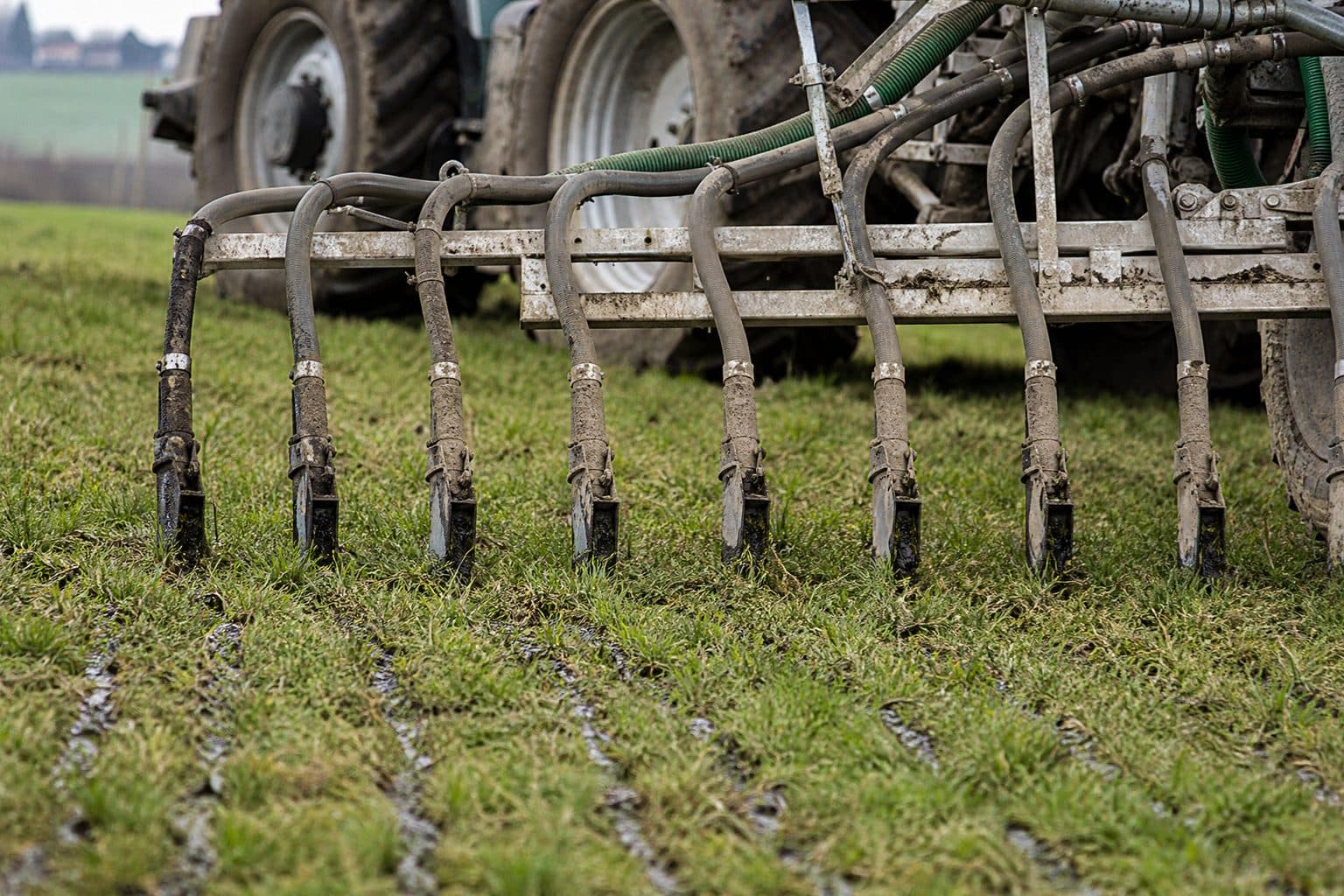
Agriculture is the dominant source of ammonia emissions in Europe, and most of it comes from manure. Spreading slurry with a splash plate throws it into the air, where much of its nitrogen is lost as ammonia; placing it in bands at the base of the crop, or injecting it into the soil, keeps far more of it. That is why governments from Dublin to Copenhagen have moved, step by step, to require low-emission application. This guide sets out what we could verify from official sources in October 2026. Rules change and have exemptions — check with your department, advisor or local authority before relying on it.
/01The methods.
| Method | How it works | Ammonia reduction vs splash plate |
|---|---|---|
| Splash plate | Slurry thrown upward onto a plate and broadcast | Baseline |
| Trailing hose (dribble bar) | Hoses on a boom drop slurry in bands on the surface | Treated as about half as effective as trailing shoe in UK and Irish inventories |
| Trailing shoeHighlighted | Shoes part the grass and place slurry at its base | About 60% (Northern Ireland); 36% on average in Irish field trials |
| Shallow injection | Discs cut slots and place slurry in them | About 70% (Northern Ireland) |
Reductions vary with weather, soil, crop height and slurry, which is why trial results and inventory factors differ. All of these methods can be fed by tanker or by an umbilical system; the umbilical adds lower soil compaction and no road traffic.
/02Ireland.
Ireland’s rules sit in the Good Agricultural Practice regulations (S.I. No. 113 of 2022, as amended). Low-emission slurry spreading (LESS) became compulsory for farms above 150 kg organic nitrogen per hectare from January 2023, above 130 kg from January 2024, and above 100 kg from January 2025 — Irish farm press estimated about 15,000 farms at the 100 kg step. All pig slurry must be spread by LESS from 2023, and manure on arable land must be applied with low-emission equipment or incorporated within 24 hours. The closed period for slurry starts on 1 October in every zone and ends on 12, 15 or 31 January depending on zone. TAMS 3 offers grant aid on LESS equipment, limited to trailing shoe and disc injection; umbilical systems qualify only with one of those applicators.
/03Germany.
The German Fertiliser Ordinance (Düngeverordnung, DüV) § 6 requires liquid manure on planted arable land to be applied in strips or put directly into the soil from 1 February 2020, and extends the same rule to grassland, permanent grassland and multi-cut forage from 1 February 2025. On bare arable land, manure must be incorporated within 4 hours, cut to 1 hour from 1 February 2025. Strip application means trailing hose (Schleppschlauch), trailing shoe (Schleppschuh) or slot injection. The federal states can approve equivalent low-emission methods and grant exceptions where farm structure or site makes compliance unreasonable — Bavaria, for example, has exempted small farms and very thin slurry.
/04Denmark.
Danish rules allow liquid manure to be applied only by trailing hose, trailing shoe or injection; broadcast spreading has been banned since 2001. Where injection is required, it must leave only a negligible amount on the surface, and in grass the slots must hold the full amount applied. Acidification — lowering slurry pH to cut ammonia loss — can substitute for injection on fodder grass and bare soil, but not within 200 m of towns, as it does nothing for odour.
/05The Netherlands.
The Netherlands requires low-emission application on all land, and surface broadcasting is not allowed. On grassland that means shallow injection, slot coulter or — with conditions — trailing shoe. On sand and loess soils trailing shoe on grassland has not been allowed since 2012, and on clay and peat since 1 January 2019 a trailing shoe may only be used with slurry diluted at one part water to two parts slurry, notified to the national agency (RVO) before first use each year.
/06The UK.
In Scotland, amended General Binding Rules took effect in January 2022: raised splash plates and rain guns have been banned since January 2023, and precision application — dribble bar or band spreader, trailing hose, trailing shoe or injection — becomes mandatory on all farms from 1 January 2027, with larger farms and contractors required to comply earlier. In England, the 2019 Clean Air Strategy committed to requiring low-emission spreading of slurry and digestate by 2025, and the government confirmed in 2020 that it would use existing powers; we could not find an instrument that put that requirement into law, so check current DEFRA guidance.
/07What it means for hose.
Low-emission booms are heavier than splash plates, and the soil-compaction case for keeping tankers off wet ground has grown with them. Umbilical systems answer both: the applicator rides on a light tractor and the slurry comes by hose. That puts the load on two lay flat hoses — a supply line that runs from the store, and a drag hose that the tractor pulls all day — joined by slurry couplings built for wet, gloved hands. Our drag hose sizing guide covers bore and wear.
Common questions
- Who must use LESS in Ireland?
- Farms above 100 kg organic N per hectare from January 2025 (150 kg from 2023, 130 kg from 2024), and all pig slurry from 2023.
- When does the German trailing hose rule apply to grassland?
- From 1 February 2025, under § 6 of the Düngeverordnung. It has applied to planted arable land since 1 February 2020.
- Does a dribble bar count as low-emission?
- It counts in Germany, Denmark and Scotland, but Irish TAMS 3 grant aid excludes dribble bars, and inventories treat trailing hose as less effective than trailing shoe.
- Is acidification allowed instead of injection in Denmark?
- In some cases — on fodder grass and bare soil — but not within 200 m of towns.
- When is the Irish slurry closed period?
- From 1 October until 12, 15 or 31 January depending on zone.
For low-emission umbilical systems
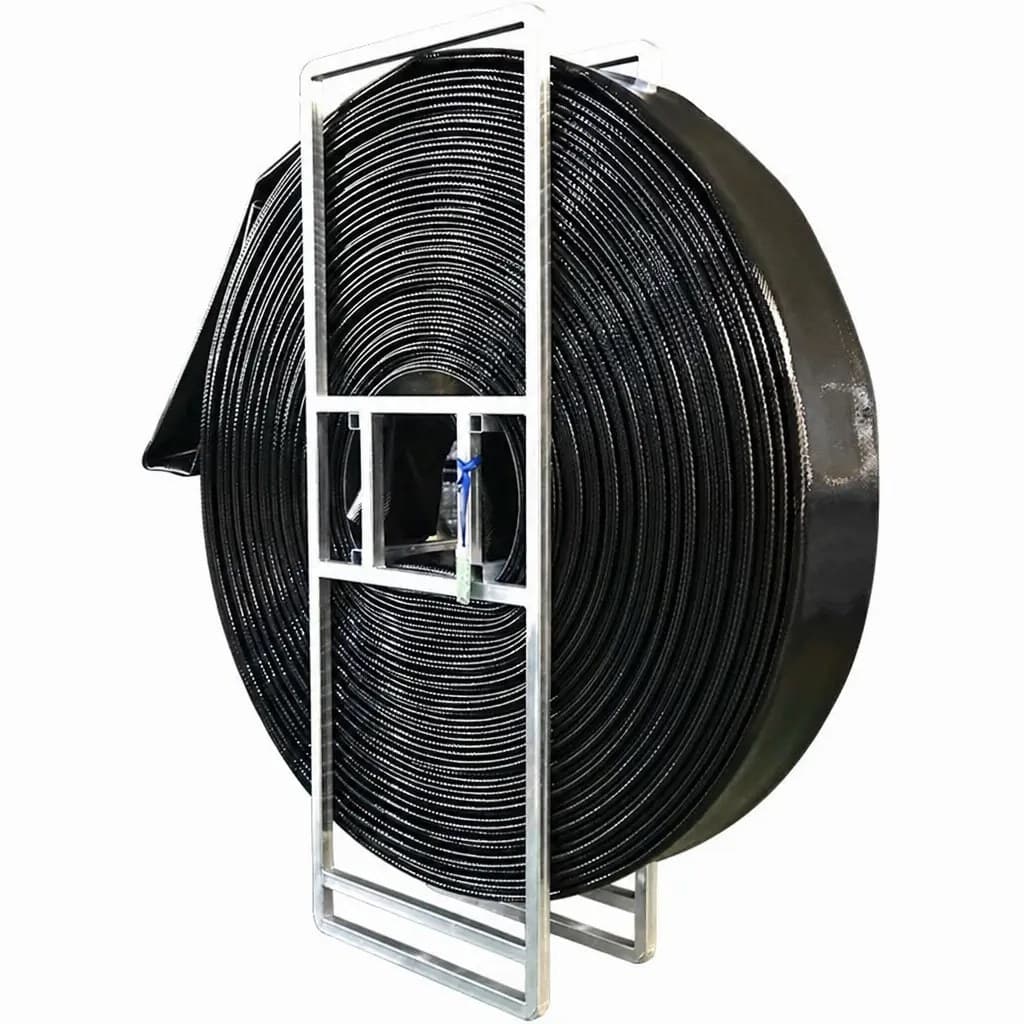 IH-LF-TSSTPU Lay Flat Slurry Supply HoseIndus Hydraulics
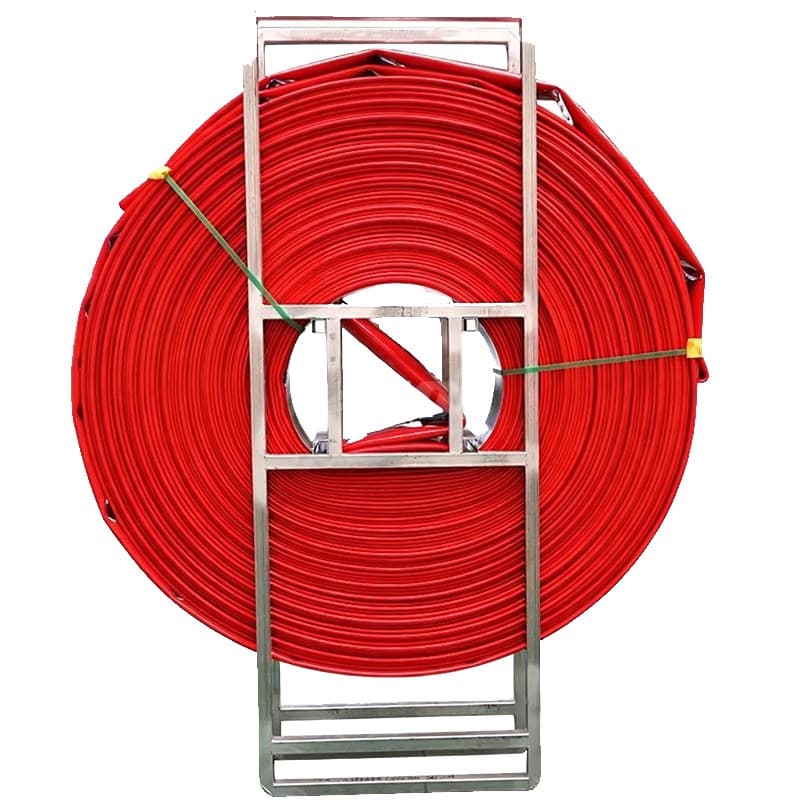 IH-LF-TSDTPU Lay Flat Slurry Drag HoseIndus Hydraulics
 IH-LF-CAGLay Flat Slurry Hose Coupling, 4" to 10"Indus Hydraulics
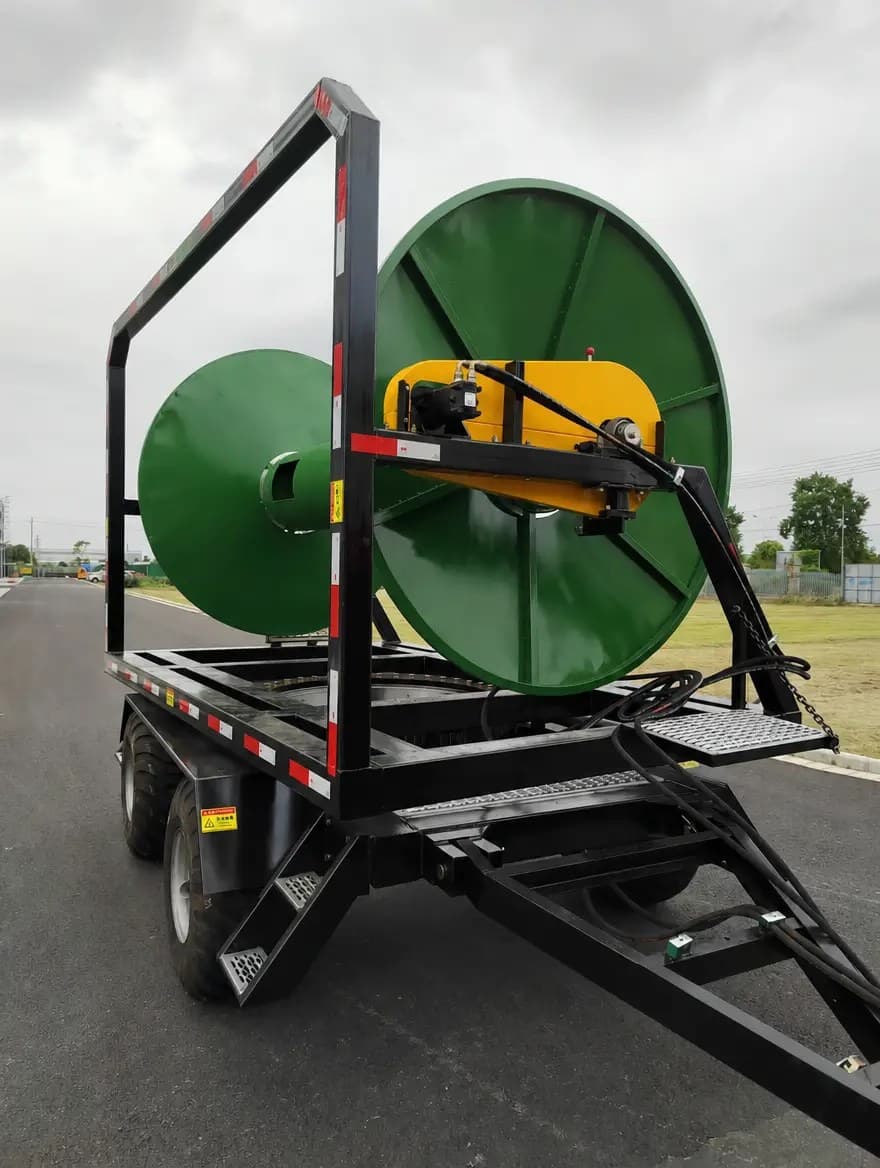 IH-LF-EHRTractor-Mounted Lay Flat Hose Reel, 3-Point HitchIndus Hydraulics
 IH-LF-EHMLay Flat Hose Mover, 3-Point HitchIndus Hydraulics


