
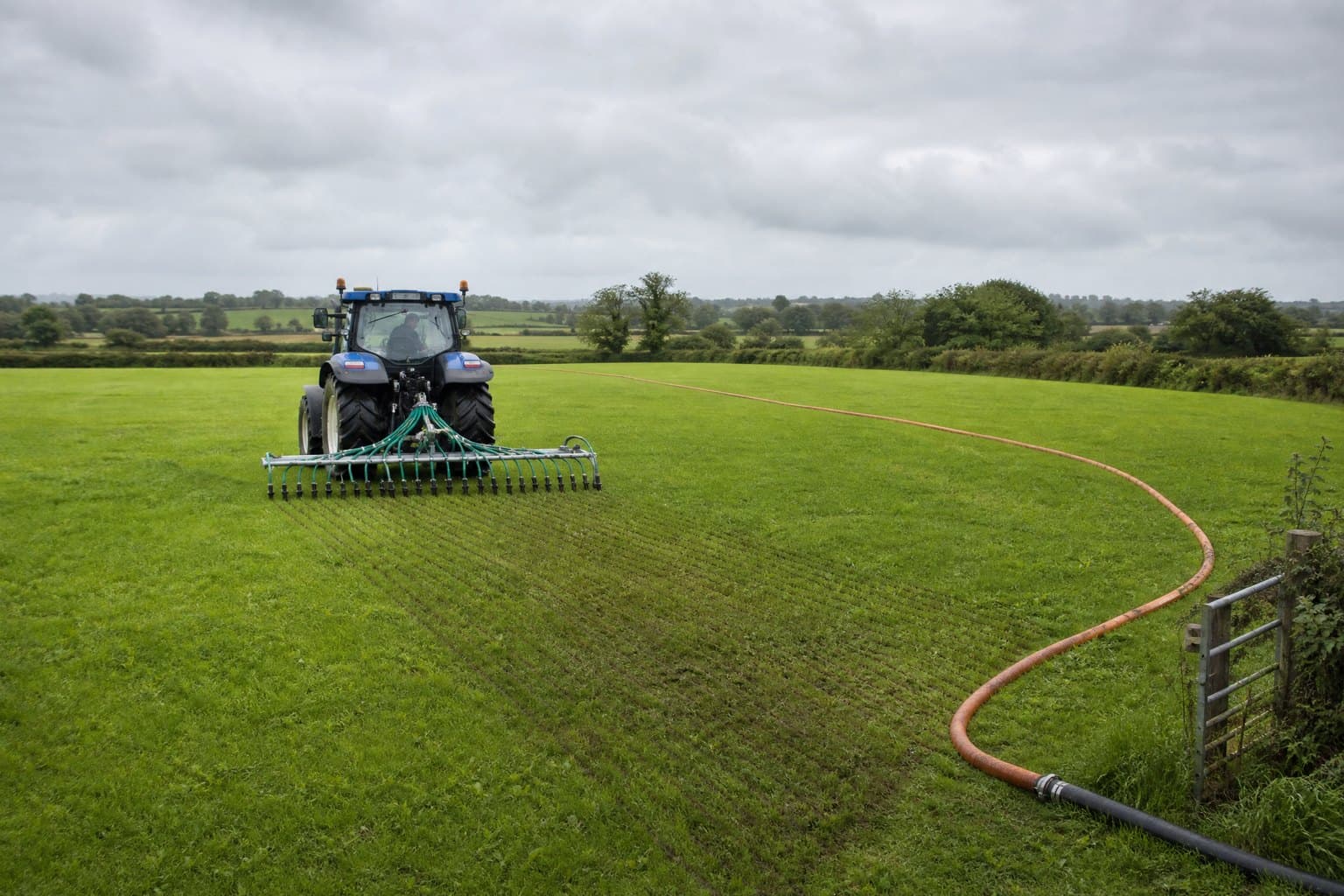
A slurry tanker carries a few thousand gallons per trip, compacts the field with every pass and spends much of its day on the road. An umbilical system replaces the trips with hose. A pump at the store pushes slurry through a supply line laid out to the field; at the field a drag hose connects to an applicator on a tractor, which pulls the hose behind it as it works up and down. The tractor carries no load, so it can be light; the applicator enters the field once; and the slurry goes on when ground and crop are ready. Known as umbilical, dragline or drag-hose systems — Schleppschlauch in German, sleepslang in Dutch — they have become a mainstay of low-emission spreading.
/01How the system is laid out.
- Store and agitator. The slurry is mixed so the pump draws a consistent material.
- Pump. A PTO- or engine-driven pump at the store. Irish farm press puts the requirement at 120 hp or more to pump through around 1,000 m of hose.
- Supply line. Lay flat hose from the pump to the field, along headlands, hedges and lanes, sometimes crossing roads under ramps or through culverts.
- Manifold or hydrant at the field. Where supply meets drag, often with a valve and flow meter.
- Drag hose. The length the tractor pulls behind it, laid in a loop and worked back and forth across the field.
- Applicator. A trailing shoe, trailing hose (dribble bar) or injector on the tractor, with a flow meter and swivel on the hose connection.
/02Why farms and contractors use them.
Teagasc, Ireland’s farm advisory service, notes that an umbilical low-emission unit covers ground quickly and is far lighter than a tanker, avoiding compaction — which makes it suited to spreading into growing cereal crops at the right growth stage. The applicator enters the field once, so there is less mud on roads and no shuttle traffic between yard and field. Irish farm press has reported outputs above 25,000 litres an hour on farm systems and up to 60,000 litres an hour on contractor rigs. The rules have pushed the other way too: low-emission spreading is now compulsory for many farms in Ireland, Germany, Denmark, the Netherlands and Scotland — see low-emission slurry spreading rules in Europe.
/03The two hoses.
| Property | Supply line | Drag hose |
|---|---|---|
| What it does | Carries slurry from the pump to the field | Is pulled behind the tractor while spreading |
| Movement | Lies still once laid | Dragged and turned all day |
| WallHighlighted | Standard wall, long lengths | Heavier wall, high abrasion and kink resistance |
| Typical bore | Often one or two sizes larger | 4" most common; 5"–6" for more output |
| Our hose | TPU slurry supply hose, 5"–16", 14–15 bar (10 bar at 16") | TPU slurry drag hose, 2-1/2"–8", red for visibility |
Our TPU slurry supply hose comes in lengths up to 400 m to cut joints, and resists hydrolysis, UV and weather on long outdoor runs. The TPU slurry drag hose has a heavier wall — 2.7 mm at 2-1/2" up to 6.0 mm at 8" — extruded through the jacket in one pass with no adhesive to fail, and resists abrasion, kinking, hydrolysis and fungus. Sizing both is covered in slurry drag hose sizing and life.
/04Couplings and handling.
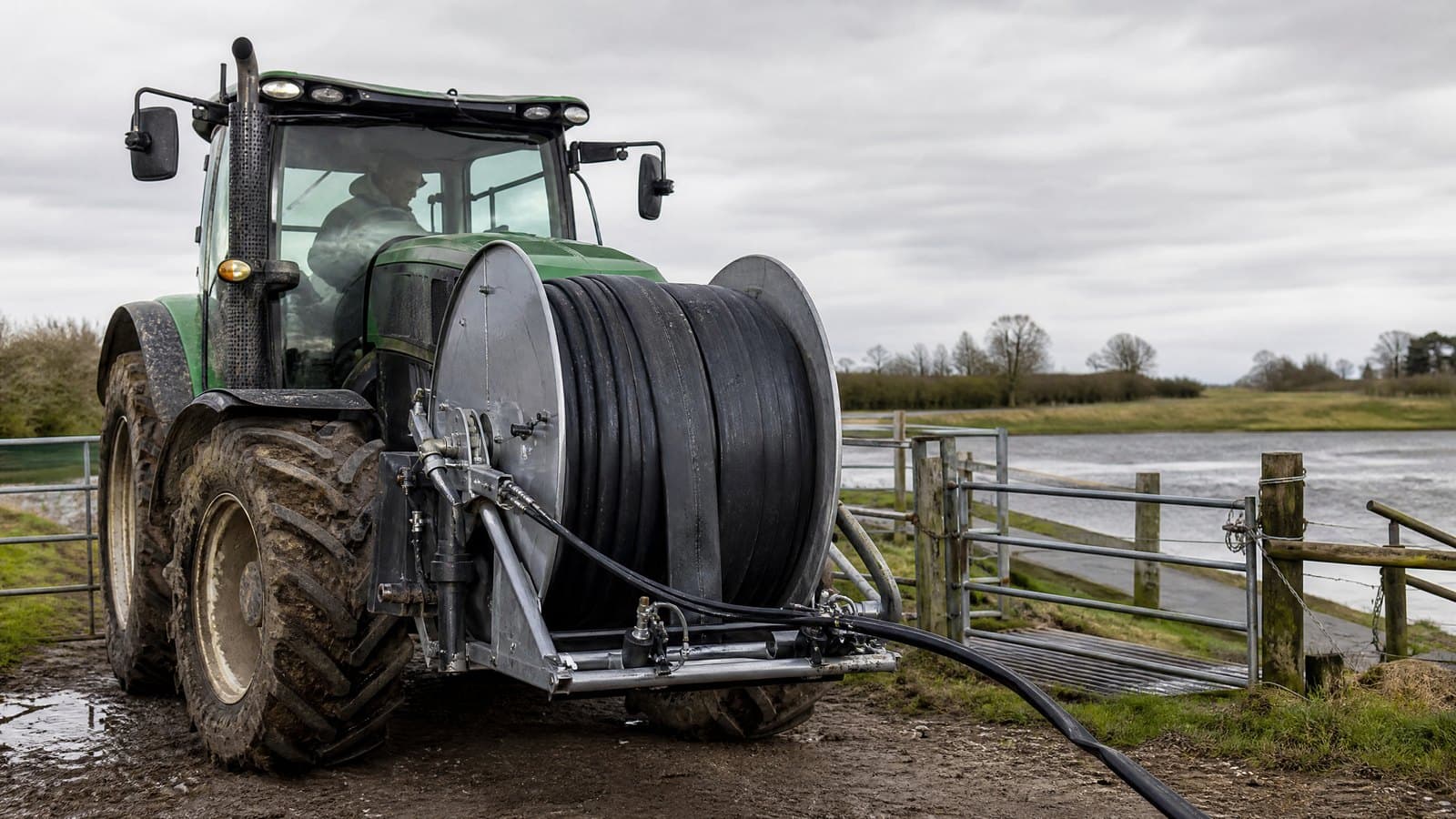
Drag hose is coupled and uncoupled in the field with wet, gloved hands, so couplings matter. Our slurry hose couplings have knurled grip ribs, a round body that reduces stress concentration, and hard-anodised aluminium that resists manure; the 4", 5" and 6" sizes intermate without adapters, and so do the 7" and 8". For handling, a tractor-mounted reel holds about 610 m of 6" lay flat and lays or recovers it from the tractor hydraulics; a hose mover relocates long lines between fields without dragging them; and a portable winder rolls up shorter lengths of 6" to 12".
Common questions
- How long is the hose on an umbilical system?
- A typical farm set-up runs around 1,000 m of hose between store and applicator; contractor systems often run more. Output falls as length rises, so bore and pump must be matched to the distance.
- How much horsepower does an umbilical system need?
- Irish farm press puts it at 120 hp or more to pump through about 1,000 m, and over 100 hp to pull the drag hose.
- Is an umbilical system low-emission?
- The applicator makes it low-emission — trailing shoe, trailing hose or injection. The umbilical makes it light on the ground and keeps tankers off the road.
- What is the difference between supply hose and drag hose?
- Supply hose lies still from pump to field; drag hose is pulled behind the tractor and needs a heavier wall and more abrasion resistance.
- Can different hose sizes be joined?
- Yes. Our 4", 5" and 6" slurry couplings intermate without adapters, as do the 7" and 8".
For umbilical systems
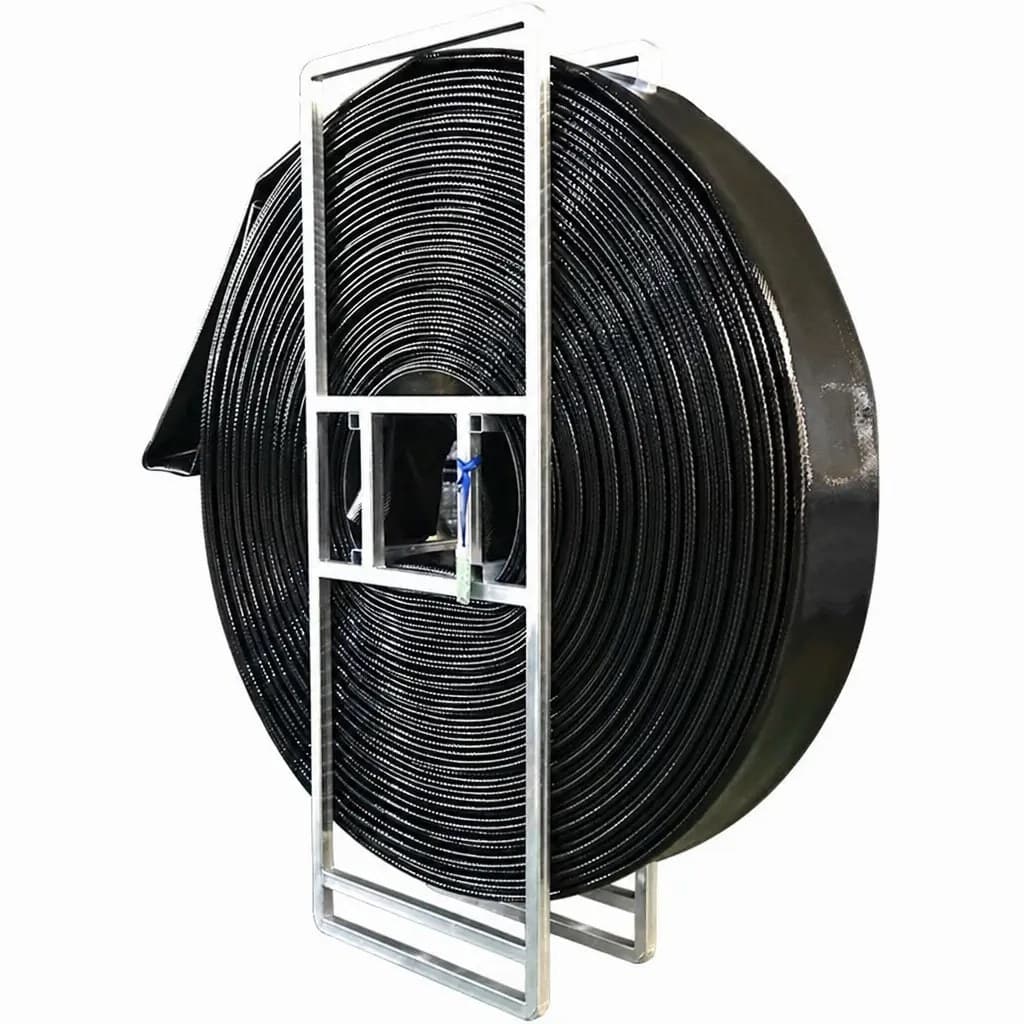 IH-LF-TSSTPU Lay Flat Slurry Supply HoseIndus Hydraulics
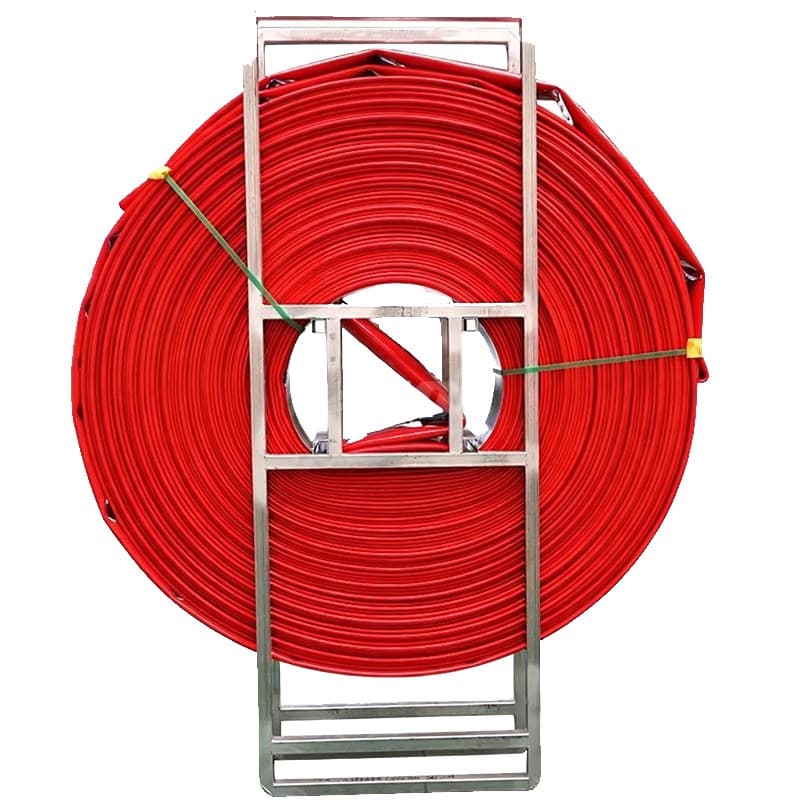 IH-LF-TSDTPU Lay Flat Slurry Drag HoseIndus Hydraulics
 IH-LF-CAGLay Flat Slurry Hose Coupling, 4" to 10"Indus Hydraulics
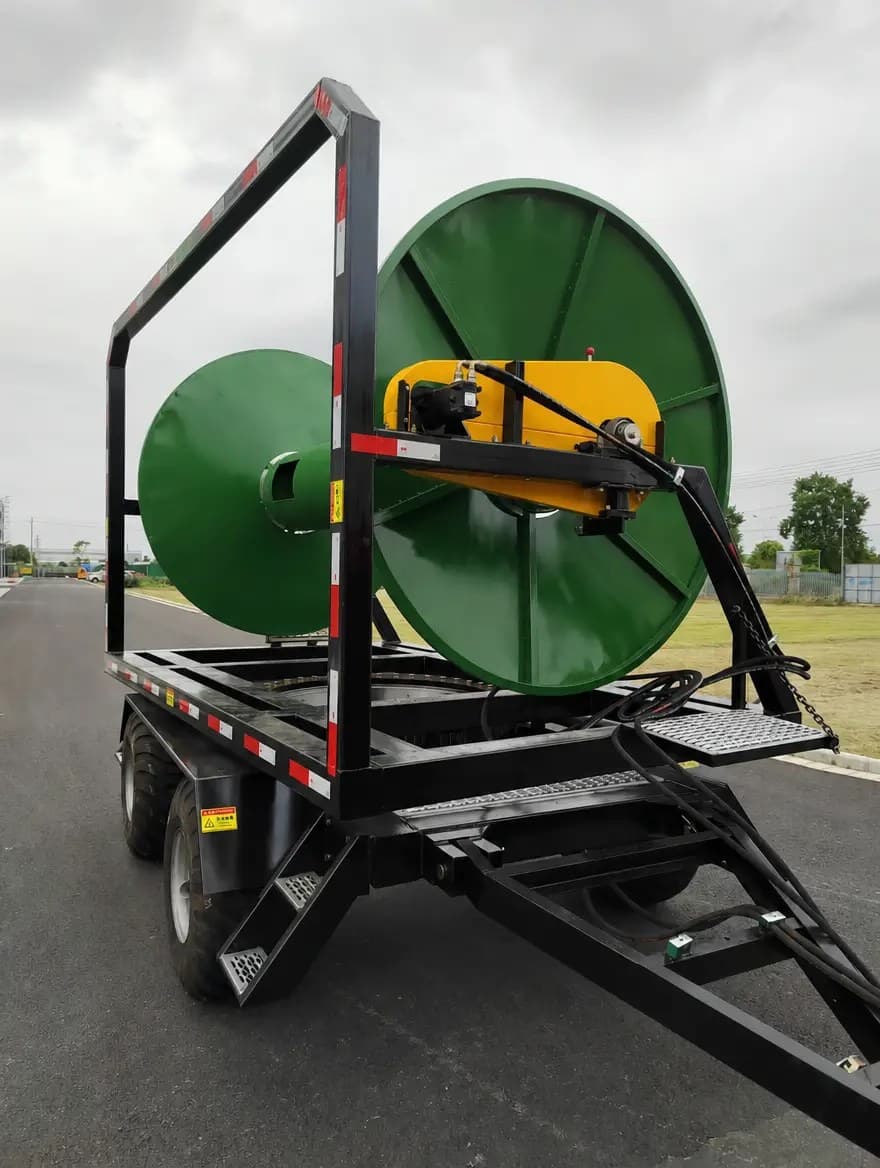 IH-LF-EHRTractor-Mounted Lay Flat Hose Reel, 3-Point HitchIndus Hydraulics
 IH-LF-EHMLay Flat Hose Mover, 3-Point HitchIndus Hydraulics
 IH-LF-EPWPortable Motorised Lay Flat Hose Winder, 6" to 12"Indus Hydraulics


