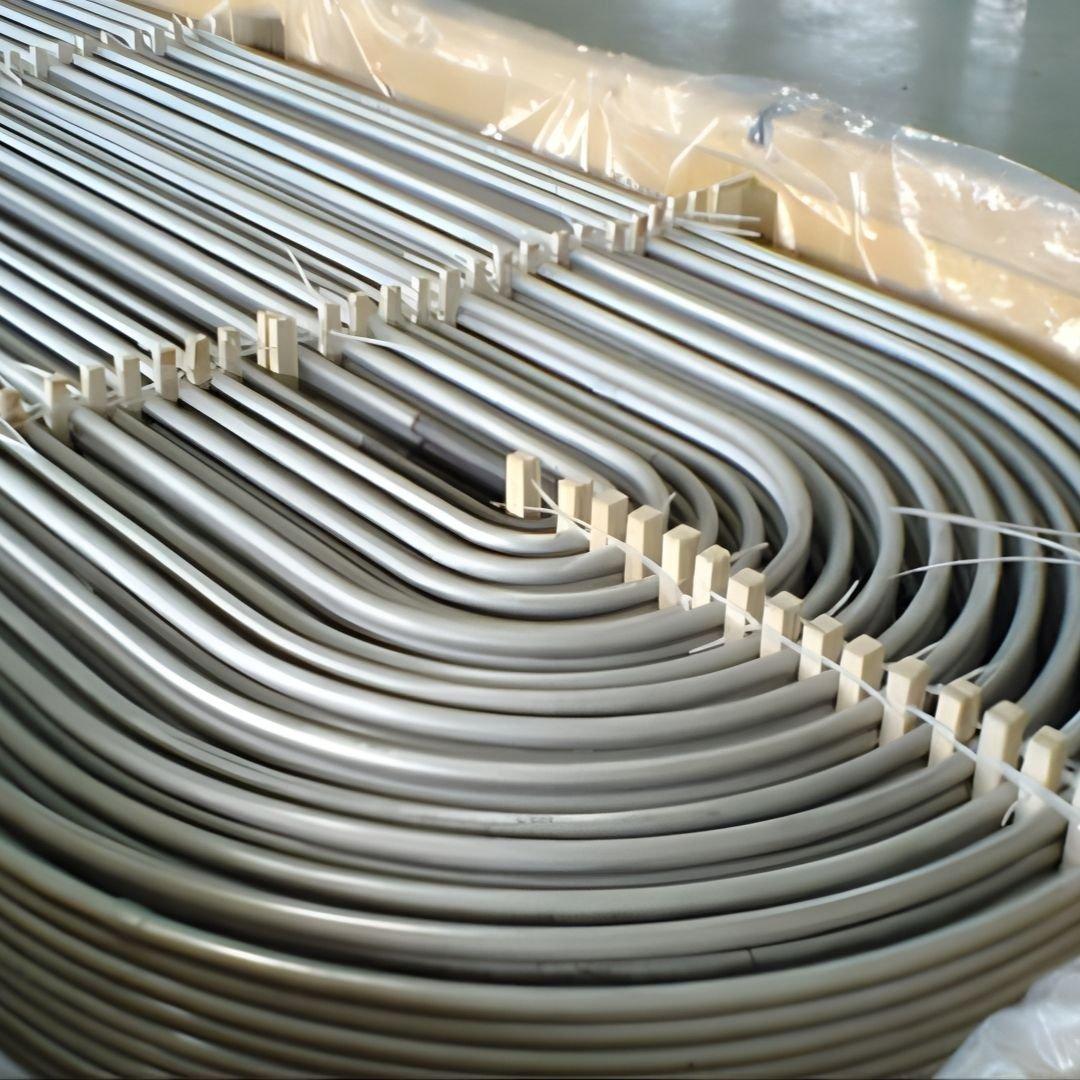
Seawater-cooled condensers and coolers are everywhere along the Gulf: in power and desalination plants, refineries, LNG trains and on ships and platforms. Copper alloys remain a standard tube for them because they resist seawater corrosion and biofouling. The choice between them is mainly a choice of how fast the water can run before it erodes the tube.
/01The alloys.
| Alloy | UNS | Min tensile | Tempers |
|---|---|---|---|
| Copper (Cu-DHP) | C12200 | 250 MPa (H55) | H55, H80 or HE80 |
| Admiralty brass | C44300 | 310 MPa (O61) | O61 annealed |
| Aluminium brass | C68700 | 345 MPa (O61) | O61 |
| 90/10 copper-nickel | C70600 | 275 MPa (O61) | O61 or H55 |
| 70/30 copper-nickel | C71500 | 360 MPa (O61) | O61 or HR50 |
| 66-30-2-2 copper-nickel | C71640 | 435 MPa (O61) | O61 or HR50 |
/02Water velocity.
| Alloy | Water | In-tube velocity |
|---|---|---|
| Admiralty brass | Fresh, brackish, cooling-tower water | About 1.8 m/s |
| Aluminium brass | Seawater and brackish water | Higher than admiralty; figure on request |
| 90/10 copper-nickel | Seawater | 2.4–2.5 m/s |
| 70/30 copper-nickel | Seawater, more aggressive duty | Higher than 90/10 |
Above its velocity, an alloy’s protective film is stripped and the tube erodes, usually at the inlet ends. The 3.5 m/s figure sometimes quoted for 90/10 applies to large-bore pipe, not to condenser tube. Low velocity has its own risk: silt and fouling settle and pit the tube.
/03Where each is used.
Admiralty brass (C44300, C44400, C44500, inhibited with arsenic, antimony or phosphorus) serves fresh-water and cooling-tower condensers and lube-oil coolers. Aluminium brass (C68700) serves seawater and brackish condensers where copper-nickel is not specified. 90/10 and 70/30 copper-nickel serve seawater-cooled condensers in power, refinery and LNG plants, shipboard and offshore coolers, and MSF desalination heat-recovery and heat-rejection tubing, with 66-30-2-2 (C71640) in heat-rejection sections where impingement is severe.
/04Tests and ordering.
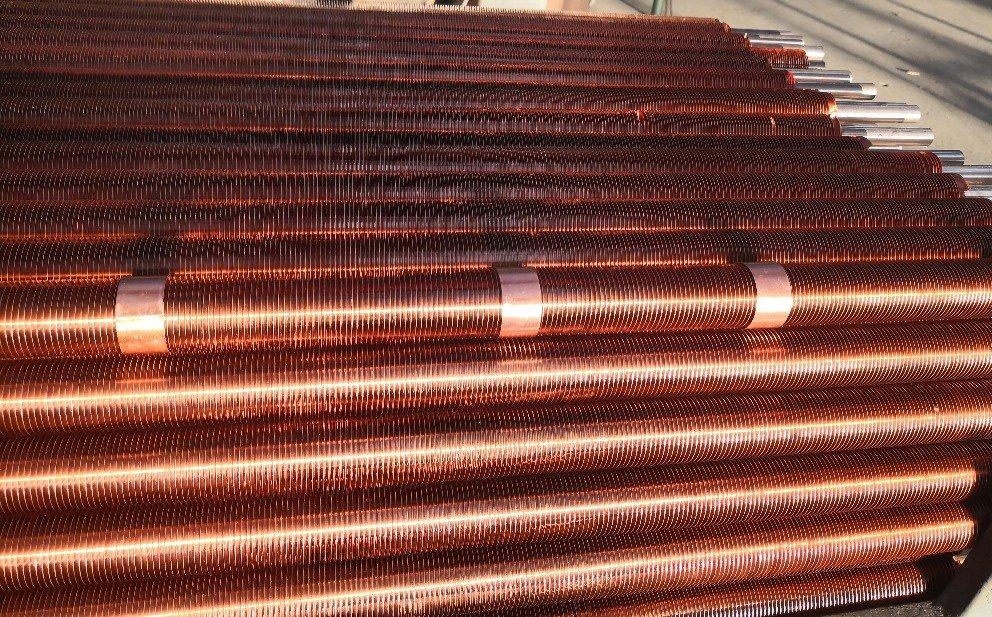
B111 tube is eddy-current tested (each tube) or given a hydrostatic or pneumatic test, expansion-tested — 30 % for annealed O61, 20 % for drawn tempers — and flattening-tested. Brasses must pass a mercurous nitrate or ammonia vapour residual-stress test. Order by alloy and UNS number, temper, OD and wall (BWG or mm, minimum or average), length and quantity. Low-fin copper-alloy tube is made to B359 — see integral low-fin tube.
Plain copper (C12200, Cu-DHP) is not a seawater alloy, but it is the tube for HVAC, refrigeration, medical gas and water services: see copper tubes, copper coils, plastic-coated copper tubes for buried and in-screed lines, and inner-grooved copper tubes for fin-and-tube evaporators and condensers.
Common questions
- Which is better for seawater, 90/10 or 70/30?
- 90/10 is the standard and more economical; 70/30 is chosen for higher velocities and more aggressive water.
- Can admiralty brass be used with seawater?
- It is better suited to fresh and brackish water. For open Gulf seawater, aluminium brass or copper-nickel is the usual choice.
- What velocity can 90/10 copper-nickel take?
- 2.4–2.5 m/s in condenser tube.
- Which standard covers copper-alloy condenser tube?
- ASTM B111 for straight tube, B395 for U-bends and B359 for low-fin tube.
- What is C71640 used for?
- MSF desalination heat-rejection sections and other duties where impingement is severe.