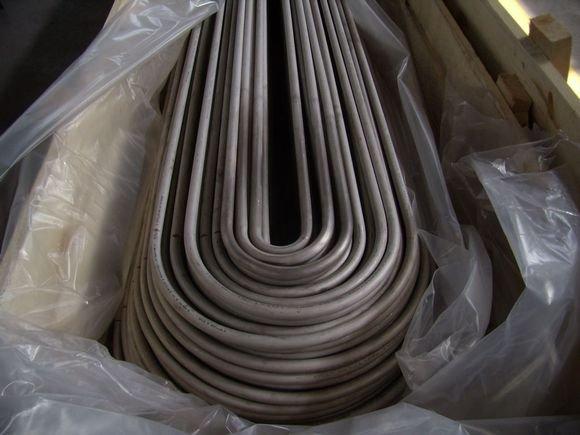
Stainless tube is chosen when carbon steel would corrode or foul: chloride-bearing cooling water, sour and acidic process streams, and feedwater systems where iron pickup matters. The choice is in two steps — the family of stainless, then seamless or welded — and each step has its own ASTM standard.
/01The grades.
| Standard | Grade | UNS | Cr % | Ni % | Mo % | Min tensile |
|---|---|---|---|---|---|---|
| A213 | TP304L | S30403 | 18.0–20.0 | 8.0–12.0 | — | 485 MPa |
| A213 | TP316L | S31603 | 16.0–18.0 | 10.0–14.0 | 2.00–3.00 | 485 MPa |
| A213 | TP321 | S32100 | 17.0–19.0 | 9.0–12.0 | — | 515 MPa |
| A213 | TP347 | S34700 | 17.0–20.0 | 9.0–13.0 | — | 515 MPa |
| A789 | 2205 | S32205 | 22.0–23.0 | 4.5–6.5 | 3.0–3.5 | 655 MPa |
| A789 | 2507 | S32750 | 24.0–26.0 | 6.0–8.0 | 3.0–5.0 | 800 MPa |
| A268 | TP405 | S40500 | 11.5–14.5 | 0.50 max | — | 415 MPa |
| A268 | TP439 | S43035 | 17.00–19.00 | 0.50 max | — | 415 MPa |
| A268 | 26-3-3 | S44660 | 25.0–28.0 | 1.0–3.50 | 3.0–4.0 | 585 MPa |
/02Austenitic: 304L, 316L, 321, 347.
TP304L and TP316L are the everyday exchanger grades; the low carbon keeps the heat-affected zone of the tube-to-tubesheet weld from sensitising. Molybdenum in 316L improves resistance to pitting; for naphthenic-acid service, 317L or 316L with at least 2.5 % Mo is specified. TP321 and TP347, stabilised with titanium or niobium, are used where the tube runs hot. All are solution-treated at 1040 °C minimum and cooled rapidly. Austenitic grades are prone to chloride stress-corrosion cracking in hot, chloride-bearing water — which is where duplex comes in.
/03Duplex and super duplex.
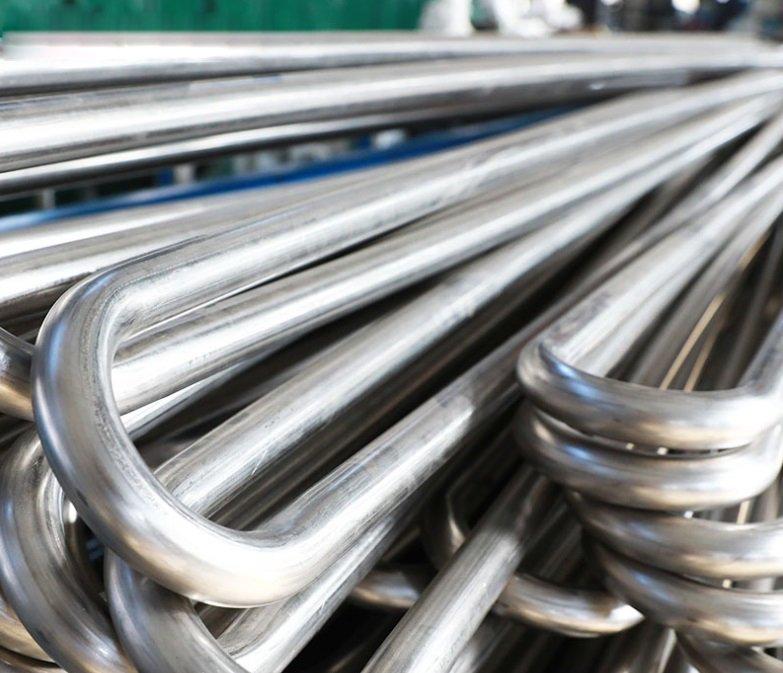
Duplex 2205 (S31803 / S32205) and super duplex 2507 (S32750), made to ASTM A789, combine high strength — 655 and 800 MPa minimum tensile — with resistance to chloride stress-corrosion cracking. They are the usual choice for crude and vacuum overhead condensers and for offshore platform exchangers in chloride service. Bends in duplex U-tubes need ferrite and sigma-phase checks, covered in U-bend tubes.
/04Ferritic and martensitic.
ASTM A268 covers ferritic and martensitic stainless tube: TP405, 409 and 410 at around 12 % chromium, TP430 and TP439 at 17–19 %, and super-ferritic 26-3-3 (S44660). Ferritic grades do not suffer chloride stress-corrosion cracking like the austenitics. TP439 under A803 is widely used for power-plant feedwater heaters.
/05Tests.
Flattening, flaring, hardness and tension tests come with A213 and A1016; each tube is hydrostatically tested or given an electric test (eddy current or ultrasonic). A249 adds reverse-bend and flange tests on the weld, and an optional weld-decay test (supplementary S7). State on the order if you need eddy current on every tube, intergranular corrosion testing, or positive material identification.
Common questions
- Is welded A249 tube as good as seamless A213?
- For most exchanger duties, yes, which is why it is widely used. Some specifications call for seamless; follow the data sheet.
- When should I use duplex tube?
- Where chloride stress-corrosion cracking is a risk: seawater or brackish cooling, crude and vacuum overheads, offshore chloride service.
- What is TP439 used for?
- Feedwater heaters in power plants, under ASTM A803.
- Why specify 316L rather than 316?
- The low carbon limits sensitisation when the tube is welded, which preserves corrosion resistance at the tube-sheet joint.
- What is the minimum tensile of 2205?
- 655 MPa for S32205 and 620 MPa for S31803 under A789.