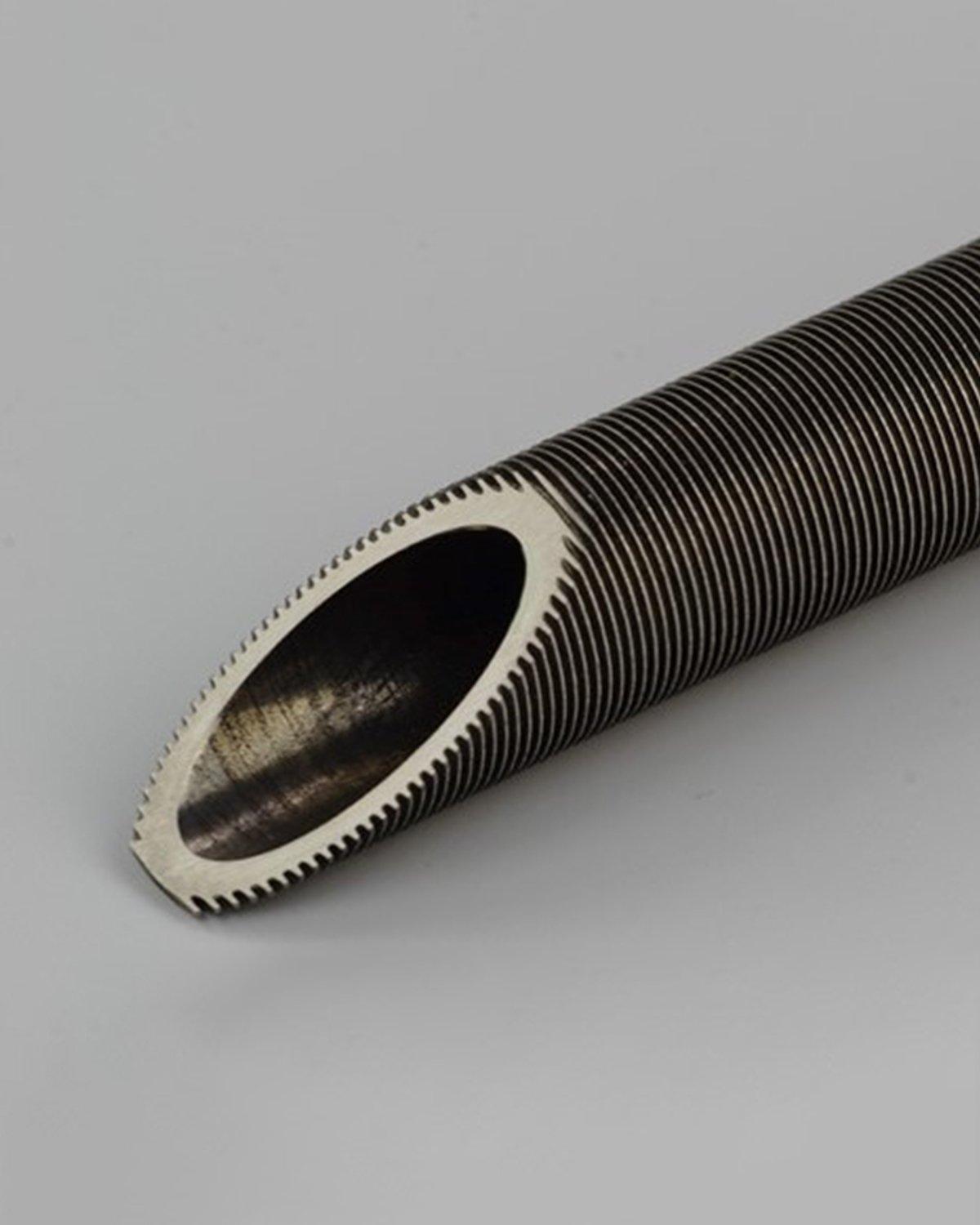
When a shell-and-tube condenser or cooler runs short of duty, the shell side is often the limit: the outside of the tube is too small for the film that forms on it. Integral low-fin tube adds outside surface inside the same bundle, because the fins are rolled out of the tube wall and the plain ends keep the original diameter to fit the existing tube sheet and baffles.
/01How it is made.
Rolling discs on arbors displace metal from the tube wall outward into fins along the finned length, leaving plain lands where the tube passes through baffles and plain ends for the tube sheet. Because the fins come from the wall, the wall under the fin is thinner than the plain wall, and the root diameter is below the plain OD. All three — plain wall, wall under fin and root diameter — appear in the size table and on the order.
/02Where it helps.
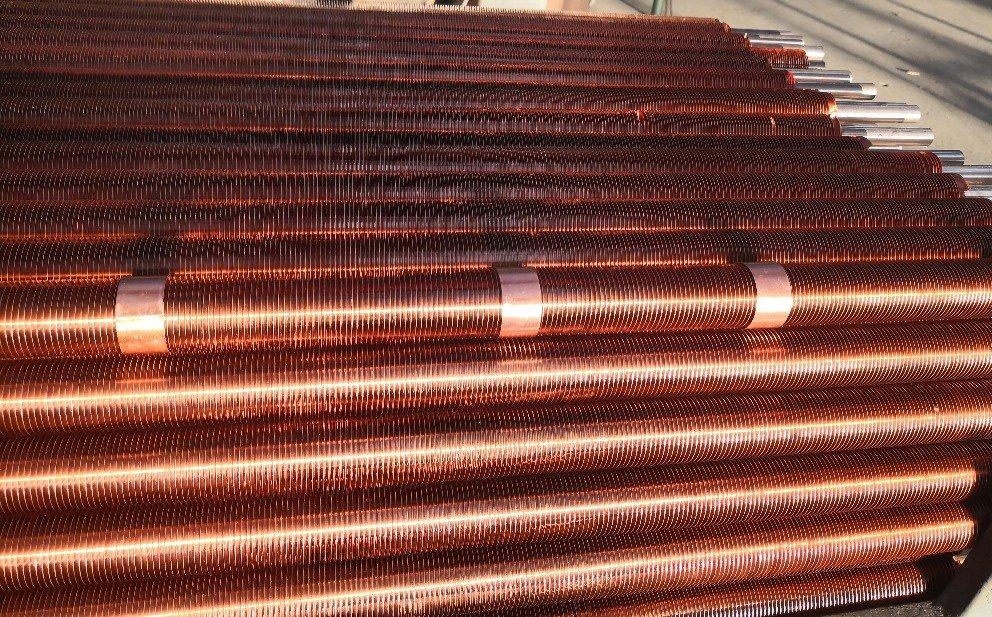
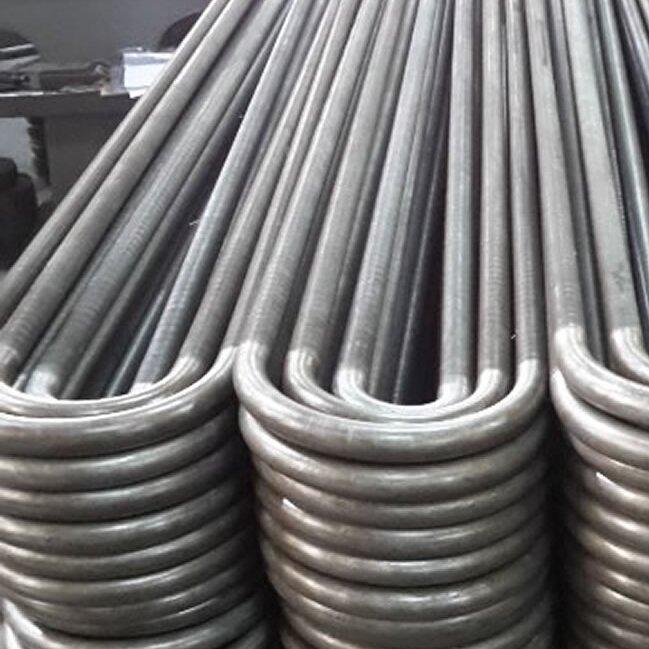
Low fins pay off where the outside film is the larger resistance: shell-side condensing of refrigerants and hydrocarbons, and clean liquid coolers in gas plants and refineries. Copper-nickel low-fin tube is used in seawater-cooled condensers. They are less suited to heavily fouling shell-side fluids, which can fill the fin gaps. Tubes can also be bent after finning as low-fin U-bends.
/03Materials and standards.
Steel low-fin tube is made to ASTM A498 (seamless and welded steel integral-fin tube) and A1012 for welded tube, on base tube such as SA-179, SA-214 and SA-334 Grade 1, 3 and 6. Stainless choices run from ferritic 405, 410, 430 and 439 through austenitic 304, 316, 317 and 321 to duplex 2205 and 2101 and 6Mo. Nickel alloys — Alloy 400, 600, 625, 800, 825 and C-276 — and titanium Grades 1, 2, 16 and 26 are available. Copper and copper alloys, including Cu-Ni, come under ASTM B359; see also low-fin copper-alloy tube.
/04Testing.
Under A498 every tube is pressure tested. In our listing, straight tubes are air tested at 250 psi (1.72 MPa) after finning, hydro is optional, all tubes are eddy-current tested after finning, and U-bends are hydrotested after bending.
/05Sizes.
| OD in | Wall | Wall under fin | Root dia | Fin height | FPI | Materials | Part number |
|---|---|---|---|---|---|---|---|
| 3/4 | 1.829 | 1.245 | 16.256 | 1.397 | 19 | 300 stainless; Cu-Ni | IH-TF-IL-ILF-0190-183-H014 |
| 3/4 | 2.235 | 1.651 | 16.256 | 1.397 | 19 | 300 stainless; Cu-Ni | IH-TF-IL-ILF-0190-224-H014 |
| 1 | 2.235 | 1.651 | 22.606 | 1.397 | 19 | 300 stainless; Cu-Ni | IH-TF-IL-ILF-0254-224-H014 |
| 1 | 2.769 | 2.108 | 22.606 | 1.397 | 19 | 300 stainless; Cu-Ni | IH-TF-IL-ILF-0254-277-H014 |
| 5/8 | 1.829 | 1.245 | 13.386 | 1.245 | 26 | CS; 400 ferritic; Cu-Ni; Alloy 400 (N04400) | IH-TF-IL-ILF-0159-183-H012 |
| 3/4 | 1.829 | 1.245 | 16.561 | 1.245 | 26 | CS; 400 ferritic; Cu-Ni; Alloy 400 (N04400) | IH-TF-IL-ILF-0190-183-H012 |
| 3/4 | 2.108 | 1.651 | 16.561 | 1.245 | 26 | CS; 400 ferritic; Cu-Ni; Alloy 400 (N04400) | IH-TF-IL-ILF-0190-211-H012 |
| 1 | 1.829 | 1.245 | 22.911 | 1.245 | 26 | CS; 400 ferritic; Cu-Ni; Alloy 400 (N04400) | IH-TF-IL-ILF-0254-183-H012 |
| 1 | 2.108 | 1.651 | 22.911 | 1.245 | 26 | CS; 400 ferritic; Cu-Ni; Alloy 400 (N04400) | IH-TF-IL-ILF-0254-211-H012 |
| 3/4 | 1.829 | 1.245 | 17.272 | 0.889 | 28 | Ti; Zr; 300 stainless; Ni alloys; 6Mo (N08367) | IH-TF-IL-ILF-0190-183-H009 |
| 1 | 1.829 | 1.245 | 23.622 | 0.889 | 28 | Ti; Zr; 300 stainless; Ni alloys; 6Mo (N08367) | IH-TF-IL-ILF-0254-183-H009 |
/06Ordering a retube.
- Plain-end OD and wall, matching the tube sheet and the design pressure.
- Fins per inch and fin height (or the part number above).
- Wall under fin, which sets the pressure rating of the finned section.
- The lengths of plain ends and the positions of plain lands at each baffle.
- Material grade and standard, quantity and certificate.
Common questions
- Can low-fin tube replace plain tube in an existing bundle?
- Yes, that is its main use: the plain ends keep the original OD, so the tube sheet and baffles are unchanged — provided plain lands are placed at each baffle.
- What standard covers low-fin steel tube?
- ASTM A498, with A1012 for welded tube. Copper alloys are covered by B359.
- How many fins per inch?
- Our listing runs 19, 26 and 28 fins per inch, with fin heights from about 0.9 to 1.4 mm.
- Is low-fin tube tested after finning?
- Yes: pressure testing of every tube, and eddy-current testing after finning.
- Can low-fin tube be bent?
- Yes, as low-fin U-bends, hydrotested after bending.