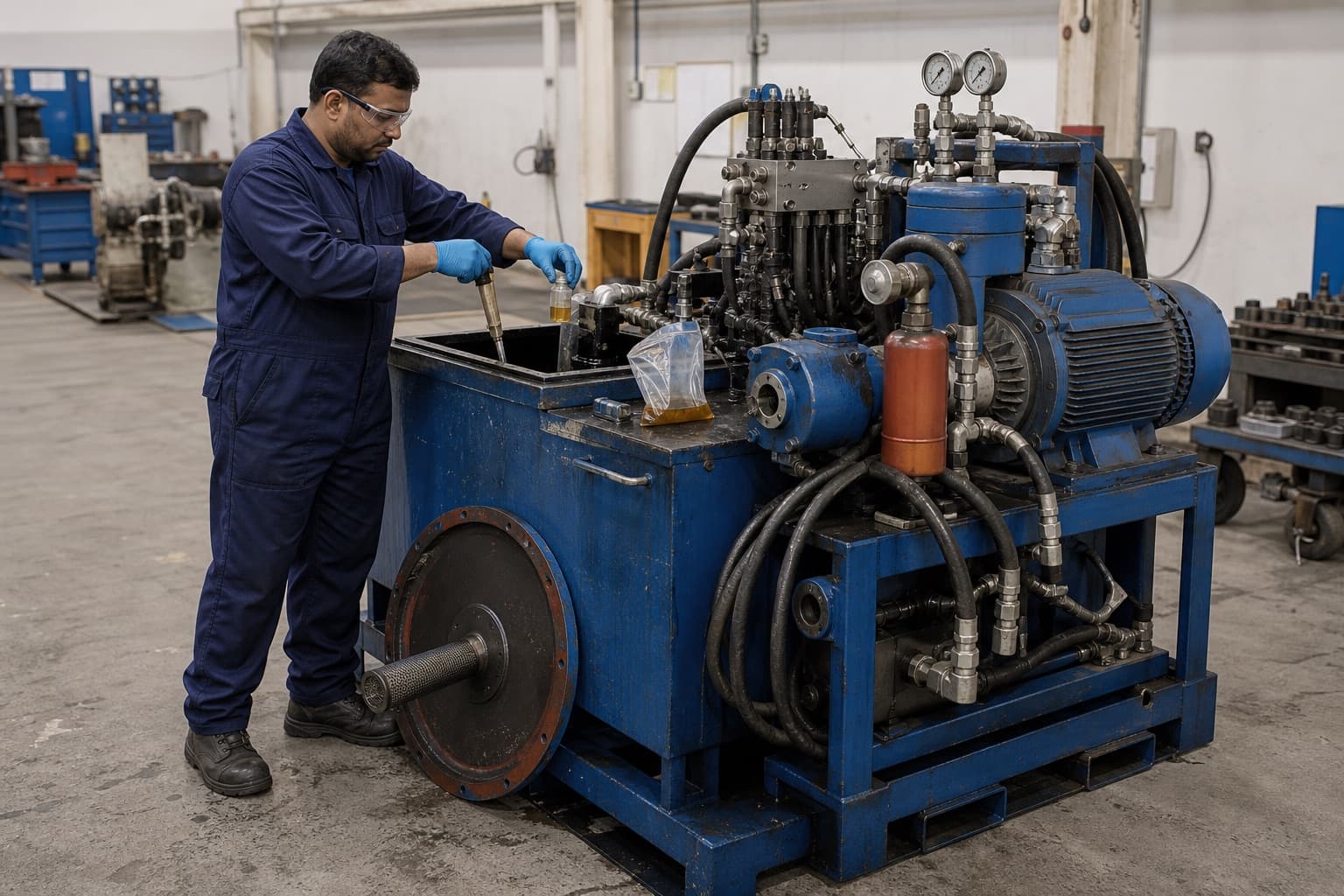
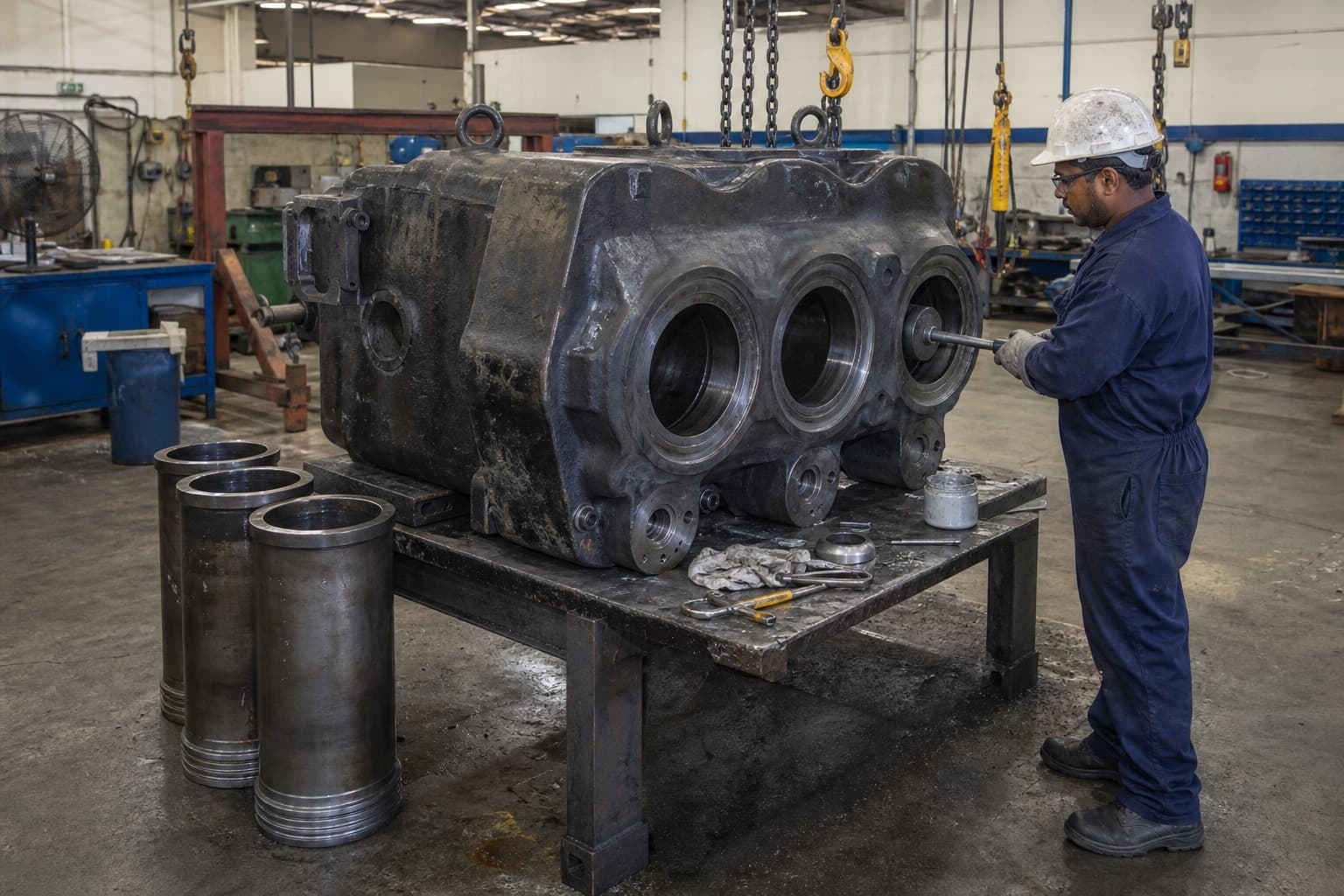
The fluid end the operator was ready to scrap.
The intake form was a single sentence. "Deck scrap on 12-P-160 unit BAB-MP-04, send quote on new fluid end." The rig crew at Bab had been pulling sand-laden mud through this pump for eighteen months without a redress, the liners were chewed out, and somewhere between the rig floor and the dispatch desk the verdict on the deck — the heavy central body that holds the liners and valves — had hardened into a fact. New fluid end list price: AED 3.8 million.
The unit landed in our Jebel Ali yard on a Monday morning, low-loaded down from the Bab field by an ADNOC Onshore drilling contractor running a 1,500 hp triplex on a sour-gas development well. The pump itself was a National-class triplex, 12″ stroke, 5,000 psi MAWP, the same fluid-end family that has been on Gulf rigs for thirty years. We pressure-washed the deck on Tuesday morning and sent an inspection engineer over with a coordinate measuring arm before anyone wrote a single line of a quote.
"Deck is scrap. Quote a new fluid end. Need it on the rig in three weeks."
Drilling contractor pulled the unit after a liner blew through; rig superintendent looked at the washouts inside the deck cavity and called for a replacement fluid end. PO desk was already pricing a new National-class deck assembly at AED 3.8M list. Three-week skid date locked in.
Liner bores washed out. Deck body within OEM tolerance. Reusable.
CMM survey showed deck flatness at 0.04 mm/m (OEM limit 0.05). Suction-discharge bridge web within hardness spec. Liner bore washouts and seat-pocket erosion were real but consumable-side — replace liners, seats, valves, manifold cap, full elastomer pack and you keep the deck.
This is the case for sending an inspection engineer before you sign a purchase order. The deck on a 12-P-160 is the most expensive piece of forged carbon steel on the entire pump skid. It is also the part that fails last. What fails first is everything bolted into it — liners, seats, valves, packing — and on a sour-service well that has not been redressed since 2024, all of those things had failed at once. The operator was reading the symptoms and condemning the wrong patient.
What we replaced. What we kept.
We kept the deck. We kept the suction and discharge cover bolting (after Charpy V-notch retest on three random studs). Everything else came out and went back in new. Three liners at 5½″ bore × 12″ stroke, six suction valves and six discharge valves, all twelve valve seats lapped to a fresh sealing surface, the suction manifold cap (which had a hairline crack at the inboard threaded port — easier to replace than to weld), and the full elastomer pack in HNBR sour-service grade for rod packing, valve packing and the gland o-rings. Bolting to ASTM A193 B7M studs with 2HM nuts on every flange make-up, mill-test certs to EN 10204 3.1. Re-stamped MIT (manufacturer's identification & test) per API 7K on the rebuilt assembly, signed by our QA and witnessed by the operator's third-party inspector.
The deck itself went through a full NDT pass before we put a single new part back into it: magnetic particle inspection on every load-bearing face, ultrasonic thickness on the inter-bore webs, dye penetrant around the liner pockets and the gland bores. Hardness checked at 22 HRC max per NACE MR0175 in eight locations on the deck and on the suction manifold replacement. Two of the original eight stud holes in the discharge cover face had thread damage; we re-tapped one and inserted the second with a Heli-Coil. None of that is glamorous and none of it costs AED 3.8 million.
Replacing a fluid end deck looks cheap on the quote line until you actually inspect what is wrong versus what is right. On this one, what was wrong cost AED 1.4 million less than what the operator thought was wrong.— Yusuf Al Hashimi · Workshop Manager · Jebel Ali
Eleven days on the bench, four phases.
Every fluid-end rebuild we run goes through the same four phases. The names don't change. The clock changes — this one was tight because the rig had a sour-gas development well booked at Bab for the second week of May and we had no margin past day 11.
Mobilise & inspect
Strip wash, CMM survey of deck flatness and bore geometry, full NDT pass (MPI, UT, DP), hardness map. Intake report on the operator's desk inside 48 h.
Quote & PO release
Two-option quote: rebuild path (recommended) versus new-build path (the one they asked for). Photos of the deck datum survey attached. PO released day 4 morning.
Rebuild & hydrotest
Liner pockets re-machined, three new liners fit, twelve valve seats lapped, full elastomer change, manifold cap swapped. Hydrotest at 7,500 psi held 30 minutes.
Function-test & release
Stroke length verified end-to-end, MIT re-stamp per API 7K, sign-off pack issued, low-loader booked. Unit on the rig pad by day 13, skidding by day 14.
The SOP we followed, line by line.
Below is the abridged SOP-OG-022 for a triplex mud-pump fluid-end rebuild on sour service. The full procedure runs 38 lines; this is the subset that was ticked off on this work order, witnessed by both our QA and the operator's third-party inspector.
The numbers, before and after.
Below is what we measured on the deck, the bores, the seats and the new consumables, against OEM and NACE MR0175. Four findings are highlighted: the two pieces of good news that saved the operator AED 1.4 million, and the two pieces of bad news that explained why the unit came off the rig in the first place.
| Component | Spec | As-found | After rebuild | Status |
|---|---|---|---|---|
| Deck flatness (OEM datum) | ≤ 0.05 mm/m | 0.04 mm/m | 0.04 mm/m | ✓ Within tolerance · re-used |
| Liner bore washout (avg of 3) | 5½″ ± 0.05 mm | +0.62 mm scored | +0.04 mm new | ↻ Pockets re-machined, new liners |
| Liner bore roundness | ≤ 0.05 mm at 5½″ | 0.18 mm out | 0.03 mm | ↻ New OEM liners |
| Valve seat sealing band | Continuous, Ra ≤ 0.4 µm | Pitted, broken band | Continuous, 0.4 µm | ↻ All 12 lapped + new |
| Valve spring rate | OEM ± 10% | −18% (fatigued) | +4% (new) | ↻ All 12 valves replaced |
| Deck hardness (8-point map) | ≤ 22 HRC · NACE MR0175 | 19.4 HRC avg | 19.4 HRC avg | ✓ Sour-service compliant |
| Suction manifold cap | No through-port cracks | Hairline at inboard port | New OEM cap | ↻ Replaced |
| Elastomers (rod + valve packing) | NACE HNBR | Standard NBR, glazed | HNBR sour-service | ↻ Full pack replaced |
| Flange bolting | A193 B7M / 2HM, NACE | Mixed B7 / B7M (3 studs) | 100% B7M / 2HM | ↻ Bolting upgraded |
| Hydrotest · 7,500 psi (1.5× MAWP) | 30 min hold | — | 30 min, 0 psi drop | ✓ Pass · TPI witnessed |
| Stroke length (3× plungers) | 12.00″ ± 0.5 mm | 11.98 / 12.01 / 12.00 | 12.00 / 12.00 / 12.00 | ✓ Within OEM |
| MIT re-stamp · API 7K | Plate retained, serial chain | Original 2018 plate | Re-stamped 2026-04-15 | ✓ Traceable to deck SN |
Outcome & sign-off.
The unit left our Jebel Ali yard on day 11, was on the rig pad at Bab on day 13, and was pumping mud on the development well by day 14 — comfortably ahead of the operator's second-week-of-May skid date. Final invoice landed at AED 1.41 million against a new-build comparable of AED 3.80 million, which is the AED 1.4M of savings the headline talks about. Twelve-month parts-and-assembly warranty on the rebuilt fluid end, MIT re-stamped, traceable from deck serial number through to every batch number on every consumable that went into it.
A 12-P-160 fluid end back on the rig at 37% of replacement cost, hydrotested to 7,500 psi, and warrantied for twelve months on sour service.
Eleven days on the bench, two days of road haul. Operator made the May skid date with three days of margin. ADNOC TPI signed the release pack on the bench. We have since been added to the operator's AVL for fluid-end rebuilds across their Bab and Bu Hasa fleet.
The team on the job.
Five engineers logged time against this work order, all of them based out of our Jebel Ali yard or the JAFZA QA office. If you call the workshop and ask about case 02, any of them can pull the file and walk you through the datum survey.
- Yusuf Al Hashimi — Workshop Manager, Jebel Ali. Owned the rebuild plan, two-option quote, and the conversation with the operator about the deck.
- Khalid Al Marzouqi — Field Lead, Jebel Ali. Stroke verification, client-witnessed release, low-loader dispatch and rig-pad handover at Bab.
- Omar Al Maktoum — Lead Fitter, Jebel Ali. Liner pocket re-machine, valve seat lapping, full assembly and bolt-up to torque chart.
- Aisha Al Suwaidi — Machinist, Jebel Ali. CMM datum survey, liner pocket skim cuts, hydrotest rig set-up and witnessed pressure hold.
- Hassan Al Awadi — QA Lead, JAFZA. NDT pass (MPI, UT, DP), hardness map, MIT re-stamp per API 7K, full sign-off pack.
Case file · INTAKE-2026-04-082 · WO-2026-1142 · Published 2026-04-22 · Updated 2026-05-09