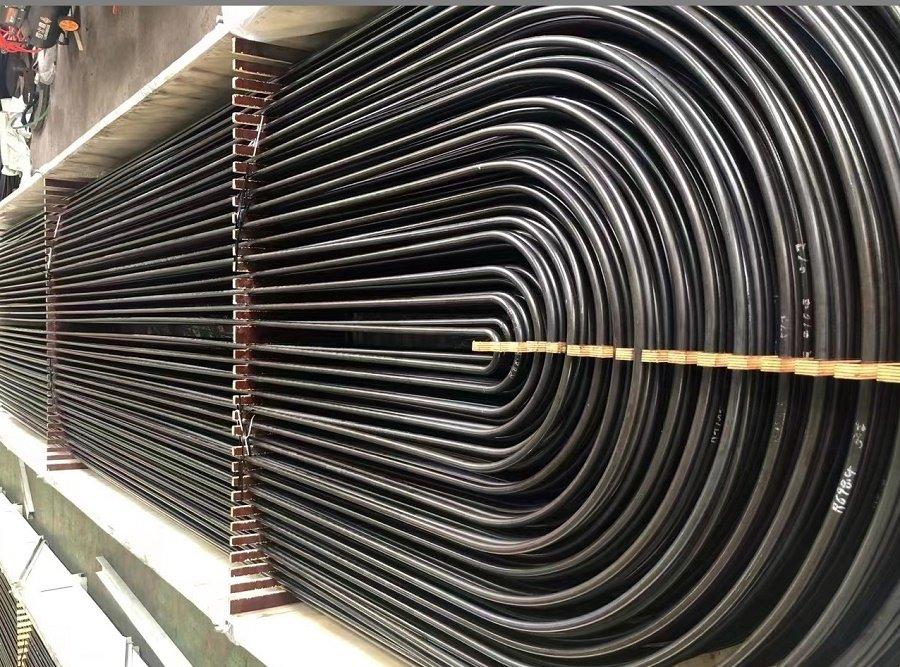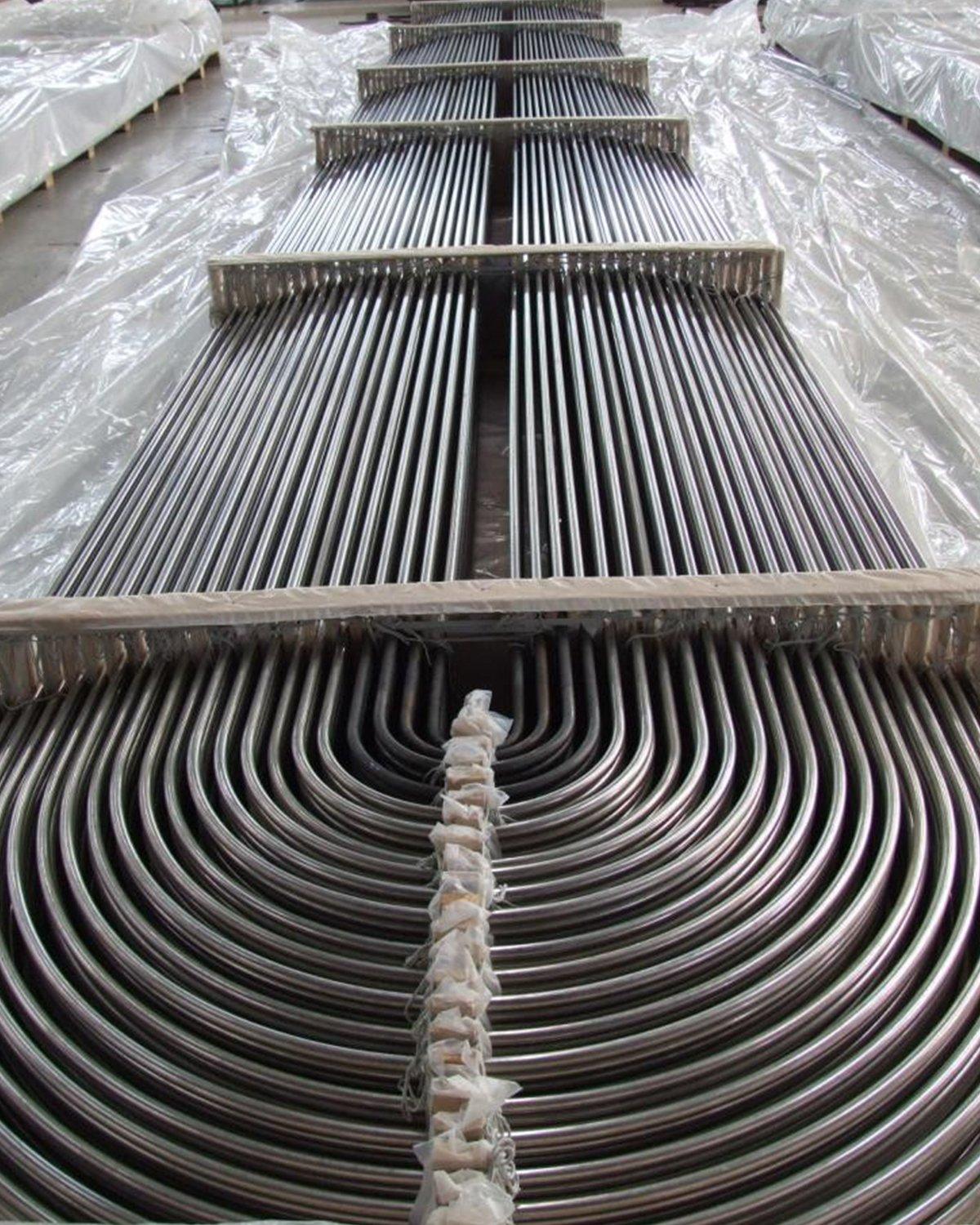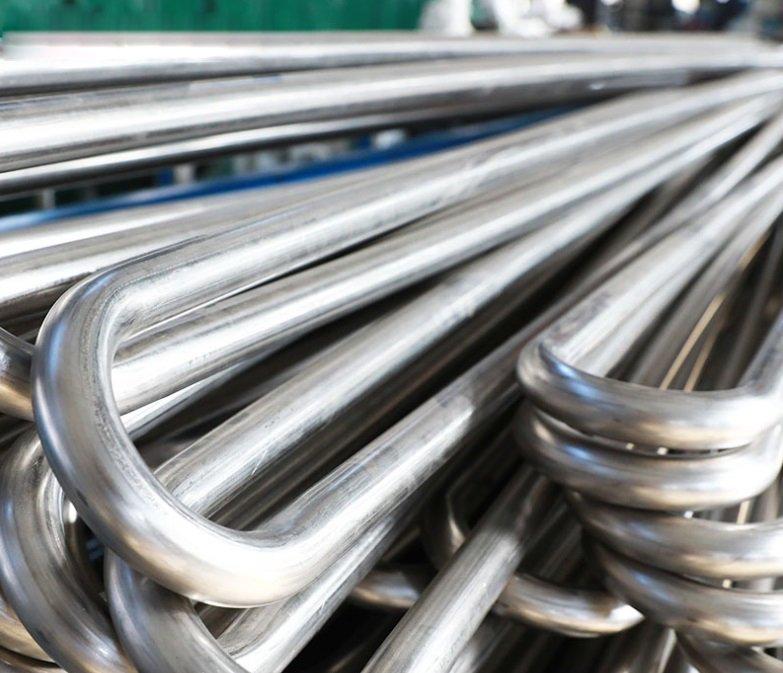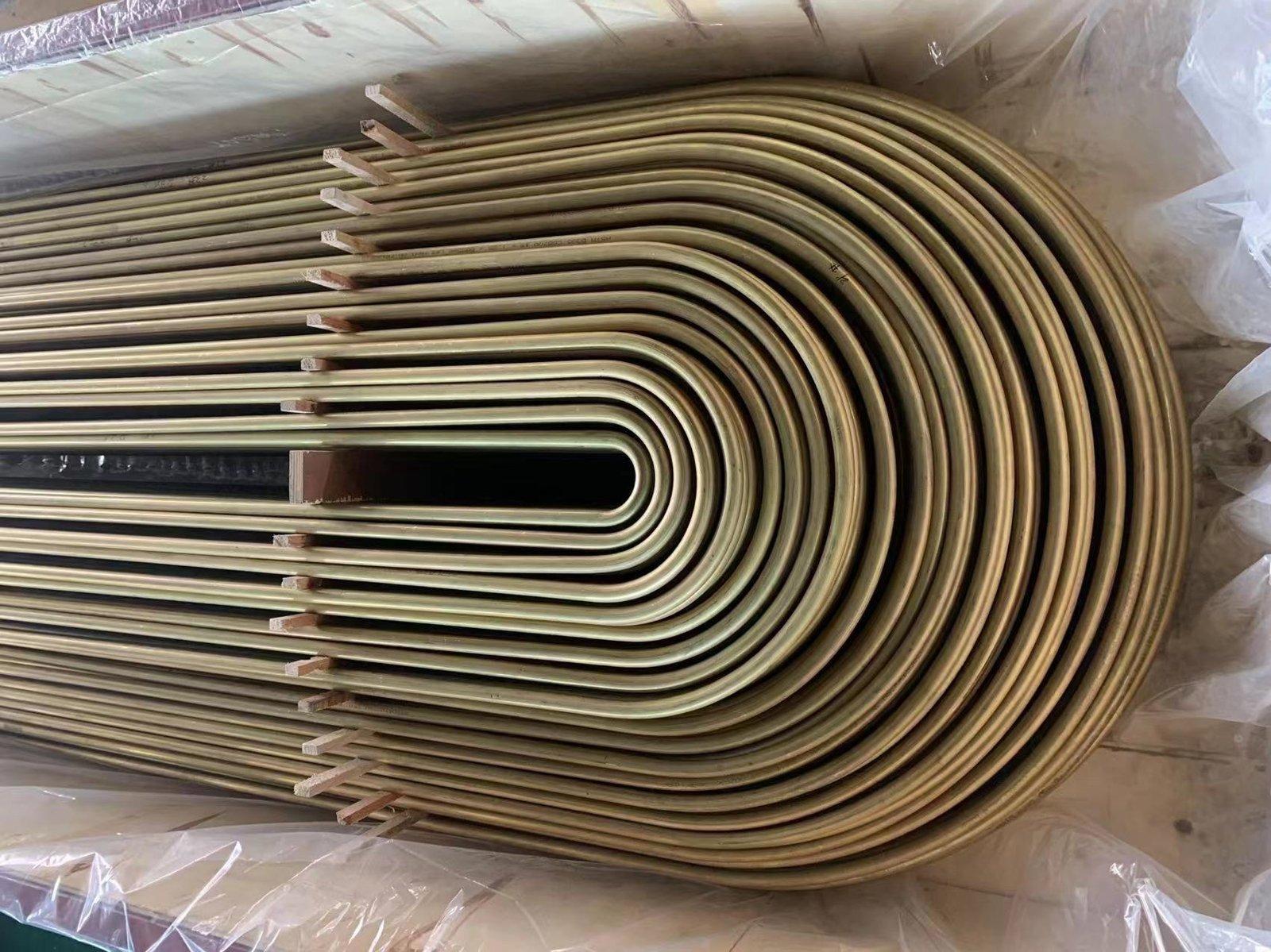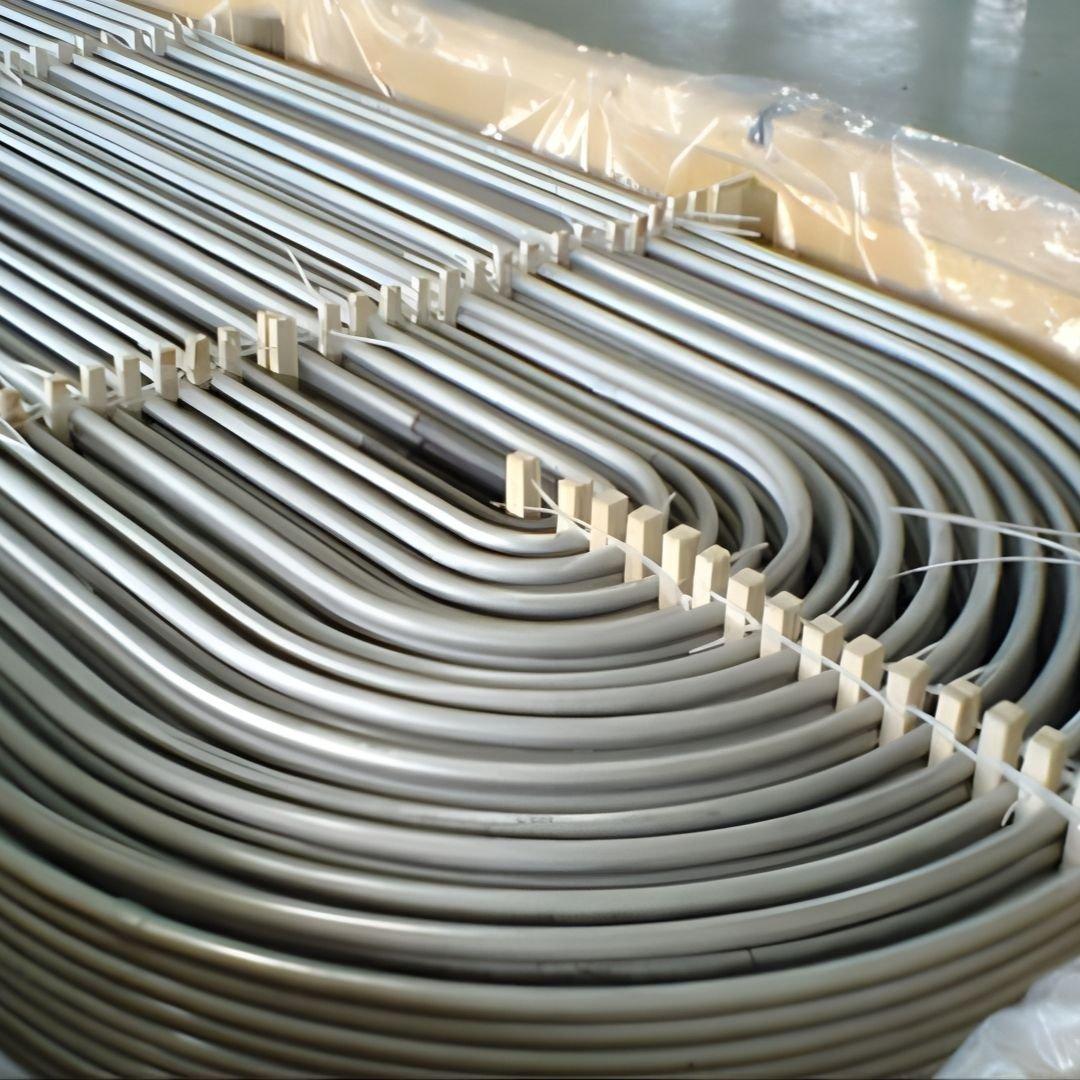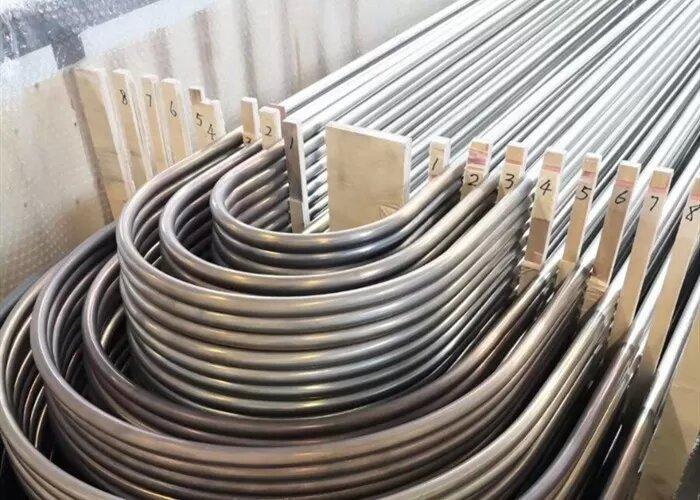
In a U-tube bundle each tube is bent back on itself, so the bundle has one tube sheet and expands freely. The price of that convenience is the bend: the tightest rows in the middle of the bundle are bent to a small radius, the wall thins and the tube ovalises there, and the bend region is where cracking and corrosion start if the bend is not made and treated properly.
/01The bend schedule.
A bundle drawing gives, for each row, the centreline bend radius and the leg length. The order lists those rows with quantities. Legs of about 12 m are usual, and straight tubes are available to 30 m. Rows are packed nested by radius, so they can be pulled out in order at the bundle shop.
/02Thinning and ovality.
Bending stretches the outside of the bend and compresses the inside: the outer wall thins and the section goes oval. Both are worst at the smallest radius. The limits are those of the governing specification on the order — ASTM A688 for welded austenitic feedwater-heater tube, A556 for carbon steel feedwater-heater tube, B395 for copper alloys, or TEMA — so we never quote a single thinning percentage. To keep the minimum wall at the bend, order the straight tube to a minimum wall, or a heavier gauge for the tight rows.
/03Heat treatment of the bend.
Cold bending leaves residual stress and, in stainless and duplex, can change the structure. Austenitic stainless bends are solution-annealed to order, usually the bend plus part of each leg, to restore corrosion resistance where stress-corrosion cracking is a risk. For duplex bends the qualification tube at the smallest radius is checked for ferrite (40–60 %) and for freedom from sigma phase by ASTM A923 Method A. Where ASTM A688 applies, intergranular corrosion testing by A262 is done on the smallest heat-treated bend. Treatment of chrome-moly bends is agreed with the order.
/04Testing after bending.
Straight tubes are tested to their base specification before bending. After bending and any heat treatment, each U-tube is pressure tested where the specification calls for it — under A688 and A556 every U-tube; under B395 hydrostatically or pneumatically. Brass U-tubes are also checked for residual stress by mercurous nitrate or ammonia vapour tests on the bend and leg. Say on the order if every tube must be hydrotested after bending, as some mills only do it on request.
/05Materials we bend.
| Listing | Grades | Standards | OD |
|---|---|---|---|
| Carbon Steel U-Bend Tubes | A179; A192; A210; A214; A556 | ASTM A179, ASTM A214, ASTM A556, ASTM A450 | 15.88–50.8 mm |
| Alloy Steel U-Bend Tubes | A213 T11; A213 T22; A209 T1; A209 T1a | ASTM A213 / SA-213, ASTM A209, ASTM A1016, DIN 17175 (superseded by EN 10216-2) | 15.88–25.4 mm |
| Austenitic Stainless U-Bend Tubes | TP304/304L; TP316/316L; TP321; TP347; duplex S31803/S32205/S32750 | ASTM A213, ASTM A249, ASTM A688, TEMA | 15.88–25.4 mm |
| Ferritic and Martensitic Stainless U-Bend Tubes | TP405; TP409; TP410; TP439; S44660 | ASTM A268, ASTM A803, EN 10297-2, JIS G3463 | 19.05–25.4 mm |
| Nickel-Alloy U-Bend Tubes | N04400; N06600; N06625; N08800; N08825 | ASTM B163, ASTM B444, ASTM B407, ASTM B423 | 19.05–25.4 mm |
| Copper-Alloy U-Bend Tubes | C12200 etc.; C44300–C44500; C68700; C70600/C70620; C71500/C71520; C72200 | ASTM B395/B395M, ASTM B111, ASTM B135, ASTM B68 | To order |
| Low-Fin U-Bend Tubes | SA-334 Gr 6; SA-179; stainless; Cu-Ni | ASTM A498, ASTM A1012, ASTM B359, ASME SA334 Gr 6 | 19.05–25.4 mm |
| Feedwater Heater U-Tubes | TP304/304L/304N; TP316/316L; N08367; A556 A2/B2/C2; A803 TP439 | ASTM A688, ASTM A556, ASTM A803 | To order |
For low-fin U-tubes, see integral low-fin tube. Pipe-size return bends to ASME B16.9 and MSS SP-43 are listed as return bends.
Common questions
- What is the minimum bend radius of a U-tube?
- 1.5 × OD can be bent; tolerances are guaranteed from 2 × OD.
- How much does the wall thin at a U-bend?
- It depends on the radius and the tube. The allowance is the one in the governing specification on the order (A688, A556, B395 or TEMA).
- Are stainless U-bends heat treated?
- To order. Solution annealing of the bend and part of the legs is common where stress-corrosion cracking is a concern.
- Is every U-tube hydrotested?
- Where the specification requires it, such as A688 and A556. Otherwise state it on the order.
- How long can the legs be?
- Legs of about 12 m are usual; straight tubes are available to 30 m.