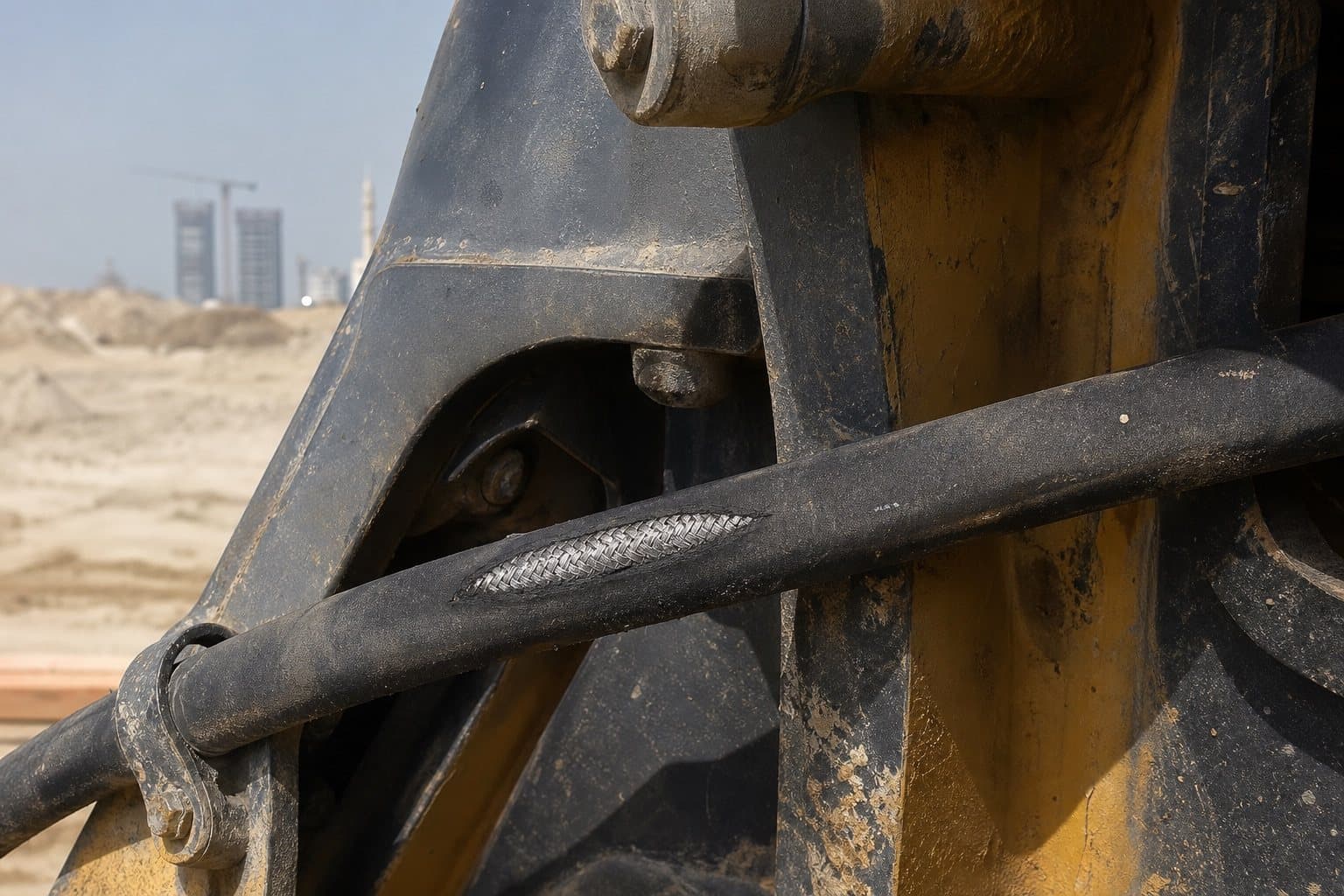
Of all the ways a hydraulic hose fails, this is the one that was visible for longest and ignored for longest. A hose does not wear through quickly. It wears through over months, in plain sight, while everyone walks past it.
/01Reading the wear pattern.
| Pattern | What it means |
|---|---|
| Flat patch on one side, sharp edgesHighlighted | Constant contact with a fixed edge — a bracket, frame or plate |
| Long shallow scuff along the hose | The hose slides against something as the machine moves |
| Worn all the way round at one point | Movement inside a clamp, or the clamp is too loose |
| Two hoses worn where they cross | Hose-on-hose abrasion — both will fail, usually not together |
| Wear only visible at full extension | Contact happens at one machine position only, which is why nobody saw it |
/02Contact you will not see standing still.
A machine at rest shows you one geometry. The hose failed in a different one. Boom, tilt and attachment circuits contact things only through part of their travel, and inspecting a parked machine tells you nothing about the position where the rubbing actually happens.
Where a hose has worn and nothing obvious is touching it, cycle the machine slowly through full travel and watch. The contact is usually obvious the moment you see it — and usually at an extreme of movement that nobody thought to check.
/03Re-route, clamp or sleeve.
| Fix | Removes the cause? | Use when |
|---|---|---|
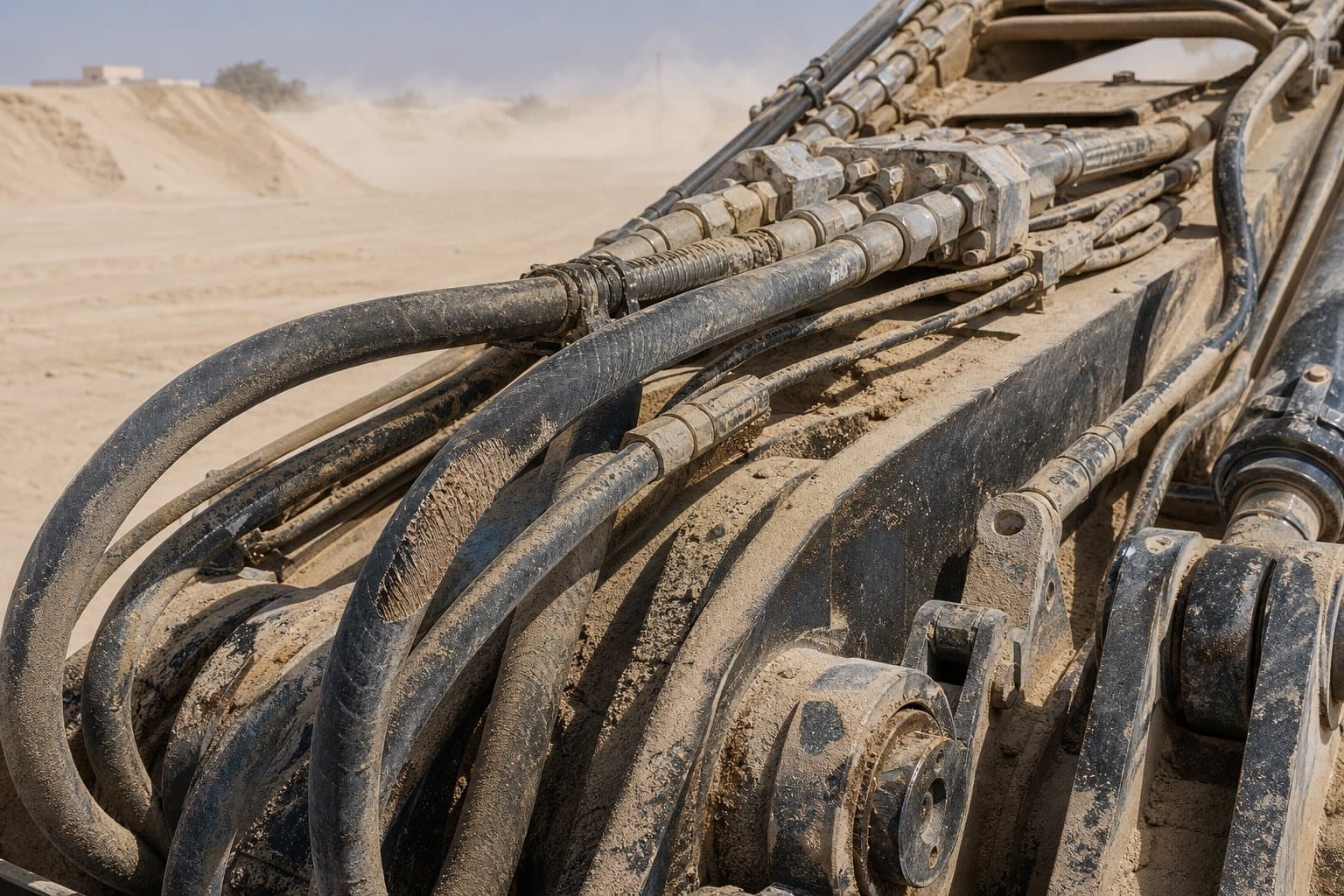
| Re-routeHighlighted | Yes | There is room to move the hose away from what it touches |
| Clamp | Yes, if it stops the movement | The hose needs to be held in a position it will not stay in on its own |
| Sleeve or spiral guard | No — protects the hose, rubbing continues | Contact is unavoidable, or as an interim while a re-route is arranged |
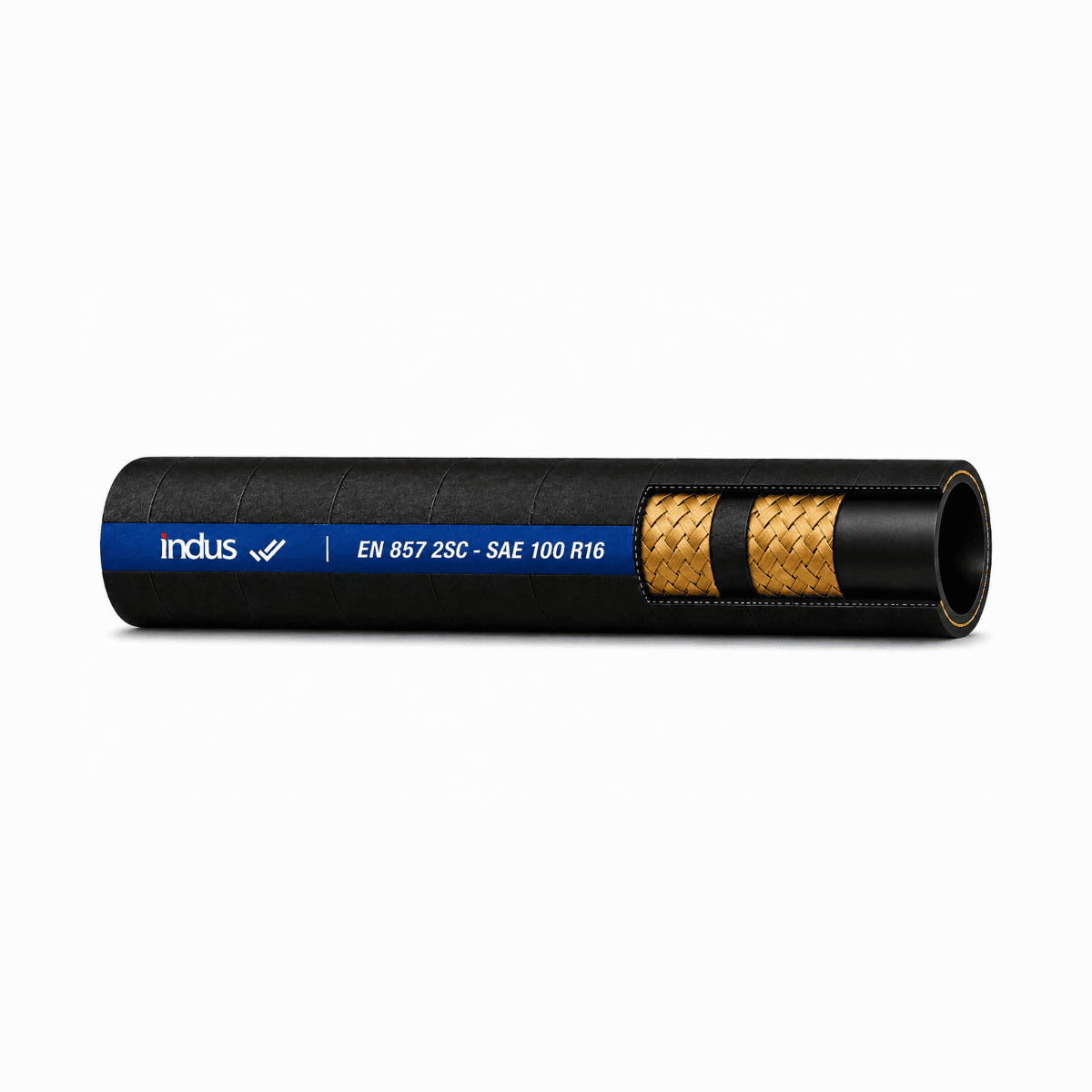
Clamping deserves more credit than it usually gets. A hose held properly at sensible intervals does not swing into things, and most hose-on-hose abrasion is really a clamping problem wearing an abrasion mask. The clamp has to hold the hose without gripping it so tightly that the hose cannot move through it at all — a hose that must slide, and is clamped so it cannot, fails at the clamp instead. Where the cover itself is the weak point, a grade with a cover specified for abrasion — 4SH and R13 among ours — buys time, but re-routing is still the fix.
Common questions
- How much cover wear is too much?
- Once any reinforcement is visible, the hose is finished — the wire is exposed to water and the protective layer has gone. Before that point it is a judgement about rate: a hose halfway through its cover in six months has a fix worth making, not a replacement worth scheduling.
- What size sleeve do I need?
- Sized on the hose outside diameter, which varies by construction at the same dash size — at −08 the grades we stock range from 17.2 mm to 23.0 mm outside. Give us the grade as well as the size.
- Is an abrasion-resistant cover worth specifying?
- Where contact is genuinely unavoidable, yes, and several of the constructions we stock carry one. It extends the time before the cover is breached; it does not change the fact that something is rubbing.
- Two hoses are rubbing on each other. Which one do I move?
- Whichever has room. If neither does, separate them with a clamp rather than sleeving both — a clamp fixes the geometry and sleeving only slows the wear on two hoses instead of one.