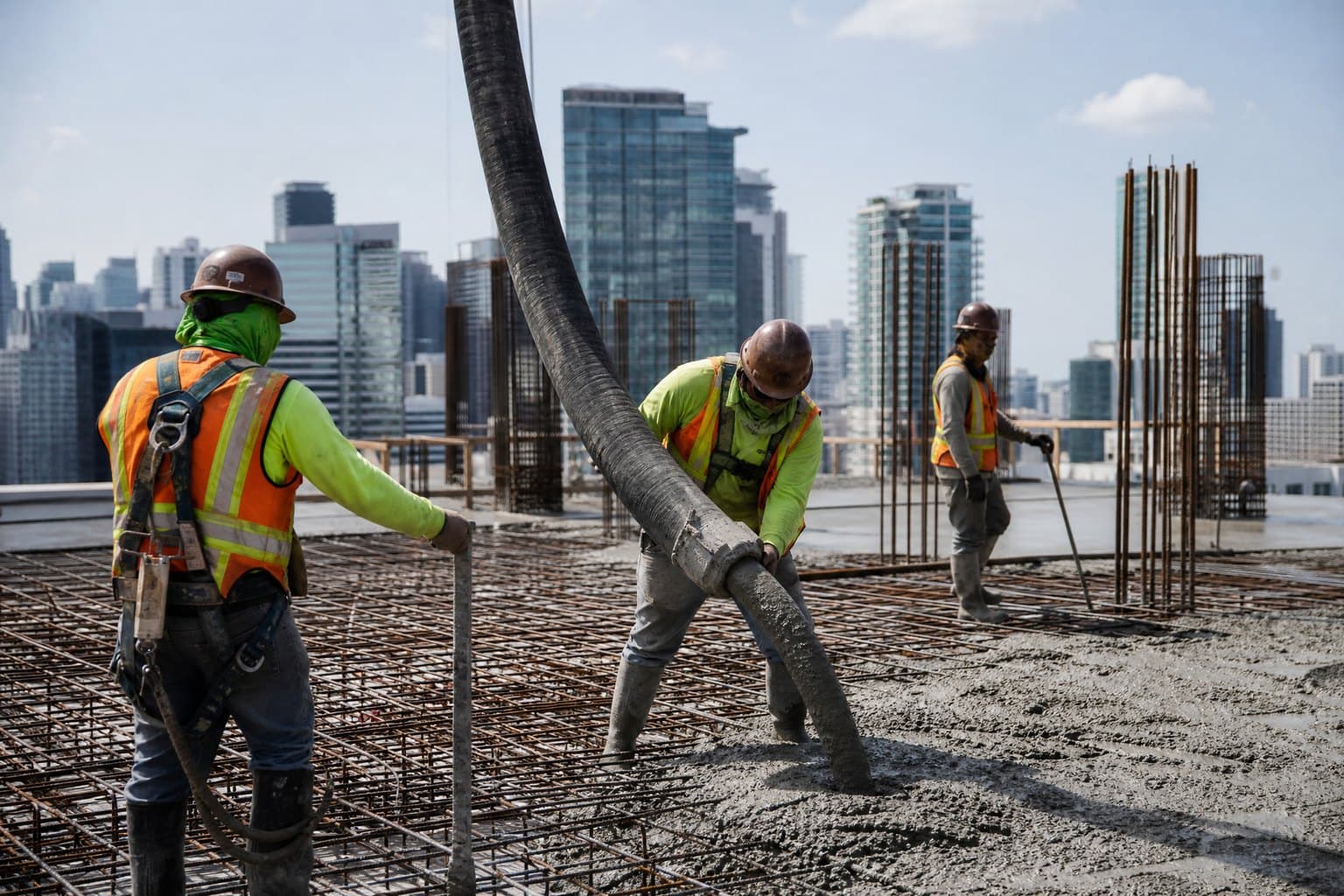
In November 2007 concrete was pumped to a height of 601 metres at the Burj Khalifa — then called Burj Dubai — through a 150 mm steel pipeline, a world record raised to 606 m in April 2008. Most pours are less dramatic, but the physics is the same: a piston pump forces a heavy, abrasive, semi-solid material through a pipeline at high pressure, and at the end a flexible hose lets the crew put it exactly where it is needed. That last hose is the part people hold — and the part that must be specified right.
/01Boom pumps, line pumps and pressure.
A boom pump carries its delivery line along a folding boom and places concrete through an end hose hanging from the tip. A line pump (trailer or truck-mounted) pushes concrete through steel pipe and hose laid across the site or up the building — the method for long horizontal runs, tunnels and high-rise cores. Trade sources describe boom pumps with two common pressure settings, around 85 bar and 130 bar, with boom delivery lines typically limited to 85 bar, and mainstream line pumps rated around 125 to 160 bar. The highest pressure is at the pump outlet; it falls along the line as the concrete overcomes friction and lift.
/02Choosing a pressure class.
| Class | Sizes | Working pressure | Burst pressure |
|---|---|---|---|
| Standard | 3", 4", 5" | 50 bar at 5"; 3" and 4" confirmed with the quotation | 100–126 bar |
| High-pressureHighlighted | 3" to 5" | 75–85 bar | 150–170 bar |
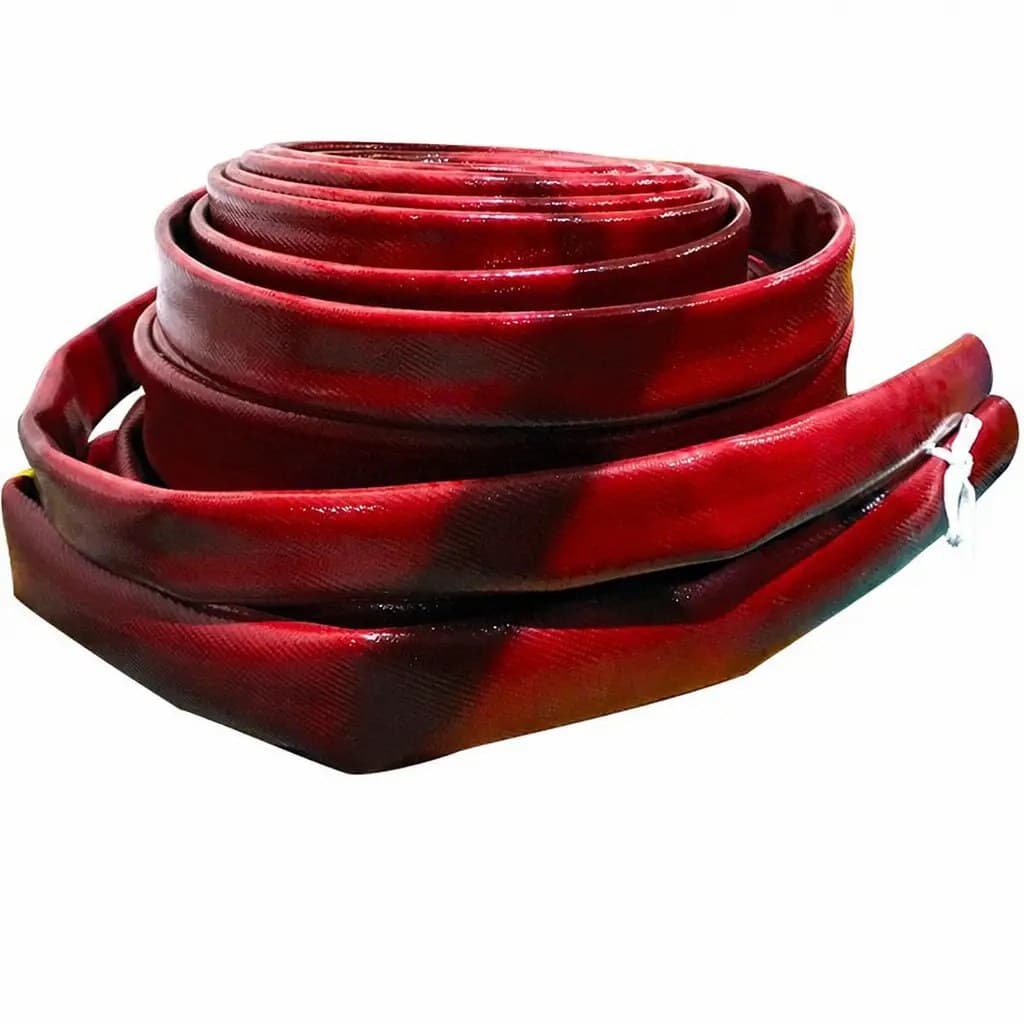
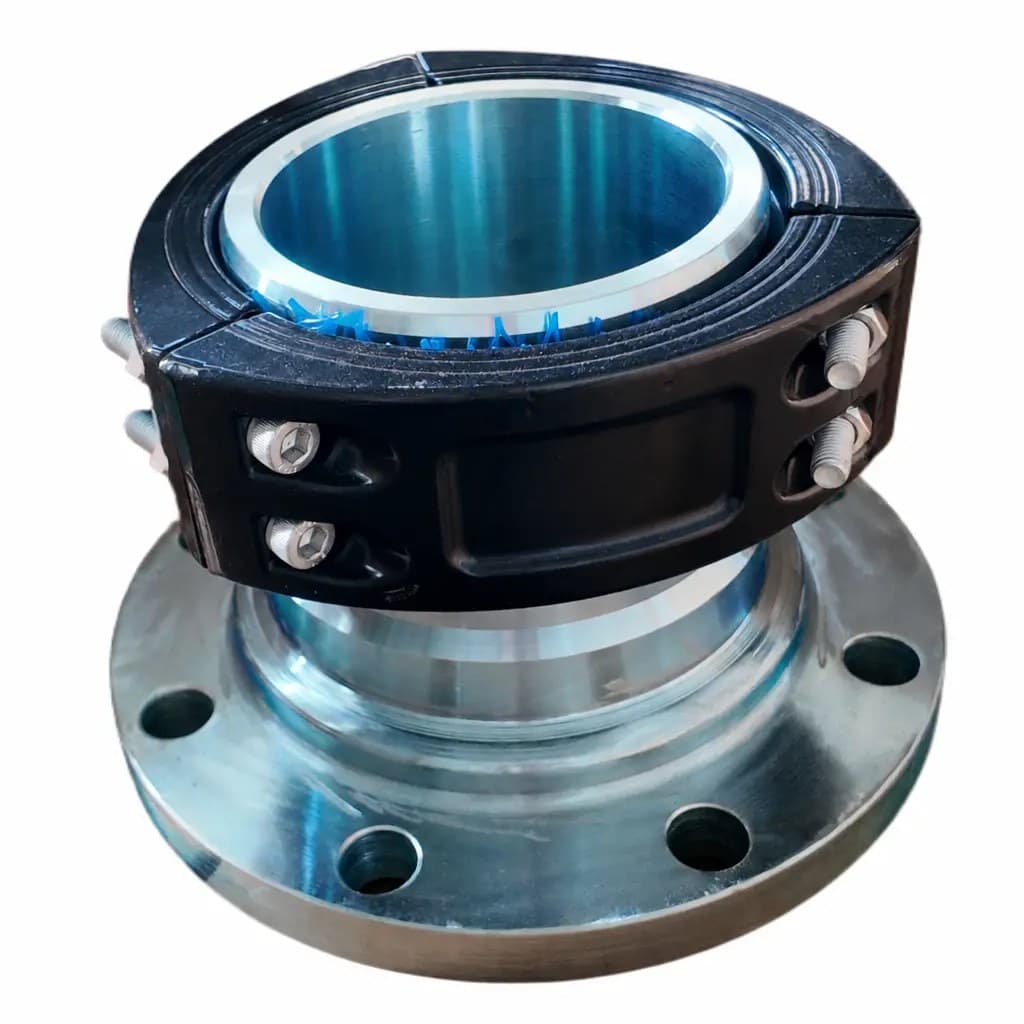
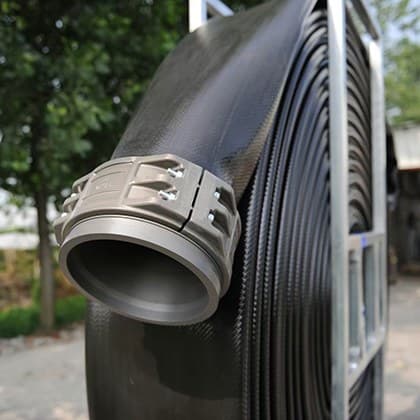
Our TPU concrete placement hose is light and flexible enough for crews to move the end by hand, flattens for transport, and has a smooth bore that keeps flow steady and resists blockage. Match the class to the pump’s maximum concrete pressure at the point of use: the high-pressure class for long or high pumping lines, the standard class where pressure at the hose is lower, such as grouting and short placing runs. Where the line pressure exceeds the hose rating, use steel delivery pipe and keep the hose to the end, where pressure has fallen.
/03Hose whip.
Hose whip is the uncontrolled, violent movement of the flexible end hose, and it can cause serious injury or death. Workplace safety regulators such as WorkSafe Queensland identify trapped air as the main cause: air pockets compress in the line and release suddenly at the outlet. It happens most at start-up, after the pump has been moved or the line extended, and after a blockage has been cleared.
- No metal fittings on the free end of the hose — a whipping coupling or reducer is a weapon.
- Start the pump slowly, and restart slowly after any stop, move or blockage.
- Keep the hose near vertical, not stretched out or bent back on itself.
- Keep an exclusion zone around the hose at start-up and after stoppages; nobody holds the hose until flow is steady.
- Clean out with water, not compressed air.
- Follow the pump maker’s instructions and EN 12001, the European safety standard for concrete pumps and their delivery lines.
/04After the pour.
Clean the line and hose immediately with water and a cleaning ball or sponge, before the concrete starts to set; concrete left in a hose ends its life in hours. Flush the couplings, drain the hose, and store it flat or coiled loosely out of the sun. Lay flat placement hose rolls flat for transport, which saves space on the truck. For grout and cement slurry in tunnels and mines, the same hose and the same cleaning discipline apply.
Common questions
- What is concrete hose whip?
- The sudden, violent movement of the flexible end hose, mostly caused by trapped air released at the outlet — at start-up, after moving the pump or after clearing a blockage.
- What pressure do concrete pumps run at?
- Boom pumps commonly around 85 bar or 130 bar depending on setting, with boom lines typically limited to 85 bar; line pumps often 125–160 bar.
- Can lay flat hose be used for concrete?
- Yes, if it is built for concrete and rated for the pressure at its position in the line. Our TPU placement hose comes in standard and high-pressure (75–85 bar) classes.
- Should the end hose have a metal fitting?
- No. Safety regulators advise against metal fittings on the free end, because a whipping fitting can cause serious injury.
- How high has concrete been pumped?
- To 606 m at the Burj Khalifa in April 2008, after a 601 m record in November 2007, through steel pipeline.