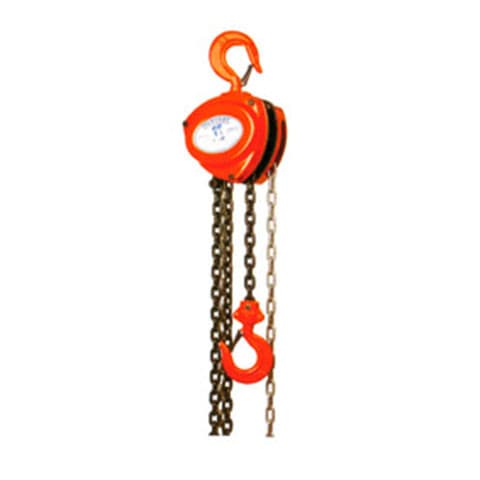
Hang a chain block from a trolley on an I-beam and it can travel the length of a workshop, a pump house or a plant room. On shutdowns and in plant rooms, beam trolleys move valves, motors and pumps where no crane can reach. Choosing one comes down to how it travels, how much it carries and which beam it fits. For the hoist itself, see chain block vs lever hoist vs electric hoist.
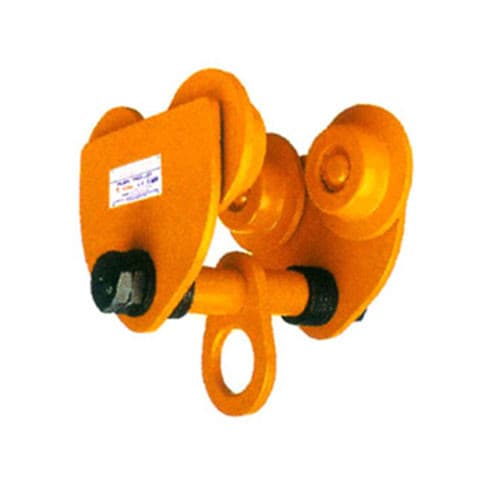
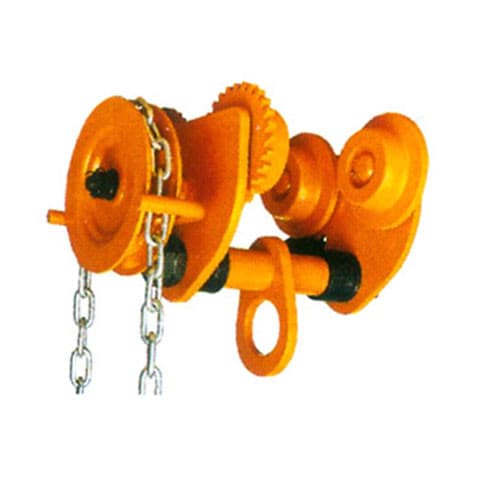
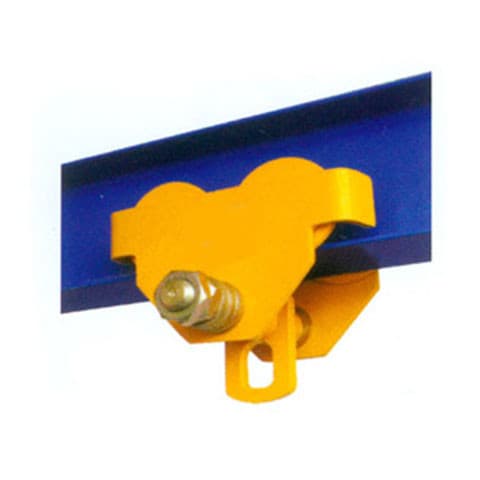
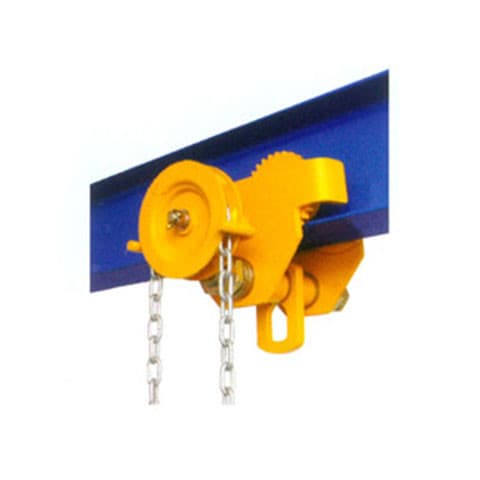
/01Push or geared.
| Feature | Push trolley | Geared trolley |
|---|---|---|
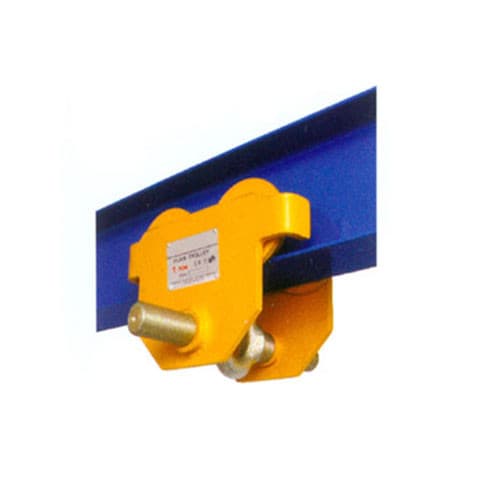
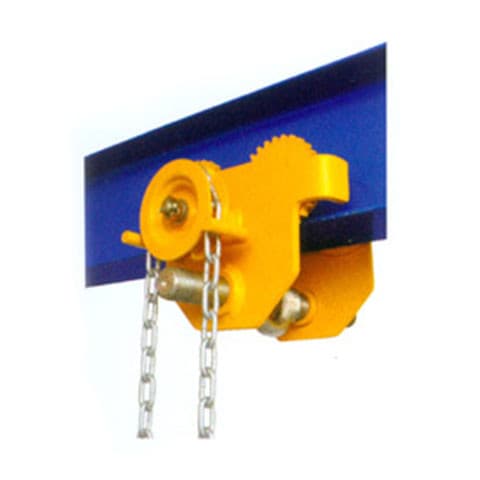
| Travel | Pushing or pulling the load | Pulling a hand chain on a geared wheel |
| ControlHighlighted | Load can swing and run on | Slow, precise positioning |
| Best for | Lighter loads, low beams, short travel | Heavier loads, precise placing, high beams |
| Weight (1 t, from our table) | 8 kg | 15 kg |
/02Sizing to the beam.
| Capacity | Type B | Type C | Type F |
|---|---|---|---|
| 0.5 t | 75–125 | 64–140 | 50–220 |
| 1 t | 75–125 | 64–140 | 58–220 |
| 2 t | 100–150 | 76–165 (geared) / 76–203 (push) | 66–220 |
| 5 t | 125–175 | 88–203 | 90–220 |
| 10 t | 125–180 | 125–203 | — |
Choose a capacity that covers the hoist and its load together, then a trolley whose flange range includes your beam’s flange width. Set the wheels to the maker’s clearance — one maker specifies 2–4 mm each side — not jammed against the flange. Wheels are profiled for tapered or parallel flanges: tapered-flange beams to DIN 1025-1 have a sloping flange that wheels must be designed for. Curved track needs a trolley rated for the curve radius; makers publish minimums that grow with capacity.
/03Before first use.
- The beam is rated for the load and the trolley, confirmed by whoever is responsible for the structure.
- End stops are fitted at both ends of the beam.
- The trolley’s and the hoist’s ratings are marked and certified, and the pair is examined after installation.
- Clearance and wheel profile match the beam.
Hand-operated trolleys are covered in Europe by EN 13157 and in the US by ASME B30.17; local rules on examination apply — see lifting equipment inspection in the UAE.
Common questions
- How do I size a beam trolley?
- By capacity — enough for the hoist and its load — and by the flange width range, which must include your beam’s flange.
- What is the difference between a push and a geared trolley?
- A push trolley moves when the load is pushed; a geared trolley moves by a hand chain on a geared wheel, for more control.
- Can a beam trolley go round curves?
- Yes, if rated for the curve radius. Makers publish minimum radii that increase with capacity.
- Do beam trolleys work on tapered flanges?
- Yes, if the wheels are designed for the flange profile. Check the trolley suits your beam’s flange slope.
- Do your trolleys come certified?
- Yes, with the manufacturer’s test certificate.