A skid pulled off a well mid-job, with a 7-day clock.
The call came in at 19:40 on a Wednesday. A coiled-tubing contractor working a sour-gas well in the Eastern Province had pulled their 80,000-lb injector skid off location after the gripper-block chain started slipping under load on a CT pull. One of the two N₂ accumulators on the injector head circuit had quietly lost its pre-charge over the previous month, the chain blocks were grabbing inconsistently, and the well slot was booked for the following Wednesday. Five working days, including transport, to make the unit safe to put back into a sour string.
A coiled-tubing contractor does not own its slots — Aramco does. If the injector is not back on location on the day, the rig moves to the next program, and the contractor goes to the back of a queue that stretches into the following quarter. The contractor we work with has done 14 jobs through us; this was the first emergency. The skid was loaded onto a low-bed at the wellsite, cleared the Saudi border early Thursday and was in our Jebel Ali bay by Thursday afternoon. We had a hydraulics technician, a machinist and a QA inspector standing by from the moment customs cleared the vehicle.
"Chain slipping under load — and one accumulator pre-charge is gone."
Two complaints, one obvious, one suspected. The chain had visibly slipped on the last pull. The accumulator had been logged at 620 psi against a 1,000 psi specification at the previous pre-job check. Asked us to "do whatever the chain needs and recharge the bottle."
Both gripper blocks worn out of dimension; both accumulators bladders failed; control loop drifted.
Chain-wear faces on both gripper blocks were down 0.31 mm and 0.27 mm respectively, well past the OEM minimum. The good accumulator had a perished bladder also drifting; the closed-loop hydraulic control on the injector head had a steady-state error that explained the inconsistent grip — not just the chain.
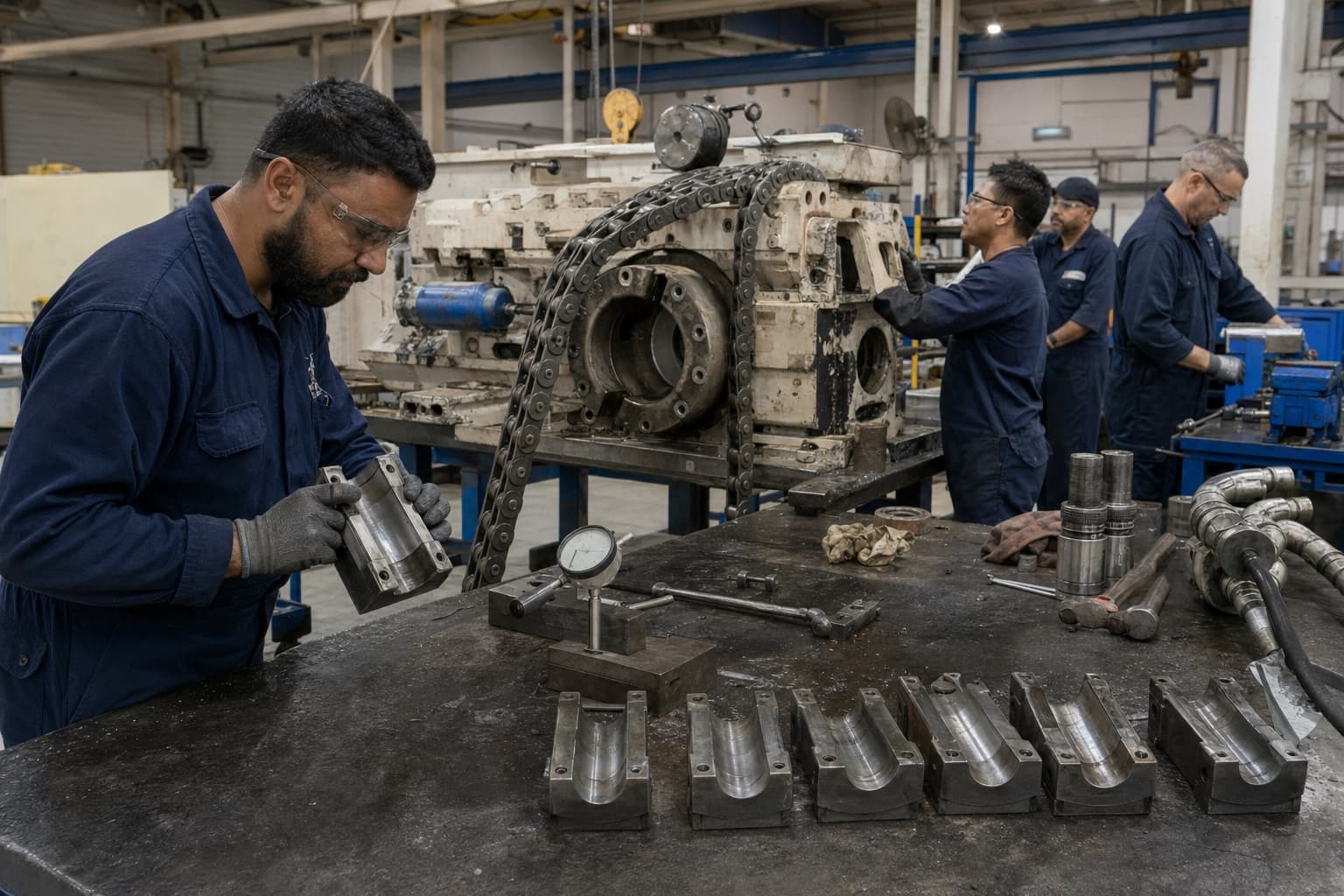
You do not get a second chance with a CT contractor's well slot. The cheapest version of this job — re-tension the chain and recharge the bottle — would have put the unit on a sour-gas string with two gripper blocks below OEM dimension and a control loop that was already wandering. We took the strip-down all the way to the head bearings. What we shipped back five days later was, in effect, a re-commissioned injector.
Strip, re-face, re-bladder, re-tune, function-test.
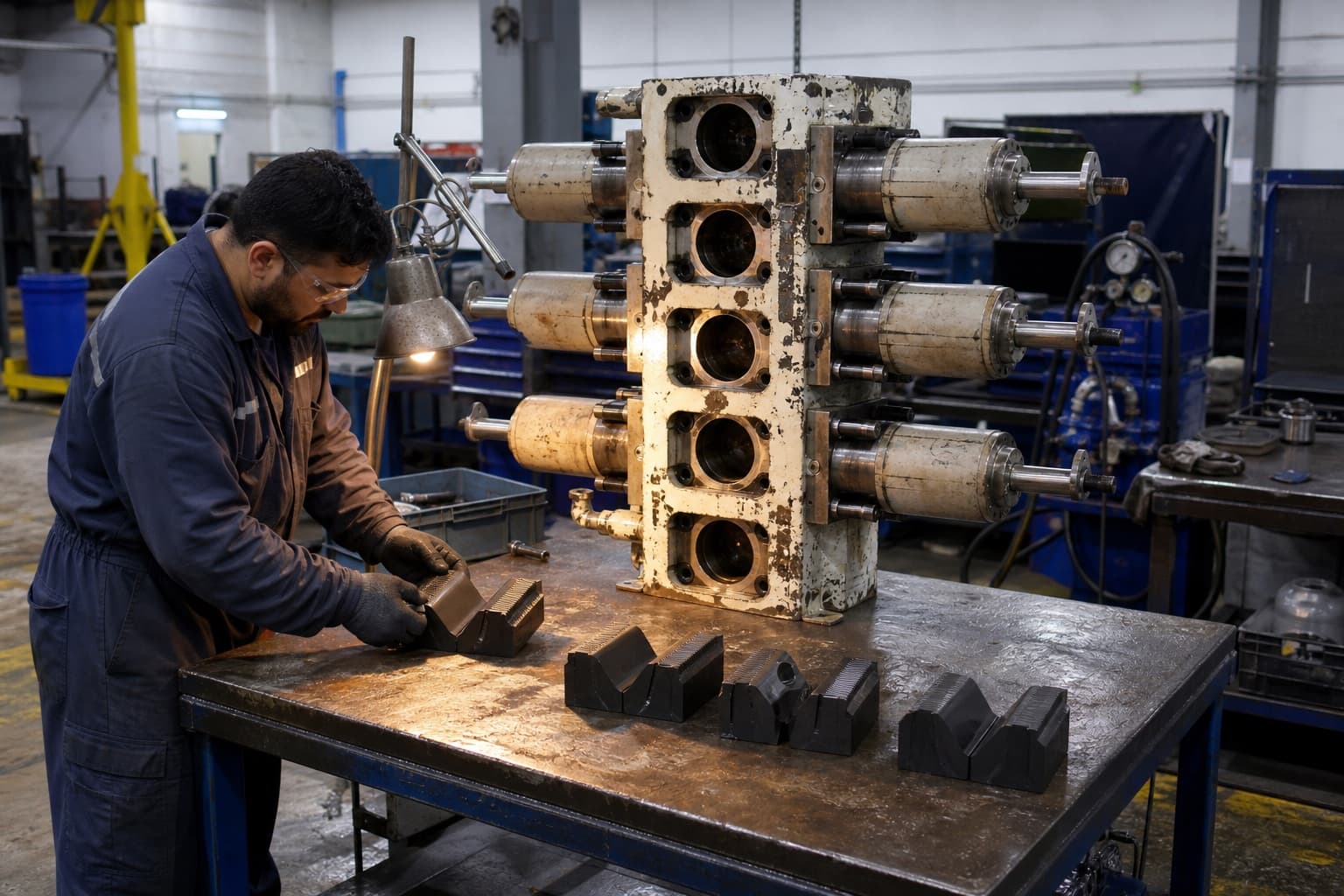
The work split into five disciplines and we ran them in parallel from Friday morning. The injector head came apart on the bench by Thursday night; gripper blocks, drive chains and the closed-loop hydraulic block all came off as sub-assemblies. The two accumulators were pulled to the high-pressure bay. Our machinist had both gripper blocks on the surface grinder by Friday lunchtime, re-facing the chain-wear contact surfaces back to OEM dimension within ± 0.05 mm with a finished surface roughness of Ra ≤ 0.8 µm — the spec the OEM uses on new blocks. Hardened-steel chain-wear faces, ground in one set-up, indicated against a master block we keep in QA for exactly this asset family.
Both accumulators were rebuilt with new HNBR sour-service bladders rated for H₂S exposure under NACE MR0175 / ISO 15156, refilled with traceable nitrogen against bottle numbers logged in QA, and pre-charged to 1,000 psi with a 24-hour decay check before the assembly bay would accept them back. The closed-loop hydraulic control on the injector head was bench-tuned against a calibrated load — PID gains adjusted on response time and steady-state error until the head held a commanded pull force inside 1% of setpoint at 3,000 psi delivered hydraulic pressure.
You don't get a second chance with a CT contractor's well slot. The chain was the symptom; the head was the patient. We were not putting that skid back on a sour string with anything less than OEM commissioning.— Khalid Al Marzouqi · Emergency Response Field Lead · Jebel Ali
Four phases, ninety hours of bench time.
Emergency CT-injector work on a sour-service skid runs through four phases. We compress the schedule but we do not compress the procedure — every step in the OEM commissioning script gets ticked off, the same as a planned overhaul.
Pickup & strip
Skid received from low-bed, photo log, fluid sample drained, injector head and accumulators broken out as sub-assemblies on the bench in Bay 5.
Re-face & re-bladder
Both gripper blocks ground to OEM ± 0.05 mm with Ra ≤ 0.8 µm finish. Both accumulators stripped, HNBR bladders fitted, traceable N₂ pre-charge.
Control re-tune & rebuild
Closed-loop PID re-tuned on calibrated load. Injector head reassembled with re-faced blocks and rebuilt accumulators. Hydraulic circuits hydrotested at 1.5× MAWP.
Function-test & dispatch
Full skid run against OEM commissioning script: push/pull cycle, gripper engage/disengage, accumulator dump test. Sign-off pack issued, low-bed loaded for return.
The SOP we ran, line by line.
Below is the actual procedure we ticked off — abridged from the master document. SOP-OG-024 is the Indus standard for emergency CT-injector repair on sour-service skids, currently at revision 03.
The numbers, before and after.
Below is what we measured against OEM commissioning tolerance. Four findings would have failed an Aramco vendor audit. All four were corrected in Phase 02 and 03; the function test in Phase 05 confirmed they stayed corrected.
| Component | Spec | As-found | After rebuild | Status |
|---|---|---|---|---|
| Gripper-block chain-wear face (LH) | OEM dimension ± 0.05 mm | −0.31 mm under spec | +0.02 mm vs OEM | ↻ Re-faced, master-checked |
| Gripper-block chain-wear face (RH) | OEM dimension ± 0.05 mm | −0.27 mm under spec | +0.01 mm vs OEM | ↻ Re-faced, master-checked |
| Chain-wear face surface finish | Ra ≤ 0.8 µm | Ra 2.1 µm (galled) | Ra 0.6 µm | ↻ Ground in single set-up |
| Chain-block flatness | ≤ 0.03 mm across face | 0.11 mm (worn unevenly) | 0.02 mm | ↻ Restored |
| Accumulator A — N₂ pre-charge | 1,000 psi · ≤ 6 mo | 0 psi · bladder ruptured | 1,000 psi · bottle traced | ↻ Re-bladdered (HNBR) |
| Accumulator B — N₂ pre-charge | 1,000 psi · ≤ 6 mo | 620 psi · bladder perished | 1,000 psi · bottle traced | ↻ Re-bladdered (HNBR) |
| Bladder elastomer | NACE HNBR · sour-service | Standard NBR (out of spec) | HNBR · MR0175 | ↻ Replaced |
| Closed-loop response time | < 100 ms to 90% setpoint | 180 ms (drifted) | 74 ms | ↻ PID re-tuned |
| Closed-loop steady-state error | < 1% of setpoint | 3.2% (low side) | 0.6% | ↻ PID re-tuned |
| Push/pull force at 3,000 psi | OEM curve · ± 2% | Off curve below 50 klb | On curve · 8 cycles | ✓ Calibrated |
| Full-skid hydrotest | 1.5× MAWP · 30 min hold | — | 0 bar drop, < 5 ml/min | ✓ Pass |
| Function test vs OEM script | All steps pass | — | 24 / 24 steps pass | ✓ Pass |
Skid back on location, slot held.
The skid left our Jebel Ali yard on Day 5 at 09:20 GST, cleared the Saudi border the same evening and was on location at the wellhead by Day 6 afternoon. The CT contractor met their Day 7 slot. The closed-loop hydraulic test was run end-to-end against the OEM commissioning sequence with the contractor's own QA on the line for the witness. Both gripper blocks, both accumulators and the re-tuned hydraulic control are covered under a single 6-month assembled-system warranty — not just parts. Aramco vendor sign-off cleared on the same paperwork.
Sour-service CT injector skid stripped, re-faced, re-bladdered, re-tuned and function-tested in five days — slot held, contractor on location.
Delivered inside the contractor's 7-day window with two days of margin to spare. Full OEM commissioning script ticked off, NACE certs on every wetted elastomer, traceable N₂ on both accumulators. Both gripper blocks restored to OEM dimension with Ra ≤ 0.8 µm finish. Closed-loop control re-tuned to < 80 ms response and < 1% steady-state error.
The team on the job.
Five engineers in Jebel Ali logged time against this work order across 90 hours of bench time. The strip-down on Day 0 ran into the night; the function test on Day 4 ran into Day 5 morning. If you call the JAFZA yard and ask about case 05, any of them can pull the file.
- Khalid Al Marzouqi — Emergency Response Field Lead, Jebel Ali. Intake, customer liaison through the 5 days, accumulator N₂ traceability, dispatch and low-bed sign-off.
- Yusuf Al Hashimi — Workshop Manager, Jebel Ali. Bay 5 scheduling, parallel-tracking the gripper-block, accumulator and control-loop work to compress the 5-day window.
- Omar Al Maktoum — Lead Hydraulics Technician, Jebel Ali. Injector head strip and rebuild, accumulator change-out, closed-loop PID re-tune against calibrated load, full-skid hydrotest.
- Aisha Al Suwaidi — Machinist, Jebel Ali. Surface-grinding both gripper blocks back to OEM dimension in a single set-up, master-block reference, flatness verification.
- Hassan Al Awadi — QA, Jebel Ali. Dimensional inspection, NACE MR0175 sign-off on bladder elastomers, OEM commissioning function test, sign-off pack.
Case file · INTAKE-2026-03-184 · WO-2026-1142 · Published 2026-04-02 · Updated 2026-05-09