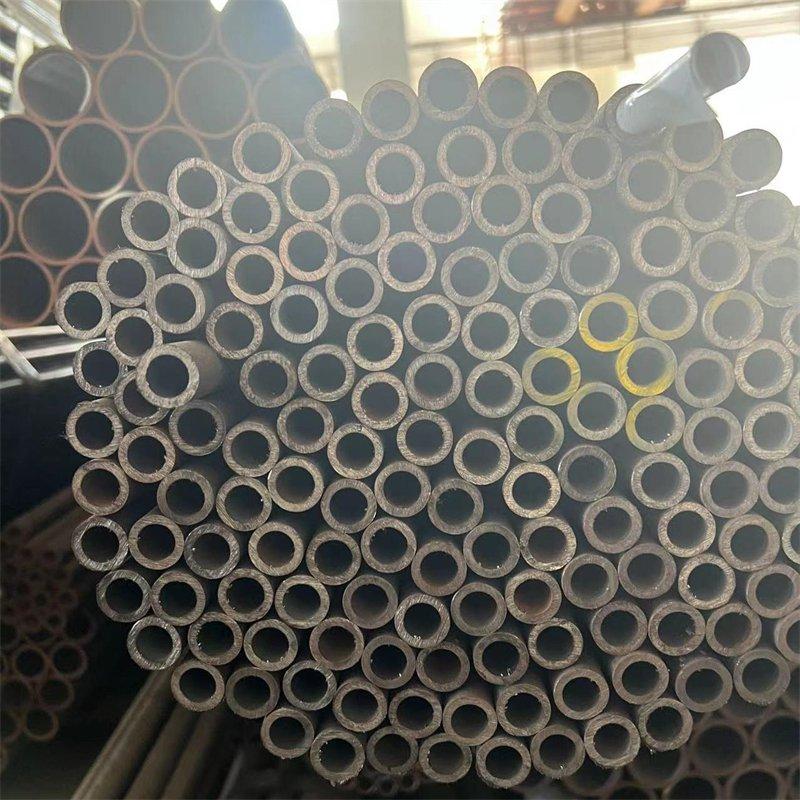
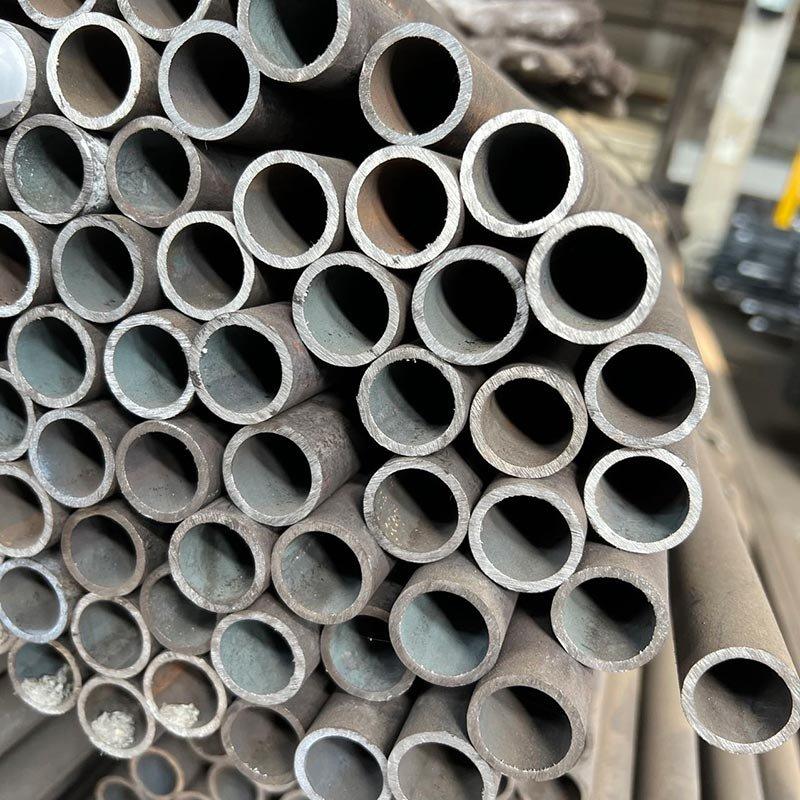
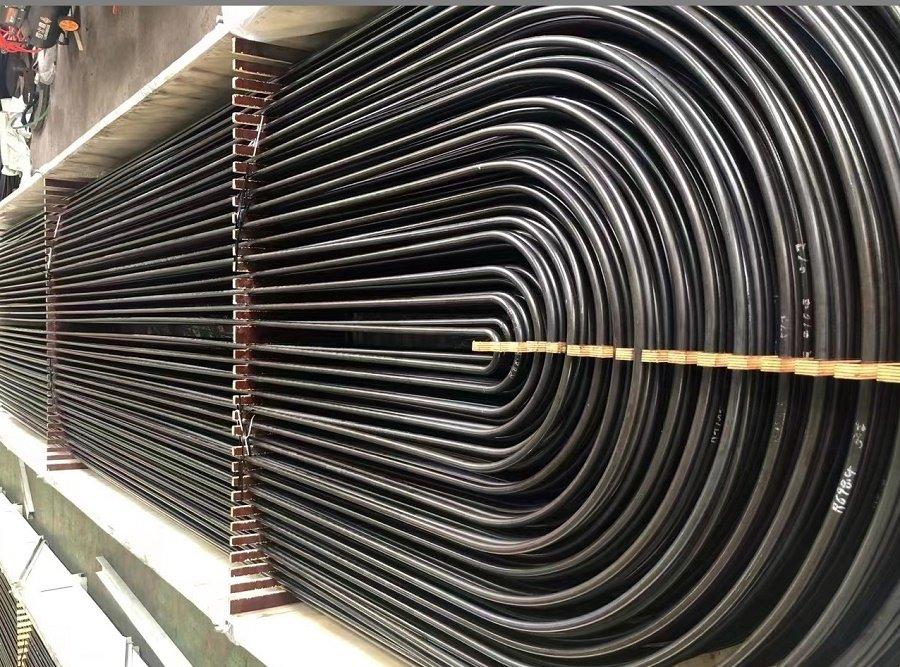
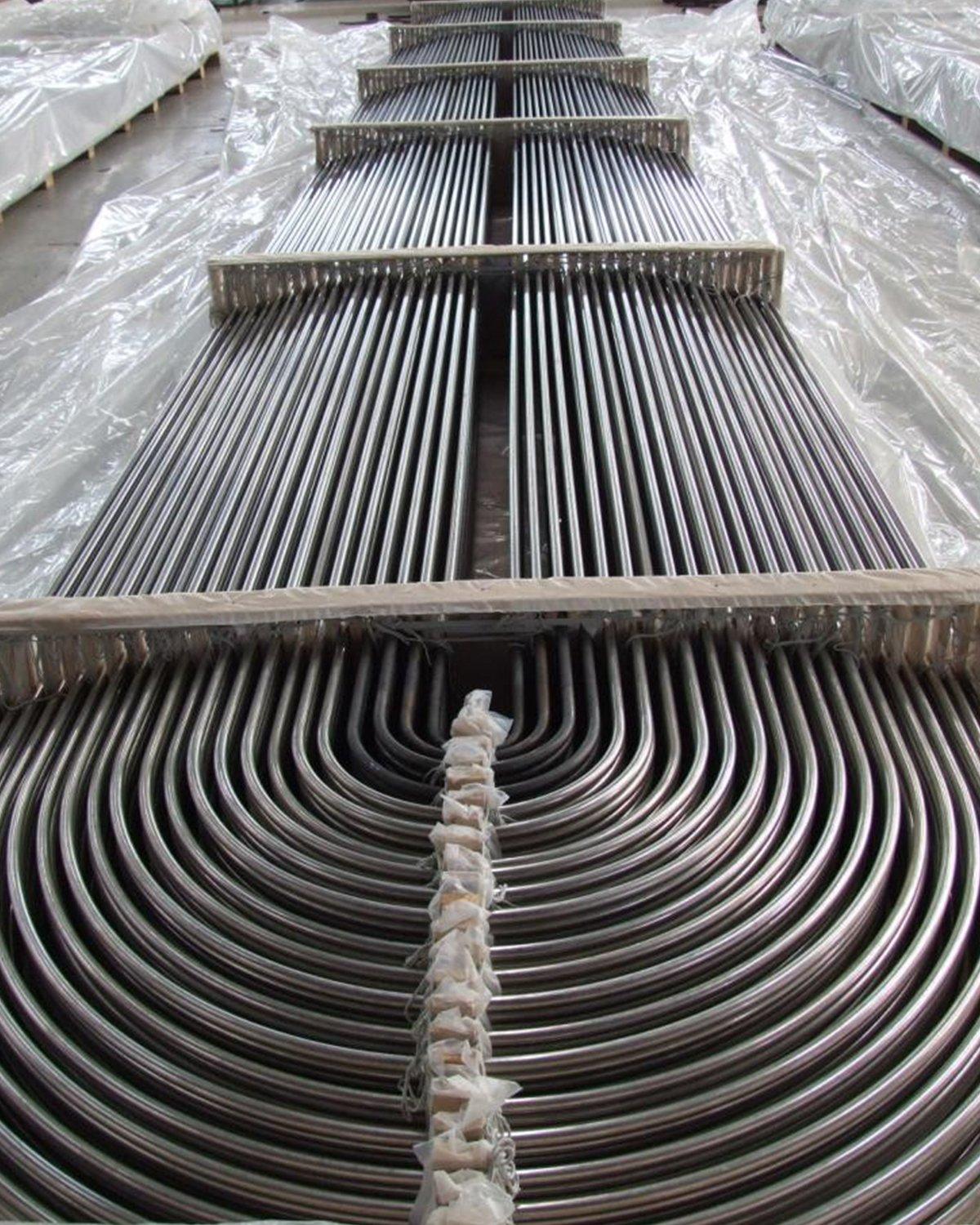
Most steel tube in a refinery exchanger, a boiler or an HRSG is ordered to one of four ASTM standards. They look interchangeable on a quick read — same sizes, similar names — but they are written for different duties, and swapping one for another changes what the mill must test and guarantee.
/01The carbon steels.
| Grade | C % | Mn % | Min tensile | Min yield | Max hardness |
|---|---|---|---|---|---|
| A179 | 0.06–0.18 | 0.27–0.63 | No requirement (hardness-controlled) | — | 72 HRB |
| A192 | 0.06–0.18 | 0.27–0.63 | No requirement (hardness-controlled) | — | 137 HB |
| A210 A-1 | ≤0.27 | ≤0.93 | 415 MPa | 255 MPa | 79 HRB / 143 HB |
| A210 C | ≤0.35 | 0.29–1.06 | 485 MPa | 275 MPa | 89 HRB / 179 HB |
A179 is the default exchanger and condenser tube and the usual base tube for finned air-cooler bundles. It is cold drawn and heat treated after the final draw so it can be expanded into a tube sheet, and it is tested by flattening, flaring, flange, hardness and hydrostatic tests. A192 has the same carbon and manganese range and adds a silicon limit; it is made for boiler and superheater tubes at high pressure. A210 is medium-carbon tube with real strength minimums: Grade A-1 at 415 MPa tensile and Grade C at 485 MPa, used for boiler, economiser and water-wall tube.
/02The alloy steels under A213.
| Grade | UNS | Cr % | Mo % | Min tensile | Min yield |
|---|---|---|---|---|---|
| T11 | K11597 | 1.00–1.50 | 0.44–0.65 | 415 MPa | 205 MPa |
| T12 | K11562 | 0.80–1.25 | 0.44–0.65 | 415 MPa | 220 MPa |
| T22 | K21590 | 1.90–2.60 | 0.87–1.13 | 415 MPa | 205 MPa |
| T5 | K41545 | 4.00–6.00 | 0.45–0.65 | 415 MPa | 205 MPa |
| T9 | K90941 | 8.00–10.00 | 0.90–1.10 | 415 MPa | 205 MPa |
| T91 | K90901 | 8.00–9.50 | 0.85–1.05 | 585 MPa | 415 MPa |
Chrome-moly grades raise creep strength and oxidation resistance as the metal temperature rises: T11 and T12 for moderate superheater temperatures, T22 above them, T5 and T9 where sulphidation matters in fired heaters, and T91 for the hottest superheater and reheater sections. T91 is supplied normalised and tempered — never annealed — and its tempering must be controlled in fabrication. A213 also covers austenitic stainless tube, compared in stainless exchanger tube grades.
/03Testing.
Under the general requirements (ASTM A450 for carbon tube, A1016 for alloy and stainless), each tube is hydrostatically tested or given an electric non-destructive test at the mill’s option unless the order says which. Some mills recommend combining ultrasonic and eddy-current testing for A209 and A213. If the project wants both, or 100 % eddy current, write it on the order.
/04Choosing.
- Shell-and-tube exchanger or condenser, carbon steel: A179.
- Boiler tube at high pressure, low carbon: A192.
- Boiler, economiser or water wall needing a strength minimum: A210 A-1 or C.
- Superheater, reheater or fired-heater coil at high metal temperature: A213 T11, T22, T5, T9 or T91, per the design.
European equivalents (P235GH, P265GH, 16Mo3, 13CrMo4-5, 10CrMo9-10) are in DIN to EN 10216. Cross-references are indicative; we check each against the tender.
Common questions
- Can A192 replace A179?
- The chemistry is almost the same, but the standards differ in purpose and tests. Substitute only with the purchaser’s or designer’s approval.
- What is the minimum tensile strength of A179?
- A179 has no mandatory minimum tensile strength; hardness (72 HRB maximum) controls it.
- What is the difference between A210 A-1 and C?
- Grade C has more carbon and manganese allowed and higher minimums: 485 MPa tensile and 275 MPa yield, against 415 and 255 MPa for A-1.
- Is T91 annealed?
- No. T91 is normalised and tempered; annealing is not permitted.
- Which standard covers alloy boiler tube?
- ASTM A213 for ferritic alloy grades such as T11, T22 and T91, with A209 for carbon-molybdenum T1 grades.