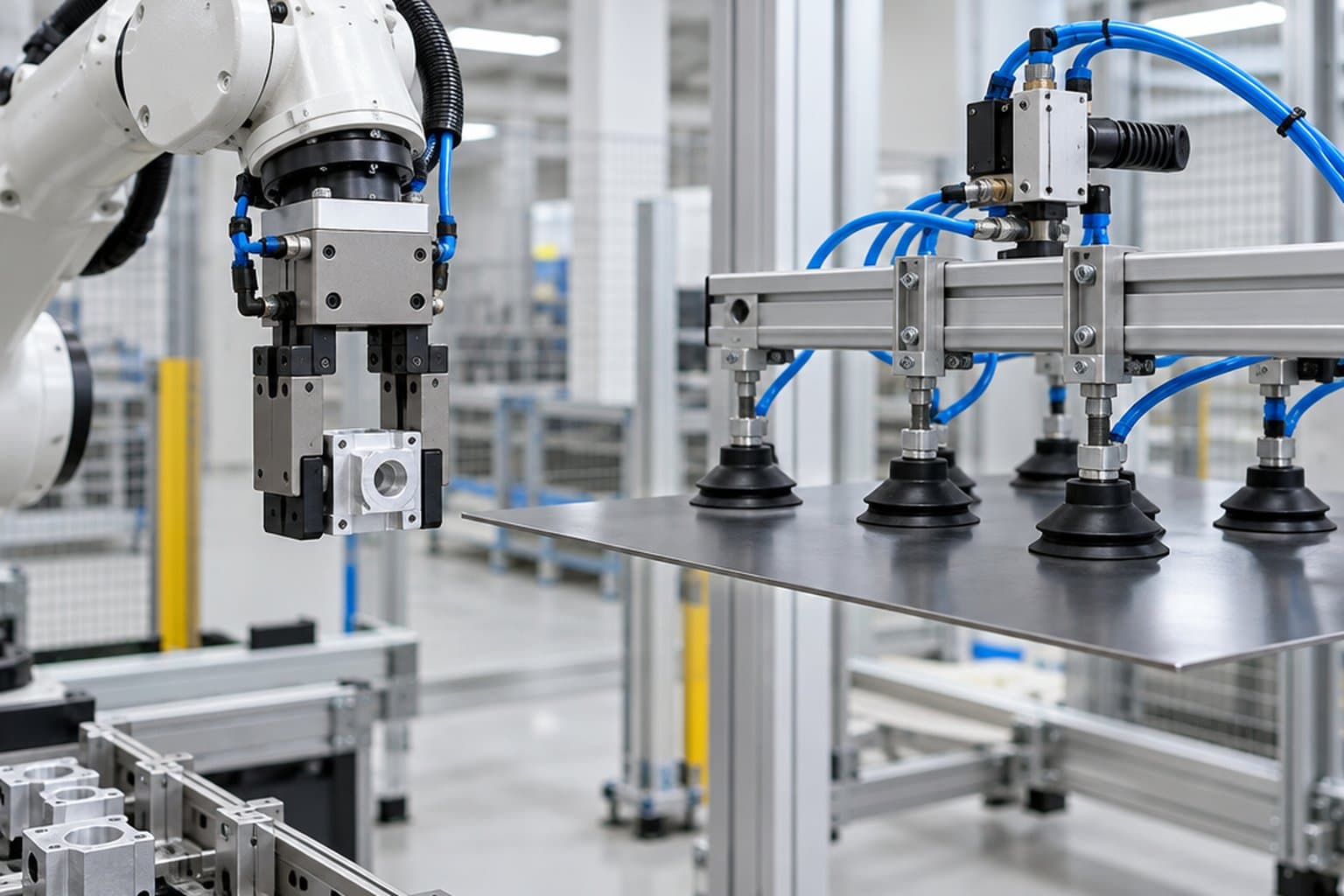
A pick-and-place station holds a part with jaws or with a vacuum cup. Both fail by dropping the part when the robot accelerates, and both are sized the same way: from the worst case, with the maker’s safety factor, at the conditions you will actually run. This guide uses the rules SMC, Parker, Destaco and Schunk publish.
/01Parallel, angular or three-jaw.
Parallel grippers move both jaws in a straight line, towards or away from each other, so the fingers stay parallel through the whole stroke. They are the general-purpose choice, and Parker shows the friction grip, flat faces squeezing the part, on a parallel gripper. Most Destaco ranges on our shelf are parallel, and the titles name the variant: sealed (RPS, RP-5-10, RP-11-19), long stroke (RPR, DPL), long finger (DPW, DPP) or wide body (RPW). Destaco designs its DPG series for CNC machining and harsh, chip-laden environments.
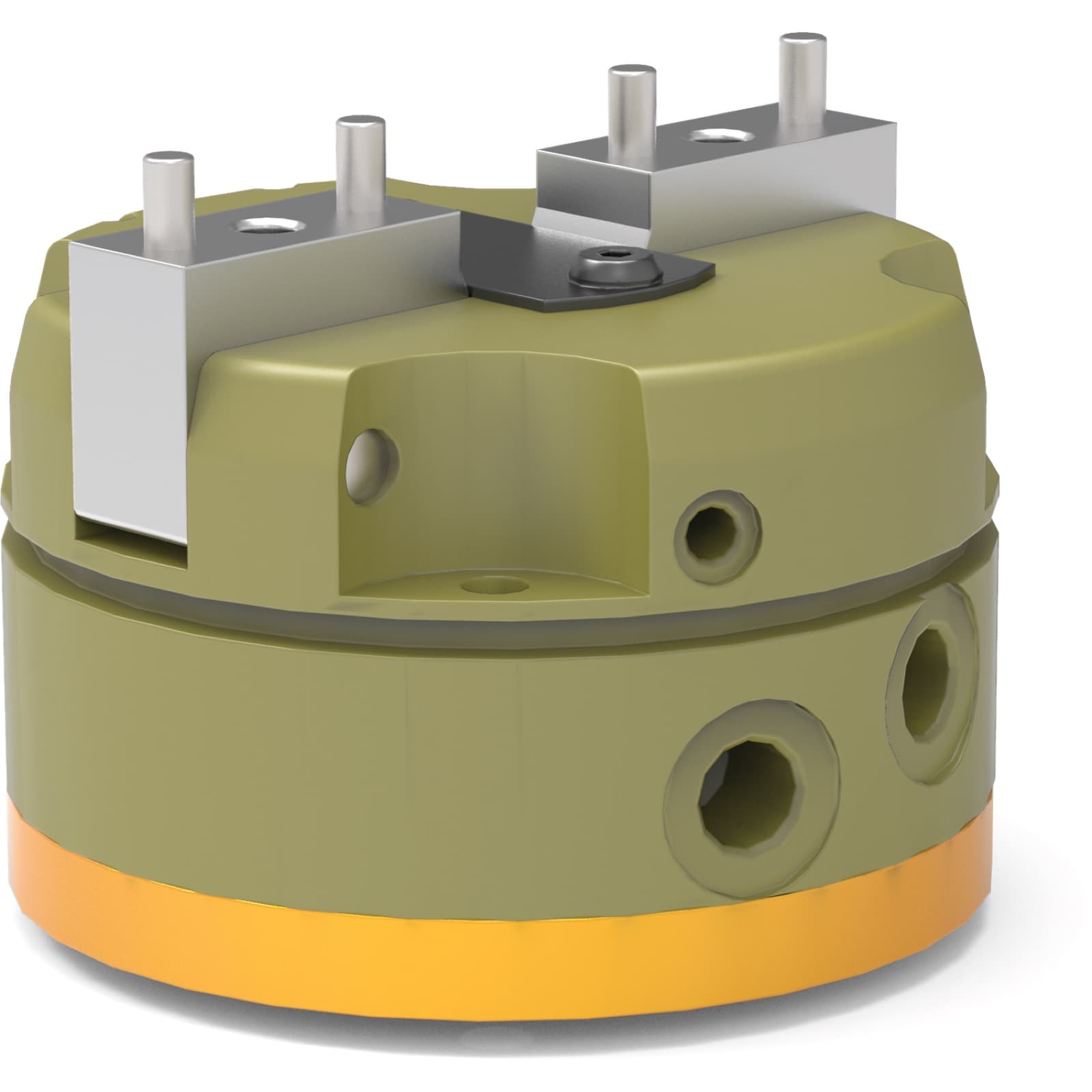
Angular grippers pivot each jaw about a pin, so the fingertips travel in an arc. Parker illustrates the encompassing grip, where the fingers cradle the part, on an angular gripper. Parker builds 30° and 180° wide-angle types; SMC’s MHC2 is a compact angular gripper, double acting or single acting (normally open).
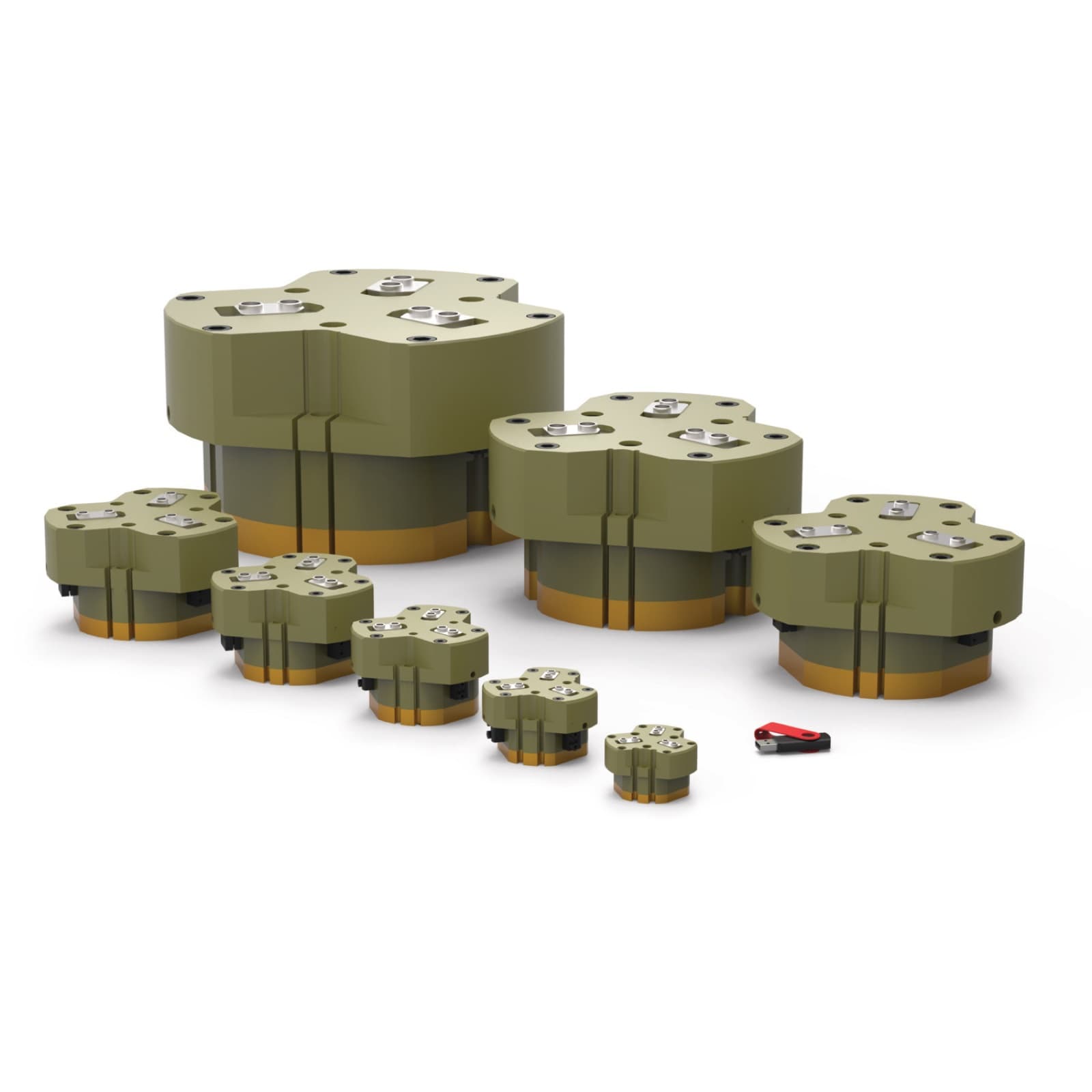
Three-jaw grippers close three fingers at 120° on a common centre, so a round part is centred on the gripper axis as it is gripped. With three fingers the friction arithmetic changes: SMC’s guidance for its three-finger MHS3 is a grip force of roughly 7 to 13 times the workpiece weight, against 10 to 20 times for two fingers.
The shelf also carries special-purpose Destaco families: 84-series and GR84 pressroom and sheet-metal grippers, DBG bag grippers, ARV vacuum grippers, and RR and other rotary actuators.
| Style | Jaw motion | Typical grip | Good for | Examples on our shelf |
|---|---|---|---|---|
| Parallel, 2-jawHighlighted | Straight line, fingers stay parallel | Friction (flat faces) or shaped fingers | General pick-and-place, varied widths, machine tending | Destaco RPS, RDH, DPG, DPDS, RPW, RPR, 2P |
| Angular, 2-jaw | Jaws pivot through an arc | Encompassing (fingers cradle the part) | Compact, light tasks; wide-angle types swing clear of the part | Destaco RUA, CT/DCT, FUA, RA, toggle-locking angular |
| Three-jaw | Three fingers close on one centre | Centring grip on round parts | Shafts, discs, turned parts | Destaco 3P, RPC, RTH 3-jaw |
| Vacuum pad | None; atmospheric pressure holds the part | Suction on one face | Sheet, cartons, glass, flat or gently curved faces | SMC ZP and pad ranges, Value Line pads |
/02Sizing the grip force.
Friction grip versus encompassing grip
Parker separates the two cases. In a friction grip only friction between finger faces and part holds it. Parker gives a typical coefficient of friction of 0.2 to 0.4 and says a friction grip can need as much as four times the force of an encompassing grip doing the same job. In an encompassing grip the fingers cradle the part, which cannot move unless they are forced open; Parker calls this more stable and safer.
The makers’ formulas
SMC states the condition for a two-jaw friction grip as 2 × μ × F > mg, then multiplies by a safety margin a:
F = mg ÷ (2 × μ) × a
where F is the gripping force (N), μ the coefficient of friction between the attachments and the workpiece, m the workpiece mass (kg) and g = 9.8 m/s². SMC sets a = 4, which it says allows for the impacts of normal transport. That gives 10 × mg at μ = 0.2 and 20 × mg at μ = 0.1. SMC recommends staying at 10 to 20 times the weight even when friction is higher than 0.2, and adding more margin for high acceleration or impact.
Parker works in pounds and adds the acceleration force first. Its example is a 20 lb part accelerated at 0.5 g, giving 20 + (20 × 0.5) = 30 lbf. Parker then applies a factor of safety of 4 for a friction grip (120 lbf) or 1.25 for an encompassing grip (37.5 lbf). The Destaco product pages we read give grip force, pressure range and maximum finger length per model, but no safety factor.
Grip force depends on finger length and pressure
A gripper’s rated force is measured at a stated gripping point and pressure. SMC’s effective-gripping-force graphs plot force against the gripping-point distance L, one curve per supply pressure. Force falls as L grows and rises with pressure. In SMC’s example an MHC2-6D gives 1.25 N at L = 25 mm and 0.4 MPa, 12.7 times the weight of a 0.01 kg part, so it passes. The gripping point must stay inside the range on the graph.
Parker gives the reason: longer tooling deflects more and loses grip force, and the load acts on a longer lever arm, so grip as close to the gripper body as possible. Destaco publishes a maximum finger length for every model: 3 in on the RPS-11M, 4 in on the RPS-12M, and 5 in on the DPG-10M-4. Read the grip force at your real finger length and lowest line pressure.
/03Holding on when the air goes.
A double-acting gripper holds its part only while air pressure holds the jaws closed. If the supply fails, a hose is cut or an emergency stop dumps the air, the grip goes too. There are three ways to keep it:
- Spring assist. Destaco lists spring assist as an option on ranges including RPS and DPG. On RDH it publishes a higher grip force with spring assist than without. Springs also change the operating range: Destaco gives 50–100 psi for RDH with springs, so check the minimum pressure as well as the force.
- Spring-closed (single-acting) grippers. Parker builds both spring-open and spring-closed versions. SMC’s MHC2 comes in a single-acting, normally open version. Choose the spring direction that holds the part: spring-closed for an external grip, spring-open for an internal grip, where the jaws expand inside a bore.
- Gripping-force maintenance. Schunk’s AS/IS option is a mechanical device that keeps a minimum gripping force if the pressure drops. AS works in the closing direction and IS in the opening direction.
A spring holds the part. It does not make the machine safe to enter. Treat it as protection against dropping the part, and keep your guarding and lockout as they are.
/04Vacuum: ejector or pump, and which pad.
Generating the vacuum
A vacuum ejector (venturi or vacuum generator) blows compressed air through a nozzle and the jet draws vacuum at a side port. It has no moving parts, but uses compressed air for as long as it runs. A vacuum pump makes vacuum with its own motor and uses no compressed air; SMC’s pump circuit adds a vacuum regulator.
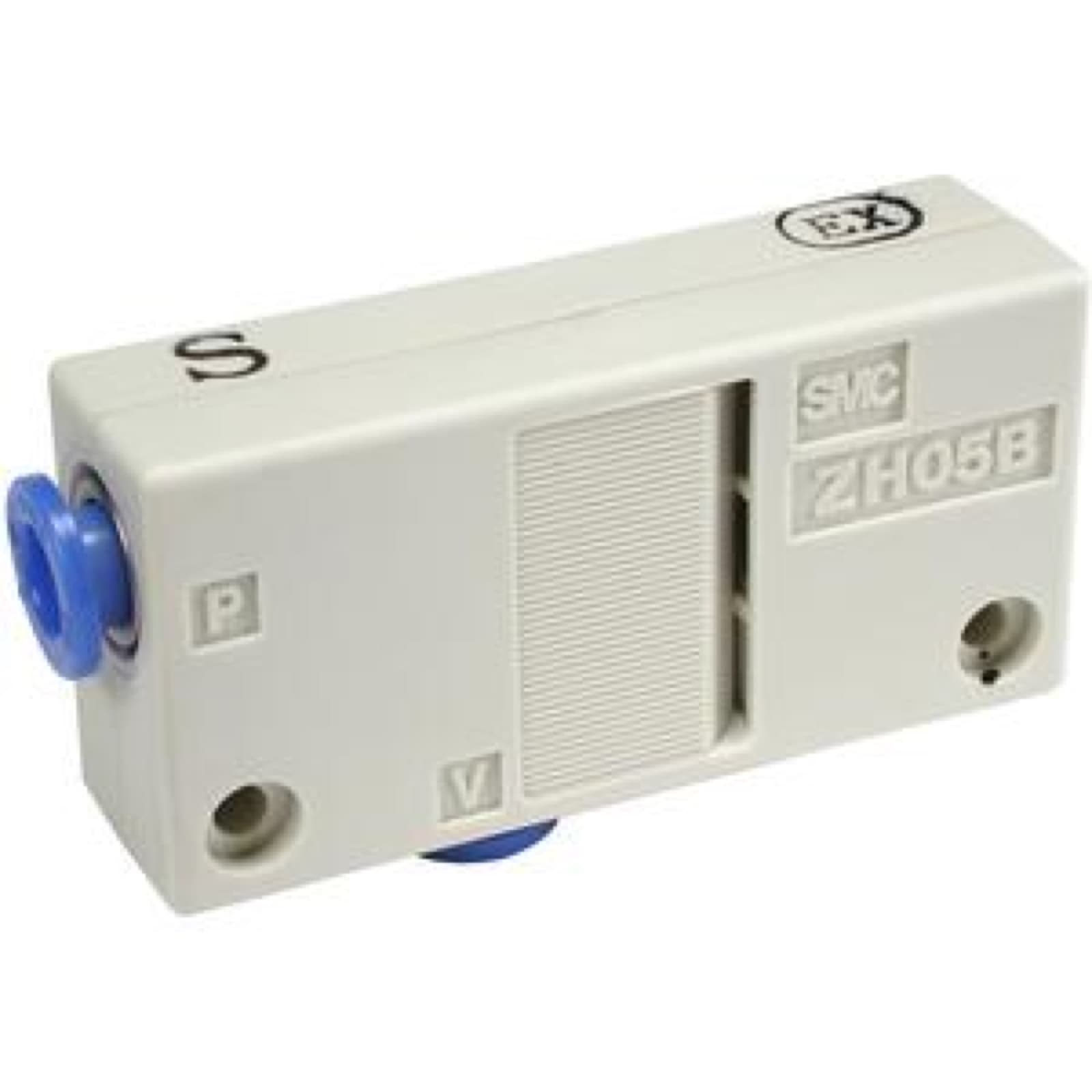
SMC says two questions decide which ejector to use. First, is a simple ejector enough (its ZU or ZH types, which are smaller and lighter), or do you need one with built-in valves and a vacuum switch? Second, how much suction flow do you need? More flow evacuates the system faster, but the ejector is larger and uses more air. On our shelf:
- SMC ZH is SMC’s single-stage, body-ported ejector. Its S (high-vacuum) type reaches −90 kPa. Its L (high-flow) type reaches −48 kPa but gives roughly twice the suction flow from the same nozzle.
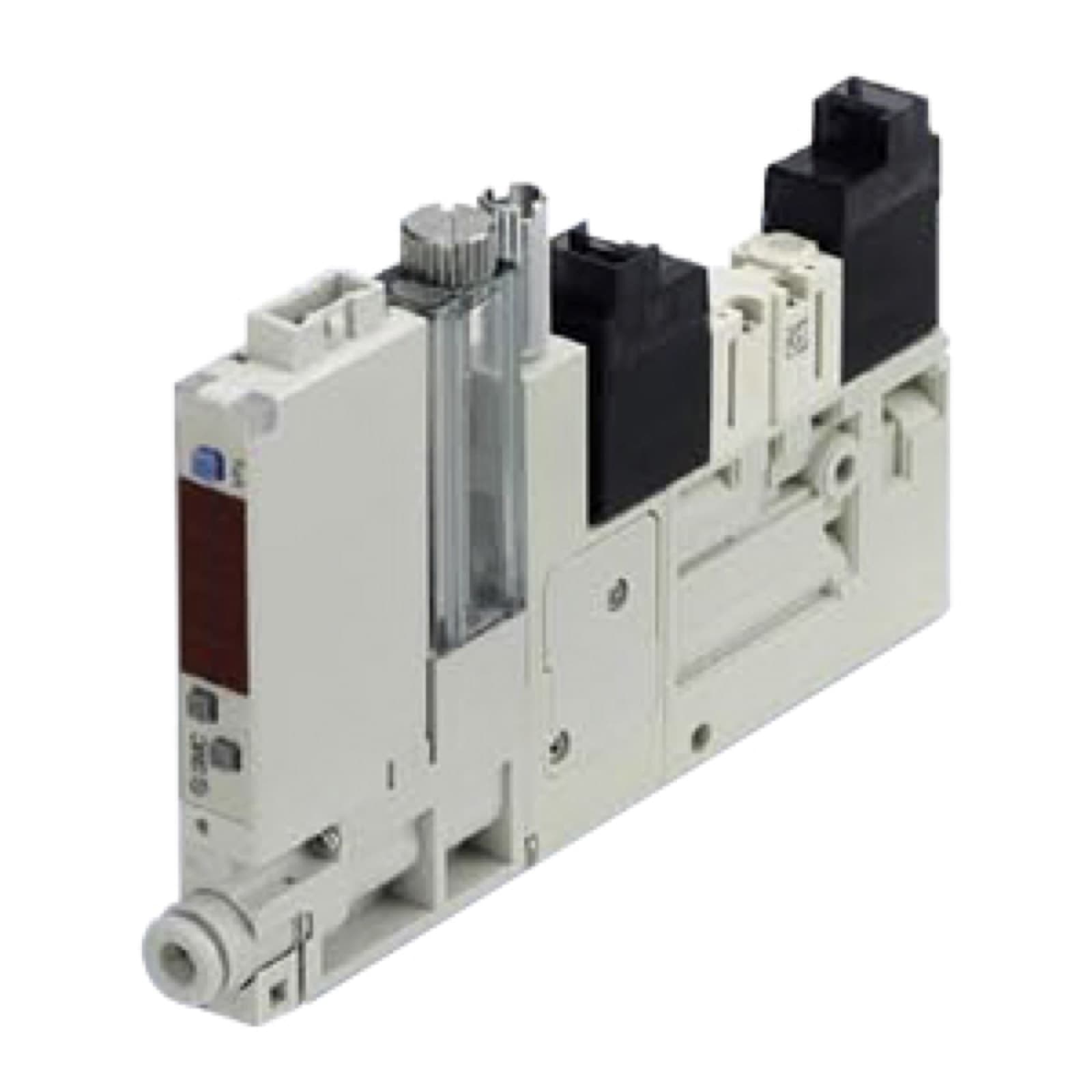
- SMC ZQ is a compact unit with a supply valve, release valve, vacuum switch and suction filter built in, rated to −80 kPa.
SMC’s integrated units with an energy-saving function close the supply valve once the switch sees the set vacuum. A check valve then holds the vacuum, and the unit restarts only when vacuum decays. SMC claims up to 93% less air use on its ZK2 units.
Units: 1 inHg = 3.386 kPa, so −80 kPa is about 23.6 inHg and −90 kPa about 26.6 inHg.
Choosing the pad
SMC’s selection table matches the pad form to the workpiece:
| Pad form | SMC: use when… | On our shelf |
|---|---|---|
| FlatHighlighted | The suction surface is flat and the workpiece will not deform | SMC Vacuum Pad Flat 6, 8, 32 and 50 mm; SMC Vacuum Pad, Flat |
| Flat with ribs | The workpiece is likely to deform, or must release cleanly | SMC Vacuum Pad, Flat With Ribbons |
| Deep | The workpiece is curved | SMC Vacuum Pad Deep 10 and 25 mm |
| Bellows | There is no room for a buffer, or the suction surface is slanted | SMC Vacuum Pad Bellows |
| Oval | The suction area is narrow or long, or the part must be located precisely | Within the SMC ZP and pad ranges |
SMC adds that bellows also take up height differences, and that ribs stop the pad deforming under heavy or flexible parts. Pick the pad rubber (NBR, silicone, urethane, FKM, conductive grades) for the part and the environment, not only for grip.
/05Sizing a vacuum pad.
SMC’s lifting-force equation is:
W = P × S × 0.1 ÷ t
where W is the lifting force (N), P the stable vacuum pressure (kPa, as a positive number), S the pad area (cm²) and t the safety factor. SMC sets t at 4 or more for a horizontal lift, with the pad on top of the part and the load hanging below it, and 8 or more for a vertical lift, where the pad holds a vertical face and the load acts along the face of the pad. The theoretical force is static, so the factor must cover real operating conditions. Rearranged for a horizontal lift with t = 4, this becomes SMC’s quick formula S = 40W ÷ P. SMC assumes −80 kPa for most applications, but use the vacuum your generator actually holds with the part on the pad.
Worked example
SMC’s own example lifts a 20 kg workpiece (196 N) on five pads at −60 kPa, which is 39.2 N per pad. For a horizontal lift at t = 4, each pad needs S = 39.2 × 4 ÷ (0.1 × 60) ≈ 26.1 cm². That is a diameter of about 58 mm, so the next standard size up in SMC’s table is Ø63 (31.2 cm²). Lift the same part from a vertical face and t doubles to 8, so you need twice the pad area.
Smaller sizes from SMC’s table: Ø10 mm 0.79 cm², Ø32 8 cm², Ø50 19.6 cm². At −60 kPa and t = 4, one Ø32 pad lifts 12 N, about 1.2 kg, horizontally.
Leak-tight versus porous loads
The equation assumes a sealed contact, as with glass, sheet metal or plastic mouldings. Cardboard, timber, fabric and perforated sheet leak air through or around the pad, and vacuum settles wherever the generator’s suction flow can hold it against the leak. SMC’s guidance covers leakage from the workpiece and an adsorption test with the real part. In practice:
- Choose by suction flow, not ultimate vacuum. A high-flow ejector such as SMC’s ZH L-type holds a porous part better than a high-vacuum type of the same nozzle size, even though its rated maximum vacuum is lower.
- Size the pad on the vacuum measured with the part on, which will be well below the data-sheet maximum.
- Use a vacuum pressure switch to confirm the part is held before the robot moves.
- If dust or liquid can be drawn in, SMC fits a filter or water separator to protect the ejector, which matters on a humid site.
Jaws or vacuum?
IfFlat, smooth, non-porous face, and the part is too thin or fragile to grip by the edges?
Vacuum pad: flat, or ribbed if the part flexes.
IH-SMC-VACUUM-PAD-FLATIfCurved surface, or heights vary between parts?
Deep pad for curves; bellows pad for slants and height differences.
IH-SMC-VACUUM-PAD-BELLOWSIfPorous or perforated part?
Vacuum with a high-flow ejector, sized from an adsorption test, or a gripper if the part has gripping faces.
IfRound part that must end up centred?
Three-jaw gripper.
IH-DST-RTH-SERIES-3-JAW-PARALLEL-GRIPPERSIfHeavy part, high acceleration, or must not drop on loss of air?
Parallel gripper with encompassing fingers and spring assist.
IH-DST-RDH-SERIES-RUGGED-MULTI-PURPOSE-PARALLEL-GRIPPERS
/06What we list.
Our grippers and actuators shelf is Destaco: parallel, angular and three-jaw grippers, pressroom and sheet-metal grippers, bag grippers and rotary actuators. Every range is listed by maker part number:
- Destaco 2P Series 2-Jaw Precision Parallel Grippers
- Destaco 2P Series Parallel Grippers
- Destaco 3P Series 3-Jaw Parallel Grippers
- Destaco 3P Series Parallel Grippers
- Destaco 84A2 Series Modular Cam-Style Pressroom Grippers
- Destaco 84A3 Series Modular Cam-Style Pressroom Grippers
- Destaco 84L3-1 Series Modular Cam-Style Pressroom Grippers
- Destaco 84N5 Series Universal Sheet Metal Press Shop Grippers
- Destaco Angular Grippers With Toggle Locking Mechanism
- Destaco ARV Vacuum Grippers
- Destaco Cam Driven Angular Grippers
- Destaco CP Series Parallel And Extended Grippers
- Destaco CT/DCT Series 2-Jaw Angular Grippers
- Destaco DBG Series Bag Grippers
- Destaco DCT Series Angular Grippers
- Destaco DGC Series 2 Jaw Precision Parallel Grippers
- Destaco DGC-GC Series Parallel Grippers
- Destaco DPDL Series General Purpose Parallel Grippers, Modular
- Destaco DPDL Series Parallel Grippers
- Destaco DPDS Series Compact Robust Parallel Grippers
- Destaco DPDS Series Parallel Grippers
- Destaco DPE Series Electric Parallel Grippers, 2-Jaw
- Destaco DPG Series General Purpose Parallel Grippers, Modular, Multi-Position Sensing
- Destaco DPG Series Parallel Grippers
- Destaco DPL Series High Grip Force Parallel Grippers, Long Stroke
- Destaco DPP Series Parallel Grippers
- Destaco DPP Series Precision Long Finger Parallel Grippers
- Destaco DPW Series Long Finger Parallel Grippers
- Destaco DPW Series Parallel Grippers
- Destaco FUA Series 2-Jaw Angular Grippers
- Destaco G110 Series Grippers
- Destaco G110 Series Parallel Grippers
- Destaco G120 Series Grippers
- Destaco G120 Series Parallel Grippers
- Destaco GR84 Series Modular Mini-Sheet Grippers With Self-Locking Linkage
- Destaco Parallel Grippers
- Destaco Pneumatic Grippers
- Destaco PPC Series Multipurpose Parallel Grippers
- Destaco RA Series Cam Driven Angular Grippers
- Destaco RDH Series Parallel Grippers
- Destaco RDH Series Rugged Multi-Purpose Parallel Grippers
- Destaco REP Series Parallel Grippers
- Destaco REP-2 Series Cam Lever Parallel Grippers
- Destaco REP-3 Series Multipurpose Parallel Grippers
- Destaco Rotary Actuators
- Destaco RP Series Parallel Grippers
- Destaco RP-11-19 Series Sealed Parallel Grippers
- Destaco RP-5-10 Series Sealed Parallel Grippers
- Destaco RP-P Series Precision Parallel Grippers
- Destaco RPB Series Parallel Grippers
- Destaco RPC Series 3 Jaw Parallel Grippers
- Destaco RPC Series Self-Centering Parallel Grippers
- Destaco RPL Series Parallel Grippers
- Destaco RPLC Series Parallel Grippers
- Destaco RPM Series Parallel Grippers
- Destaco RPMC Series 2 Jaw Parallel Grippers
- Destaco RPR Series Long Stroke Parallel Grippers
- Destaco RPS Series Parallel Grippers, Sealed
- Destaco RPW Series Parallel Grippers
- Destaco RPW Series Parallel Grippers, Wide Body
- Destaco RR Series Rotary Actuators
- Destaco RTH Series 3 Jaw Parallel Grippers
- Destaco RTH Series Multi-Purpose Powerful Parallel Grippers
- Destaco RTH Series Parallel Grippers
- Destaco RUA Series Angular Grippers, 2-Jaws
Our vacuum shelf is mostly SMC ejectors, pads, switches, regulators and separators, with other makers’ vacuum generators, pads and adapters, regulators, and filters and liquid separators for vacuum pump lines:
- Cash Valve D51 Series Vacuum Regulators
- Gast Filter Elements
- Gast Vacuum Generators
- SMC Vacuum Ejector, Single
- SMC Vacuum Ejectorline
- SMC Vacuum Ejectors
- SMC Vacuum Generator
- SMC Vacuum Pad
- SMC Vacuum Pad Assembly
- SMC Vacuum Pad Bellows
- SMC Vacuum Pad Deep 10mm
- SMC Vacuum Pad Deep 25mm
- SMC Vacuum Pad Flat 32mm
- SMC Vacuum Pad Flat 50mm
- SMC Vacuum Pad Flat 6mm
- SMC Vacuum Pad Flat 8mm
- SMC Vacuum Pad, Flat
- SMC Vacuum Pad, Flat With Ribbons
- SMC Vacuum Pressure Switch
- SMC Vacuum Regulator
- SMC Vacuum Water Separator
- SMC ZH Series Vacuum Ejector
- SMC ZP Series, Vacuum Pad
- SMC ZQ Series Vacuum Ejector
- Solberg EF Series Small Vacuum Pump Oil Mist Filters
- Solberg HDL Series Discharge Oil Mist Filters, 1-2 1/2 Inch
- Solberg HDL Series Discharge Oil Mist Filters, 3-4 Inch, DN125 - DN200
- Solberg HDL Series Discharge Oil Mist Filters, 3-8 Inch
- Solberg LRS Series Right Angle Liquid Separators
- Value Line Vacuum Generators
- Value Line Vacuum Pad Adapters
- Value Line Vacuum Pads
Common questions
- What is the difference between a parallel and an angular gripper?
- A parallel gripper moves its jaws in a straight line, so the fingers stay parallel. An angular gripper pivots its jaws through an arc and suits fingers shaped to cradle the part.
- How do you calculate gripper force?
- SMC uses F = mg ÷ (2μ) × a for a two-jaw friction grip, with a safety margin a of 4. That works out at 10 to 20 times the workpiece weight. Parker adds acceleration force to the weight, then multiplies by 4 for a friction grip or 1.25 for an encompassing grip.
- Will a pneumatic gripper hold its part if air pressure is lost?
- A plain double-acting gripper will not. Spring-assist options (Destaco), spring-closed grippers (Parker) and gripping-force maintenance (Schunk AS/IS) keep a grip force when pressure drops.
- How do you size a vacuum suction cup?
- SMC uses W = P × S × 0.1 ÷ t: lifting force in N, vacuum in kPa, pad area in cm², and a safety factor t of at least 4 for a horizontal lift and 8 for a vertical one.
- Should I use a vacuum ejector or a vacuum pump?
- An ejector runs on compressed air with no moving parts, but uses air while it runs; energy-saving units shut off once vacuum is reached. A pump has its own motor and uses no compressed air.
- What vacuum level do suction cups need?
- SMC’s quick formula assumes −80 kPa (about 23.6 inHg). Its ZH high-vacuum ejectors reach −90 kPa and its high-flow types −48 kPa. Size on the vacuum your system actually holds with the part on the pad, which is lower on porous parts.
Grippers, ejectors and pads
- IH-DST-RPS-SERIES-PARALLEL-GRIPPERS-SEALEDDestaco RPS Series Parallel Grippers, SealedDestaco
- IH-DST-DPG-SERIES-GENERAL-PURPOSE-PARALLEL-GRIPPERS-MODUDestaco DPG Series General Purpose Parallel Grippers, Modular, Multi-Position SensingDestaco
 IH-DST-RUA-SERIES-ANGULAR-GRIPPERS-2-JAWSDestaco RUA Series Angular Grippers, 2-JawsDestaco
 IH-DST-RTH-SERIES-3-JAW-PARALLEL-GRIPPERSDestaco RTH Series 3 Jaw Parallel GrippersDestaco
 IH-SMC-ZH-SERIES-VACUUM-EJECTORSMC ZH Series Vacuum EjectorSMC
 IH-SMC-ZQ-SERIES-VACUUM-EJECTORSMC ZQ Series Vacuum EjectorSMC
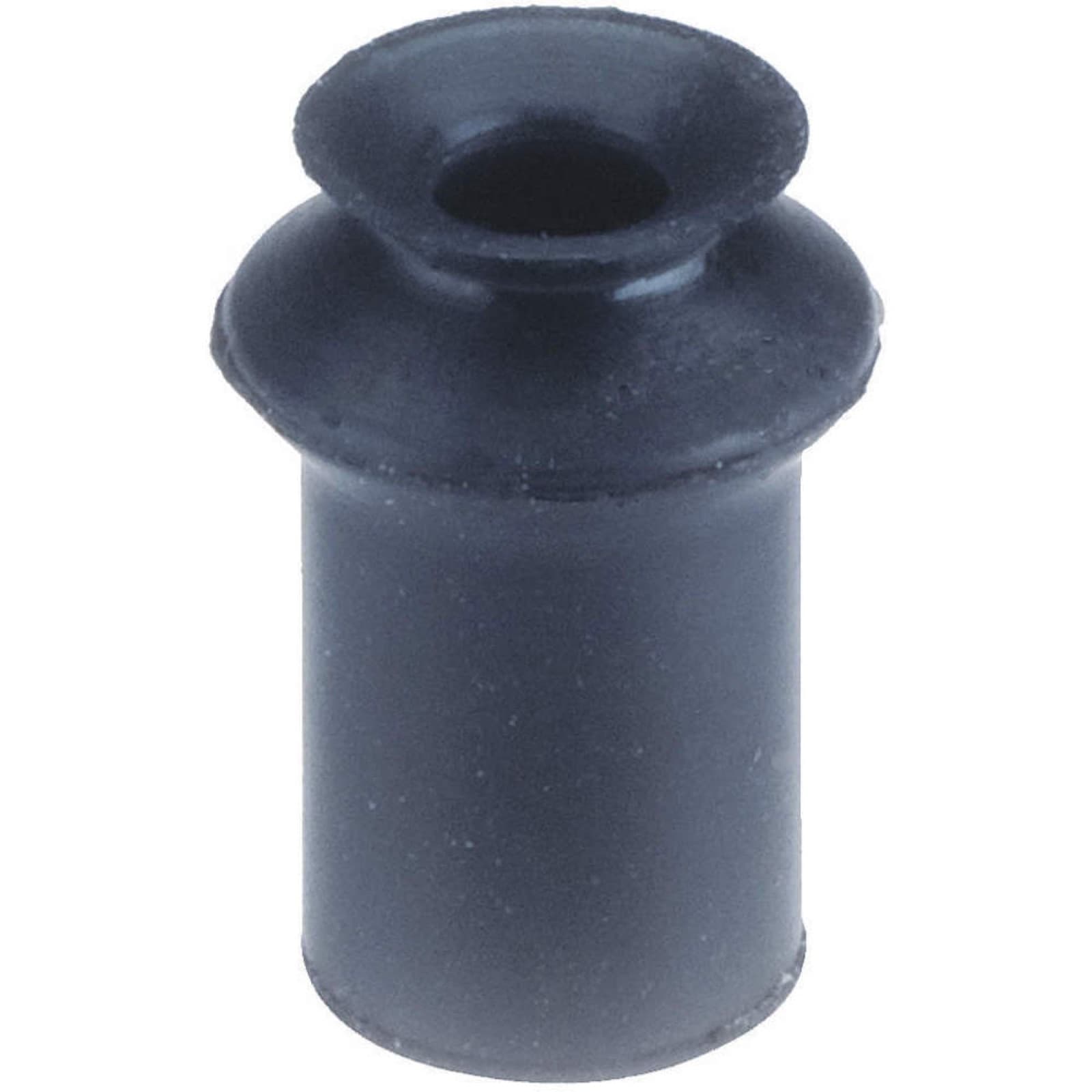 IH-SMC-VACUUM-PAD-BELLOWSSMC Vacuum Pad BellowsSMC
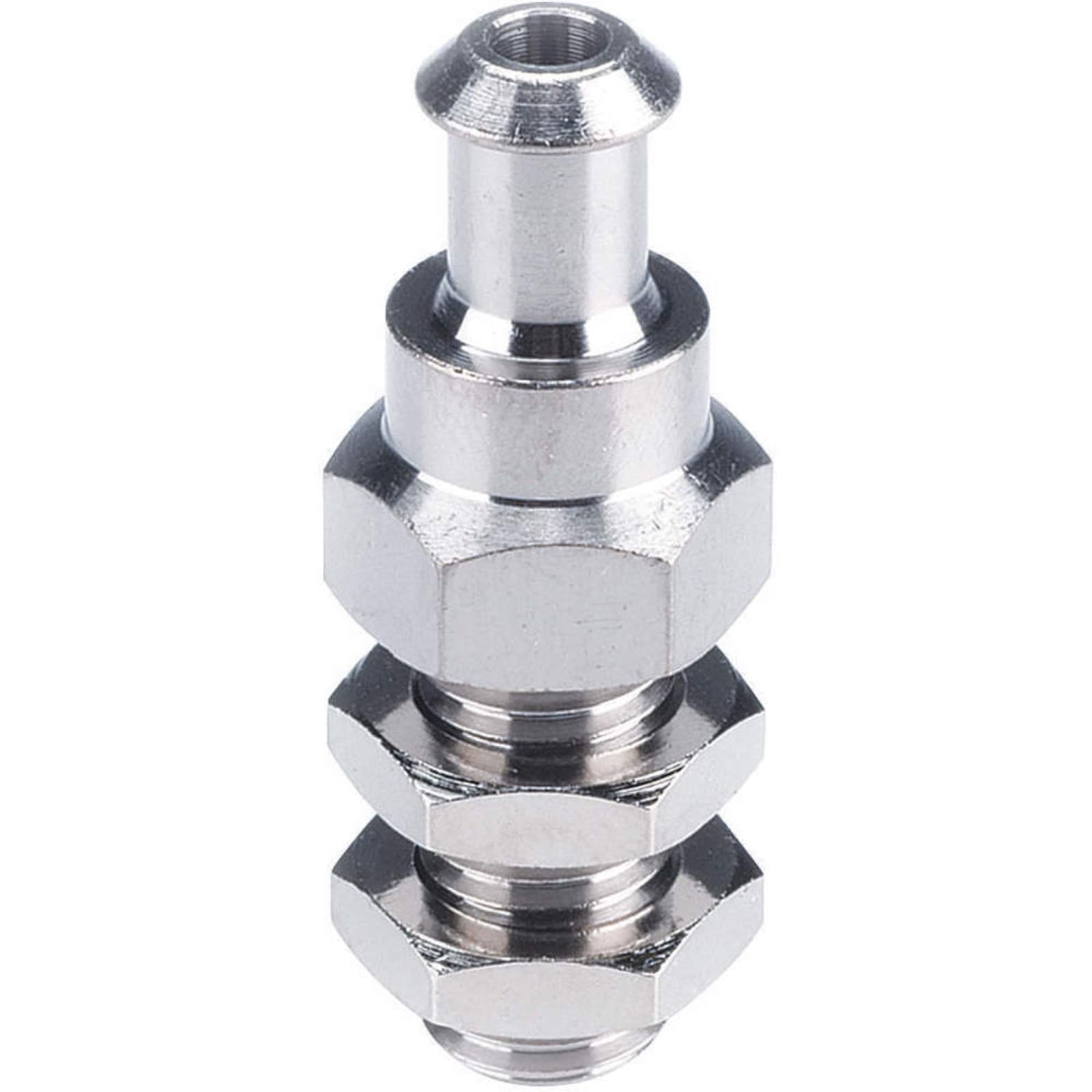 IH-SMC-ZP-SERIES-VACUUM-PADSMC ZP Series, Vacuum PadSMC