
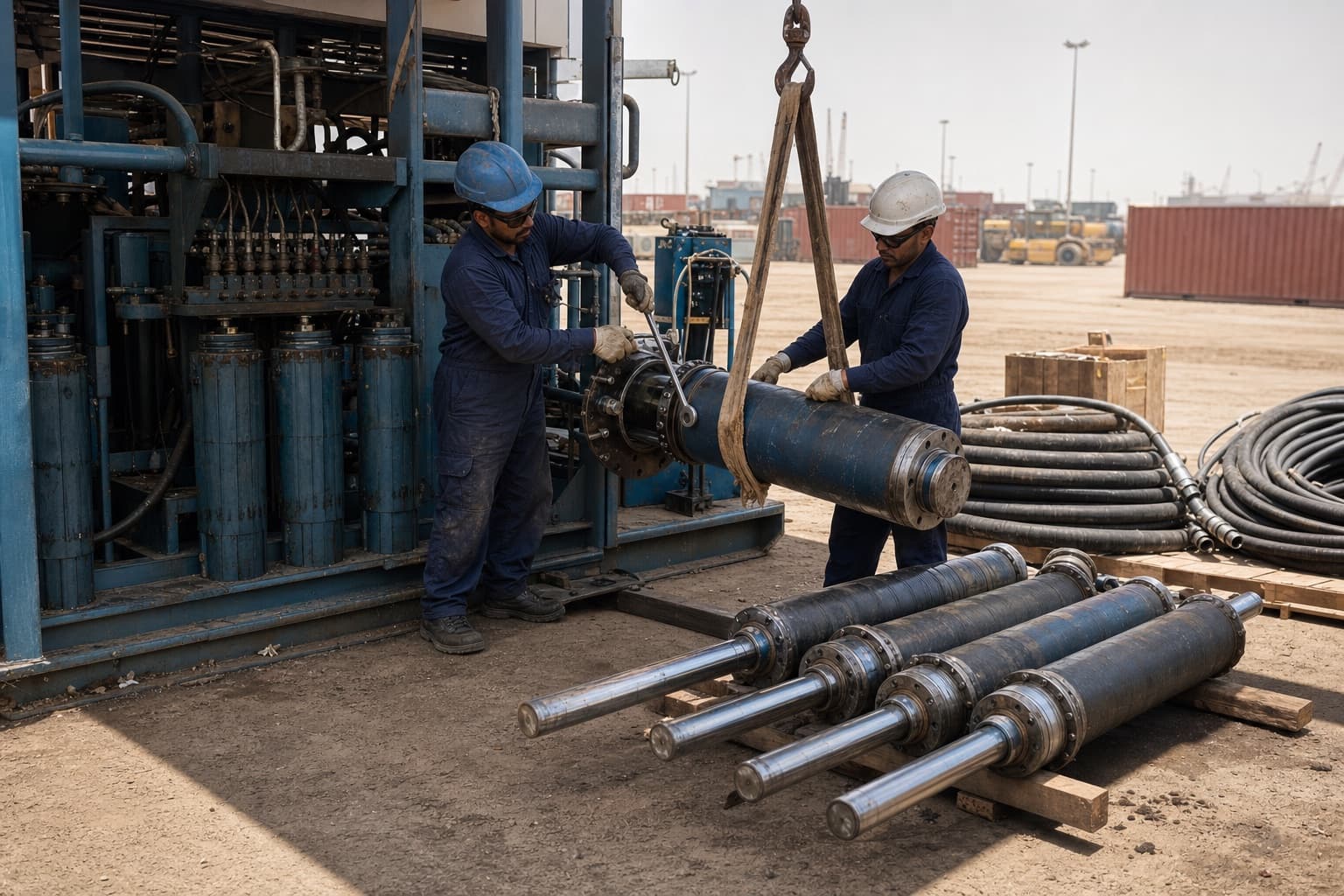
The problem on the rig.
The call came in at 22:14 on a Sunday. A 50,000-lb hydraulic workover unit had been pulled off a sour-gas well in the Rub’ al Khali because two main jack cylinders were weeping at the gland and a 1″ pressure hose had ruptured at the swage. The client had a slot booked at Habshan in three weeks. The clock was already running.
By Monday morning a transporter was rolling the unit into our Jebel Ali yard. The story we got was: “seal kits, please.” The story the unit told, once it was in the bay, was longer than that. Three of the four jack cylinders were out of straightness. Six hoses had cover degradation consistent with ambient temps north of 55 °C and a year on a rig without UV shrouds. The accumulator pre-charge file hadn’t been updated since the 2024 rainy season — there isn’t one in Abu Dhabi, but you know what we mean.
“Weeping seals, one burst hose — seal kits, please.”
Two jack cylinders weeping at the gland, one pressure hose ruptured at the swage. Operator wanted a 5-day seal-and-swap and back on hire. They asked for parts. They did not ask for an engineer.
Three bent rods, 96 hoses end-of-life, recerts overdue
Rod straightness out on 3/4 jacks. Hose covers cracked across the boom run. Accumulator nitrogen + relief valves out of recert by 7 months — we couldn’t legally re-skid the unit on sour service without sign-off.
This is the case for sending an inspection engineer before you send a seal kit. The cheapest version of this job — the one the operator asked for — would have put the unit back on a wellhead with two cylinders that were going to fail inside a month, on a sour-gas job where failure is not a paperwork problem. We didn’t do that. We wrote it up properly, costed three options, and let the customer pick.
What we did instead.
We rebuilt all eight tie-rod cylinders (four jacks, two snubbing, two travelling), replaced 96 hoses across the boom, jack circuit and accumulator manifold, repressurised the four accumulators with traceable nitrogen, and ran a closed-loop function test against the rig’s original commissioning sequence. Nineteen days, end to end, with three of our engineers on-site at JAFZA and two more on the bench in our Jebel Ali shop for the hose end-fitting work. Every assembly went out tagged, every test report sat on the customer’s rig manager’s desk before the unit was loaded.
Every hose was built in-house to EN 856 4SP on the high-pressure circuits, EN 853 2SN on the return and case-drain lines, and API 7K Grade D on the two rotary-line replacements. End fittings are 316 SS with NACE MR0175-compliant elastomers throughout — non-negotiable on sour service, and not a corner you cut to save a day.
You can’t argue with sour service. NACE elastomers, 316 fittings, proof test on every assembly. The minute you cut a corner, you’re betting somebody’s life against three days of schedule.— Khalid Al Marzouqi · Field Lead · Jebel Ali
How we approached it — the four phases.
Every workover-rig hydraulic overhaul we run in the Gulf goes through the same four phases. Names don’t change; the durations vary with how much we find on the bench.
Mobilise & inspect
Engineer on rig within 24 h. Photo log, fluid sample, dimensional survey, recerts audit. Report on operator’s desk inside 48 h.
Quote & PO release
Three-option quote: minimum-fix, recommended, full-recert. Hose schedule attached, with EN/API/SAE specs called out per circuit.
Rebuild & assemble
Cylinders honed, rods chromed, sealed to NACE. 96 hoses built in JAFZA bay. Accumulators re-bladdered, N₂ recharged.
Function-test & release
Closed-loop test vs OEM commissioning sequence. Witnessed by client rep. Sign-off pack: 42 pages, two paper copies on the skid.
The SOP we followed, line by line.
Below is the actual SOP for a tie-rod cylinder & rig-hose overhaul on a sour-service workover unit — abridged. The full SOP-OG-014 runs 46 lines; this is the subset that was ticked off on this job, signed by the QA lead and counter-signed by the customer’s HSE rep.
The numbers, before and after.
Below is what we actually measured on the cylinders and hose population, against OEM and API/EN tolerance. Four cylinder findings and two hose findings would have failed an audit — all six were fixed in Phase 03. Numbers in the as-found column are the worst-case reading per population; after-rebuild is the average across the eight units or 96 hoses.
| Component | Spec | As-found | After rebuild | Status |
|---|---|---|---|---|
| Jack rod straightness (avg of 4) | < 0.1 mm/m TIR | 0.42 mm/m | 0.06 mm/m | ↻ Straightened + re-chromed |
| Barrel bore (jacks) | 152.4 mm ± 0.05 | 152.78 mm | 152.45 mm | ↻ Honed +0.05 |
| Rod seal compound | NACE HNBR | Standard NBR | HNBR + FKM b/u | ↻ Replaced |
| Hi-pressure hose cover (boom) | EN 856 4SP, sound | UV-cracked, 60% pop. | 100% new, tagged | ↻ All 60 replaced |
| End fittings | 316 SS, NACE | Mix of plated CS + 316 | 100% 316 SS | ↻ Replaced |
| Accumulator N₂ pre-charge | 1,000 psi · ≤ 6 mo | 700 psi · 19 mo | 1,000 psi · day 0 | ↻ Re-charged, traceable |
| Relief valve set pressure | 5,250 psi ± 100 | 5,180 psi | 5,250 psi | ↻ Re-certified |
| Cylinder wet-test, 525 bar | 30 min hold | — | 30 min, 0 bar drop | ✓ Pass · all 8 |
| Hose proof-test, 2× WP | 5 min hold | — | 96 / 96 passed | ✓ Pass |
Outcome & sign-off.
The unit left our JAFZA yard on day 19, low-loaded back to the Rub’ al Khali on day 20, and was skidding on a wellhead by day 23. The operator made their Habshan slot with four days of margin to spare. All eight cylinders, the 96 new hoses and the four accumulators are covered under a single 12-month warranty for the assembled hydraulic system — not just parts, the whole circuit. We’ve since been added to the ADNOC AVL for hydraulic field services on the back of this job.
Eight rebuilt cylinders, 96 new hoses, four re-certed accumulators — and a workover unit fit for sour service for the next 12 months.
Delivered inside the operator’s 21-day window with four days of margin to spare. ADNOC vendor sign-off, NACE certs on every consumable, traceable from end fitting to nitrogen bottle. The unit went straight from low-loader to wellhead with zero rework on first power-up.
The team on the job.
Five engineers logged time against this work order, all out of our Jebel Ali / JAFZA yard. If you call the workshop and ask about case 01, any of them can pull the file off the shelf within a minute.
- Khalid Al Marzouqi — Field Lead, Jebel Ali. On-site inspection, accumulator re-charge, client-witness sign-off. First boots on the rig, last signature on the return packet.
- Yusuf Al Hashimi — Workshop Manager, Jebel Ali. Three-option quote, sign-off pack, customer-facing review. Owned the 42-page return packet and the ADNOC vendor verification.
- Omar Al Maktoum — Lead Fitter, Jebel Ali. Cylinder disassembly, NACE seal-kit fitting, wet-test on the closed-loop rig at 525 bar. Eight cylinders, eight clean test reports.
- Aisha Al Suwaidi — Machinist, Jebel Ali. Rod straightening, 80 µm hard chroming, barrel honing to 0.05 mm oversize at 45° cross-hatch and Ra 0.4 µm.
- Hassan Al Awadi — Hose-bay Supervisor, JAFZA. All 96 hose assemblies built and tagged in-house. End-fitting traceability on every swage, proof test record on every line.
Case file · INTAKE-2026-03-097 · WO-2026-1077 · Published 2026-04-12 · Updated 2026-05-09