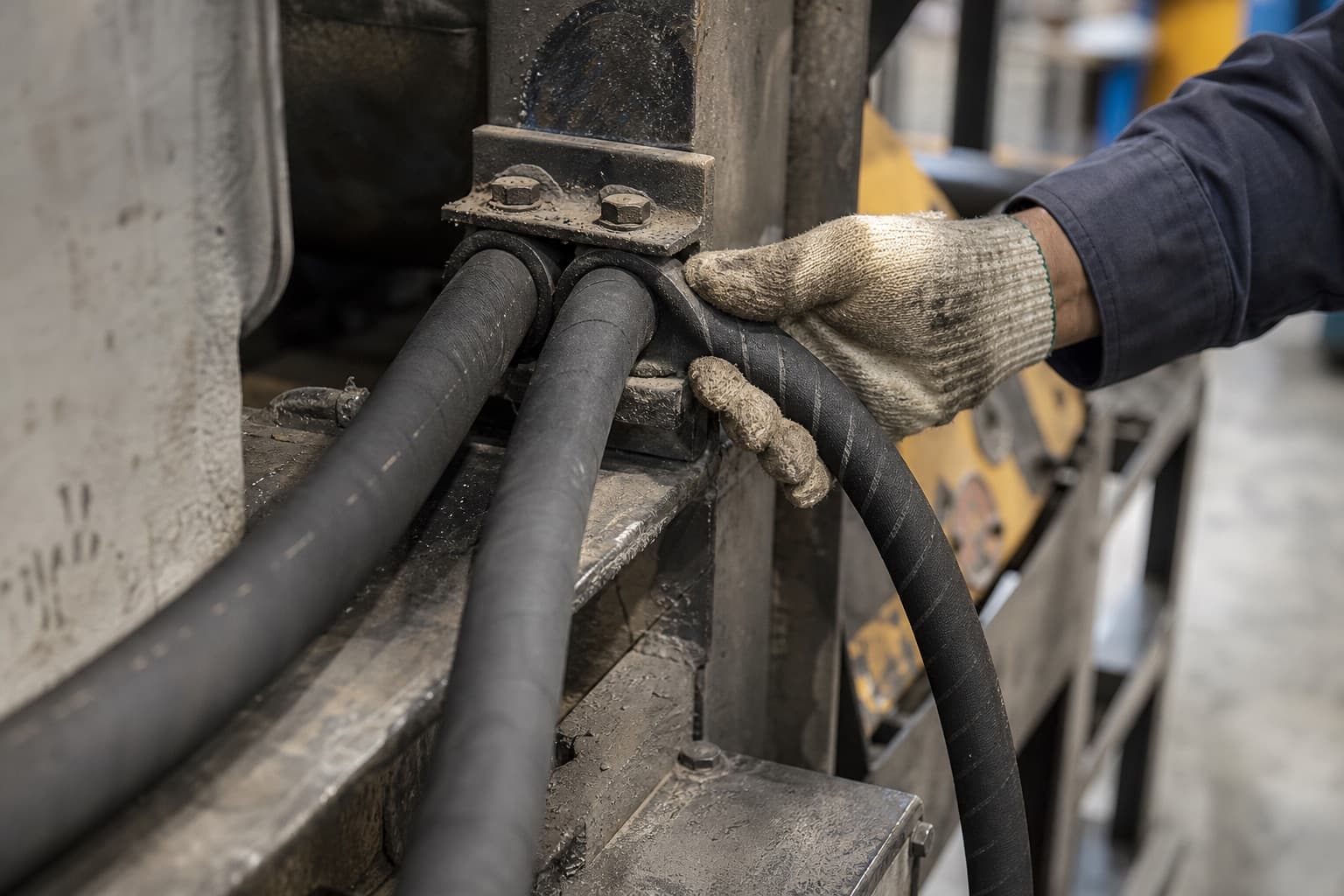
Bend radius is the specification most often treated as advisory. It is not — it is the radius below which the manufacturer no longer stands behind the hose, and a hose bent tighter has already lost capability whether or not anything looks wrong from outside.
/01What happens inside a tight bend.
Bend a reinforced hose and the wire on the outside of the curve stretches while the wire on the inside bunches. Within the rated radius both stay within what the construction tolerates. Below it, the outer wires carry more than their share and the inner ones can buckle — and a buckled wire does not recover when the hose straightens.
A visible kink is the extreme case, where the tube itself has collapsed and flow is restricted as well. The more common case is a bend a little tighter than rated, no visible deformity, and a hose that fails in that spot a year earlier than it should have.
/02The radius depends on grade and size.
There is no single figure. Bend radius rises steeply with bore, and differs substantially between constructions at the same bore — which is exactly the trade a compact grade exists to make.
| Construction | −04 | −08 | −12 | −16 | −24 |
|---|---|---|---|---|---|
| EN 853 2SN | 100 | 180 | 240 | 300 | 500 |
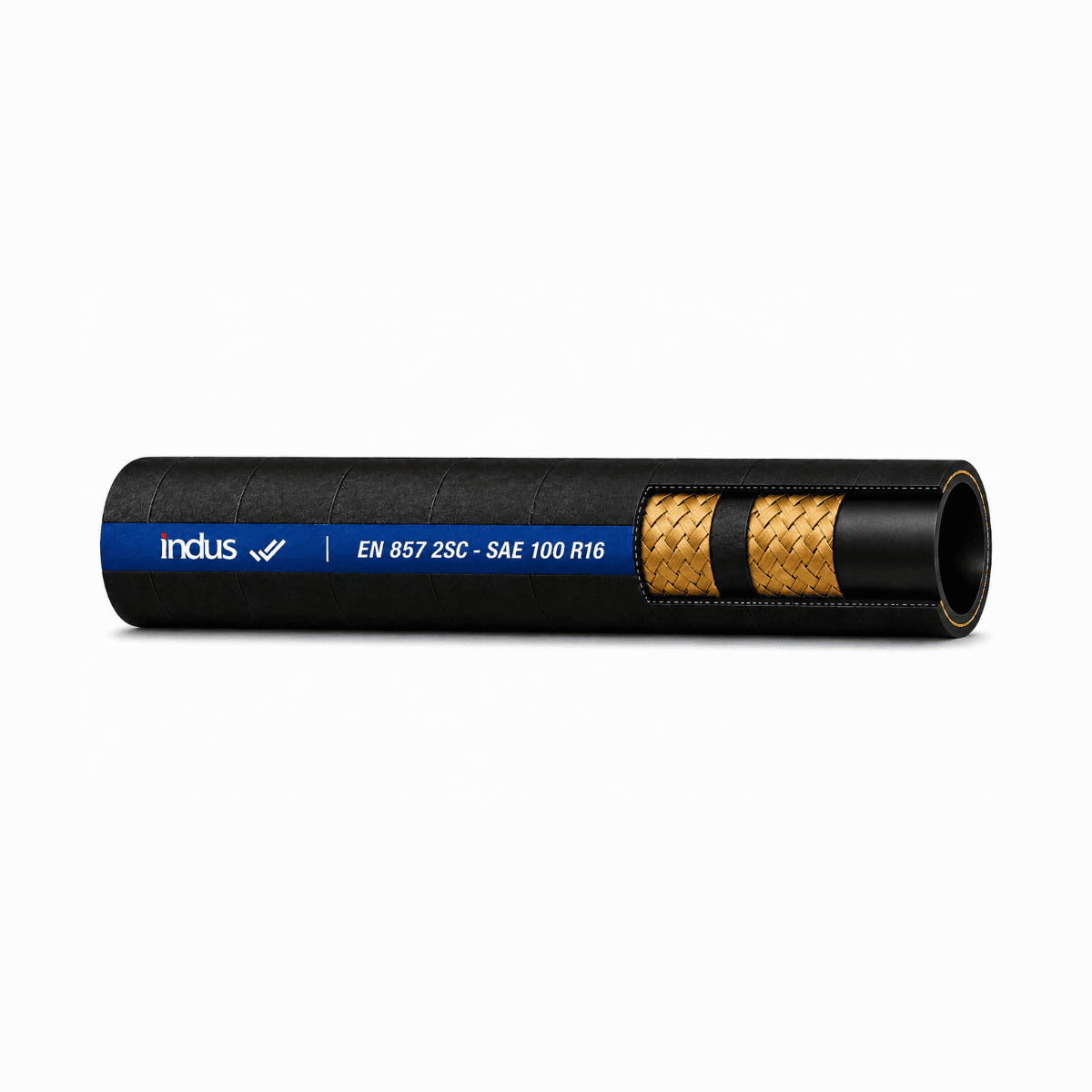
| EN 857 2SC compactHighlighted | 50 | 90 | 120 | 150 | — |
| EN 856 4SP spiral | 150 | 230 | 300 | 340 | 500 |
| EN 856 4SH spiral | — | — | 280 | 340 | 560 |
| SAE 100R14 PTFE | 45 | 70 | 190 | 270 | — |
Read the compact row against the standard braid row. At −08 the compact hose turns in half the space at the same pressure class, and at −04 in half again. Where routing is the constraint rather than pressure, that is usually the answer.
/03The bend must not start at the ferrule.
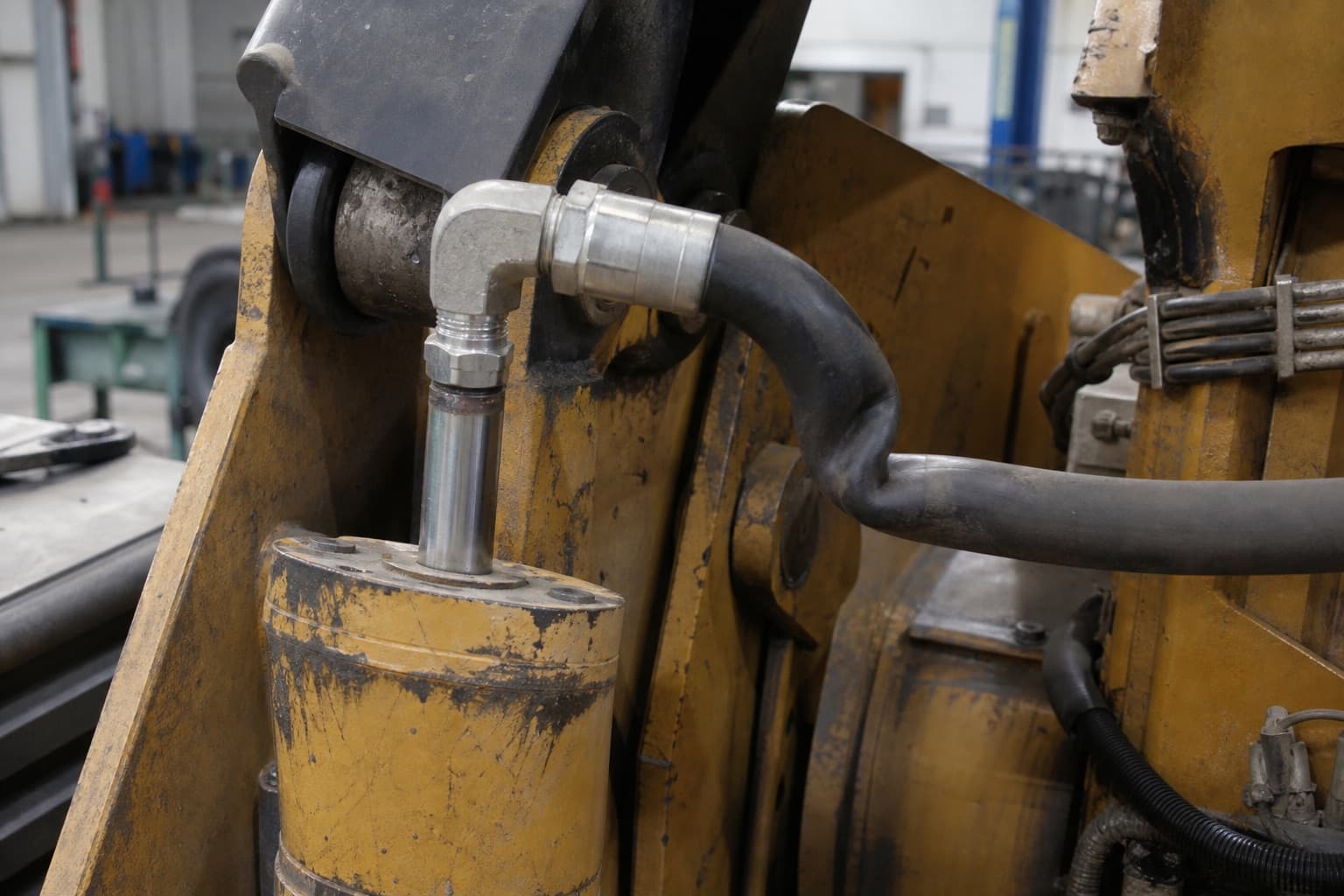
A hose needs a straight length coming out of the fitting before it begins to turn. Start the bend at the ferrule and two things happen at once: the bend is tighter than it appears because the stiff ferrule is taking up part of the arc, and the hose is being levered against the fitting every time pressure rises. Where the run has to turn immediately, a 45° or 90° elbow from our hose fittings range takes the bend in steel instead of rubber.
/04Two fixes that work.
Choose by what is actually constraining you
A more flexible hose is the third option and usually the worst of the three.
IfThe line has to change direction near the port
Use a 45° or 90° elbow fitting.
The fitting turns the line and the hose leaves it straight. This removes the bend rather than accommodating it.
IfThe run is genuinely tight along its whole length
Move to a compact construction.
EN 857 1SC and 2SC bend to roughly half the radius of the equivalent standard braid grade at the same pressure.
IH-HOSE-2SCIfThe hose is too short and is being forced round
Make it longer, then check the extra length does not create a rub point.
A short hose forced into a bend is under tension and torsion as well as over-bent.
IfNothing above is available
Rigid tube for the constrained section, hose for the parts that move.
Hose is not obliged to do the whole run. A tube run with short hose tails at each end solves routing problems hose alone cannot.
Compact constructions

Common questions
- Is bend radius measured to the inside or the centreline of the bend?
- To the inside of the curve on the published figures we work from. Where a datasheet does not say, ask before designing to it — the difference is significant at large bore.
- Does bend radius change with pressure?
- The rated figure assumes the hose is at working pressure. A hose bent to its limit unpressurised and then pressurised will try to straighten, which loads the fittings, so allow for movement rather than assuming the routing is static.
- The hose kinked once and then straightened out. Is it damaged?
- Assume yes. Reinforcement that has buckled does not un-buckle. A hose that has been kinked in handling or installation should not be fitted, even when it looks recovered.
- Why is spiral hose so much stiffer?
- Because there is more steel in it, wound as continuous helical layers rather than braided. That construction is what gives spiral its near-flat pressure rating across the bore range, and the stiffness is the price.