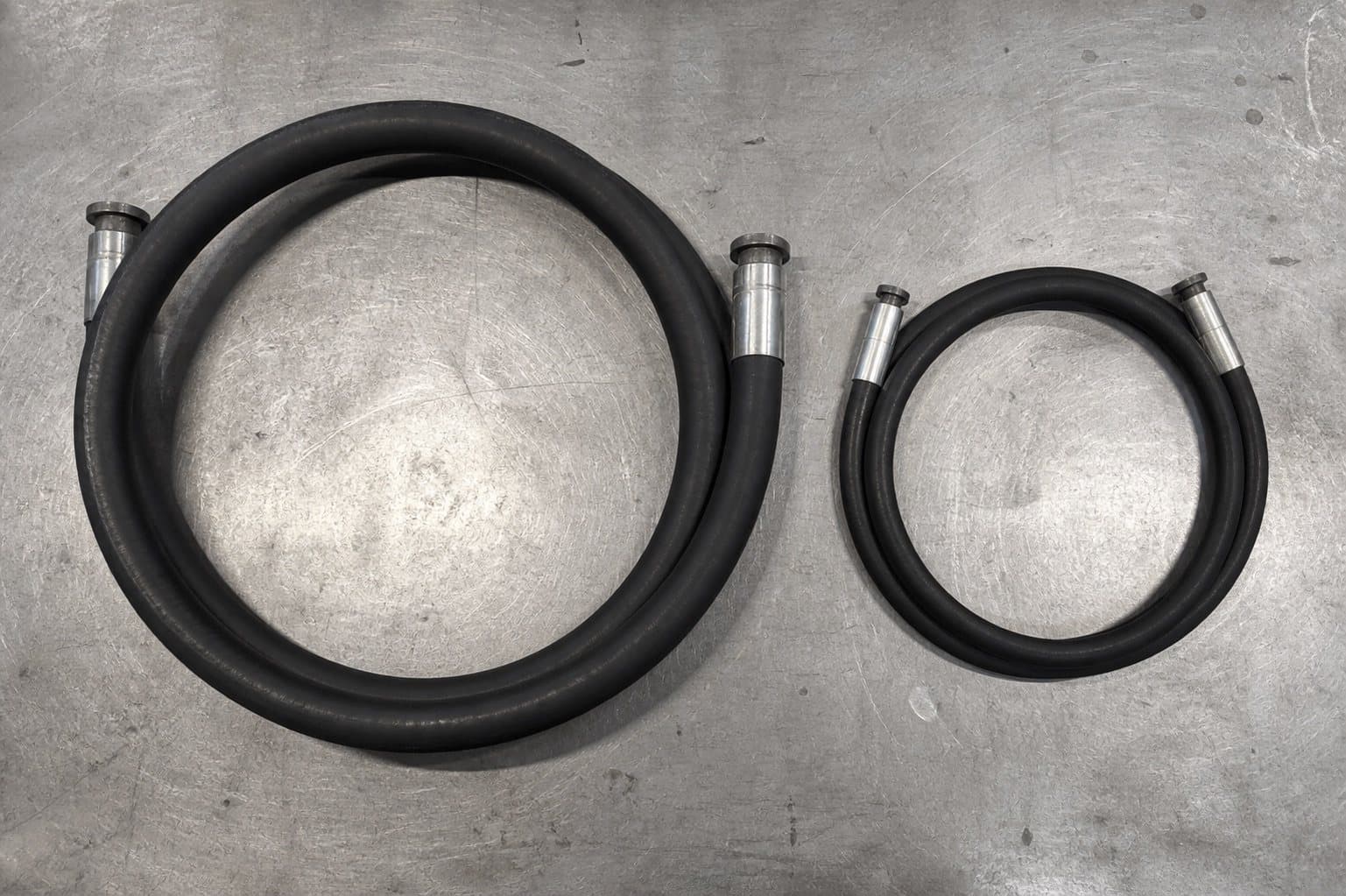
Most hose gets ordered by habit. Someone asks for two-wire, gets 2SN, and it works — so the next one is 2SN too. Compact hose exists for the case where the route is tight rather than the pressure being high, and that case is far more common than the order book suggests.
/01The comparison that matters.
| Bore | 2SN pressure | 2SC pressure | 2SN bend | 2SC bend | 2SC OD saving |
|---|---|---|---|---|---|
| −04 | 400 bar | 400 bar | 100 mm | 50 mm | 1.2 mm |
| −06 | 330 bar | 350 bar | 125 mm | 65 mm | 1.5 mm |
| −08 | 275 bar | 280 bar | 180 mm | 90 mm | 1.4 mm |
| −10 | 250 bar | 250 bar | 200 mm | 100 mm | 0.5 mm |
| −12Highlighted | 215 bar | 250 bar | 240 mm | 120 mm | 0.7 mm |
| −16 | 165 bar | 165 bar | 300 mm | 150 mm | 0.6 mm |
Read the two bend columns. Compact halves the minimum radius at every size, and at −12 it also carries 16% more pressure. There is no size in the overlap where standard braid is the better hose on either measure — the only thing 2SN has is reach beyond −16.
/02Where it changes the job.
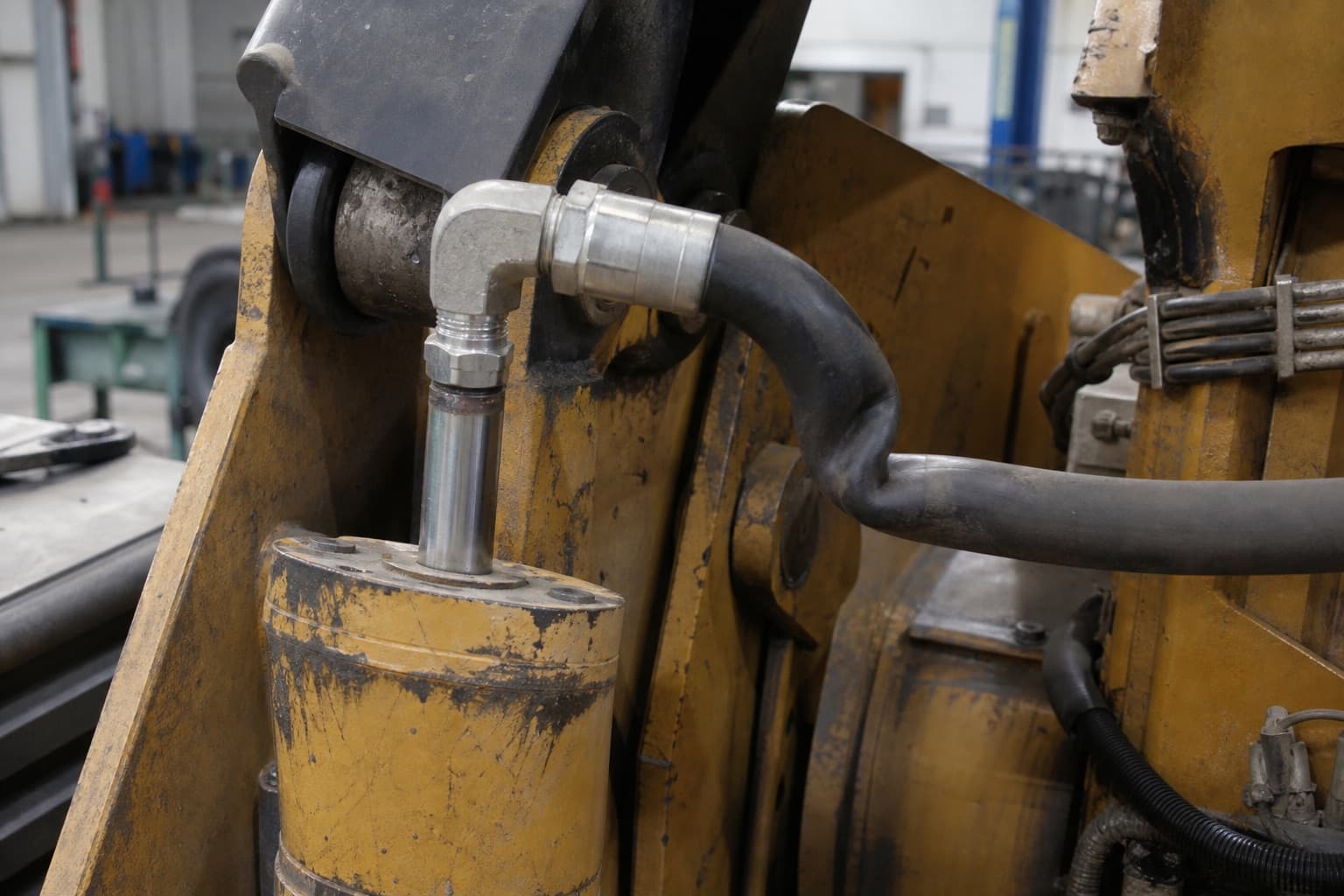
When compact is the better specification
IfThe route has a tight turn and an elbow will not fit
IfHoses run as a bundle through a fixed aperture
Compact.
A smaller OD per hose compounds across a bundle — the saving is per hose, and there are usually several.
IfMobile equipment where the hose flexes through a small arc
Compact.
Repeated flexing near the minimum radius is a failure mode; more margin means longer life.
IfBore above −16
Standard braid or spiral.
Compact is not made above −16. Above that the question becomes braid against spiral.
IH-HOSE-4SPIfPressure above what braid delivers at that bore
Spiral.
Compact is still braid. It does not change the pressure ceiling, only the geometry.
IH-HOSE-4SH
/03Why it is rarely asked for.
Two reasons, both practical rather than technical. Standard braid is what most fitters learned on and what most machines were built with, so replacement defaults to like-for-like. And bend radius is not usually the number anyone checks — pressure and bore get specified, the hose gets fitted, and if it goes round the corner the job is done.
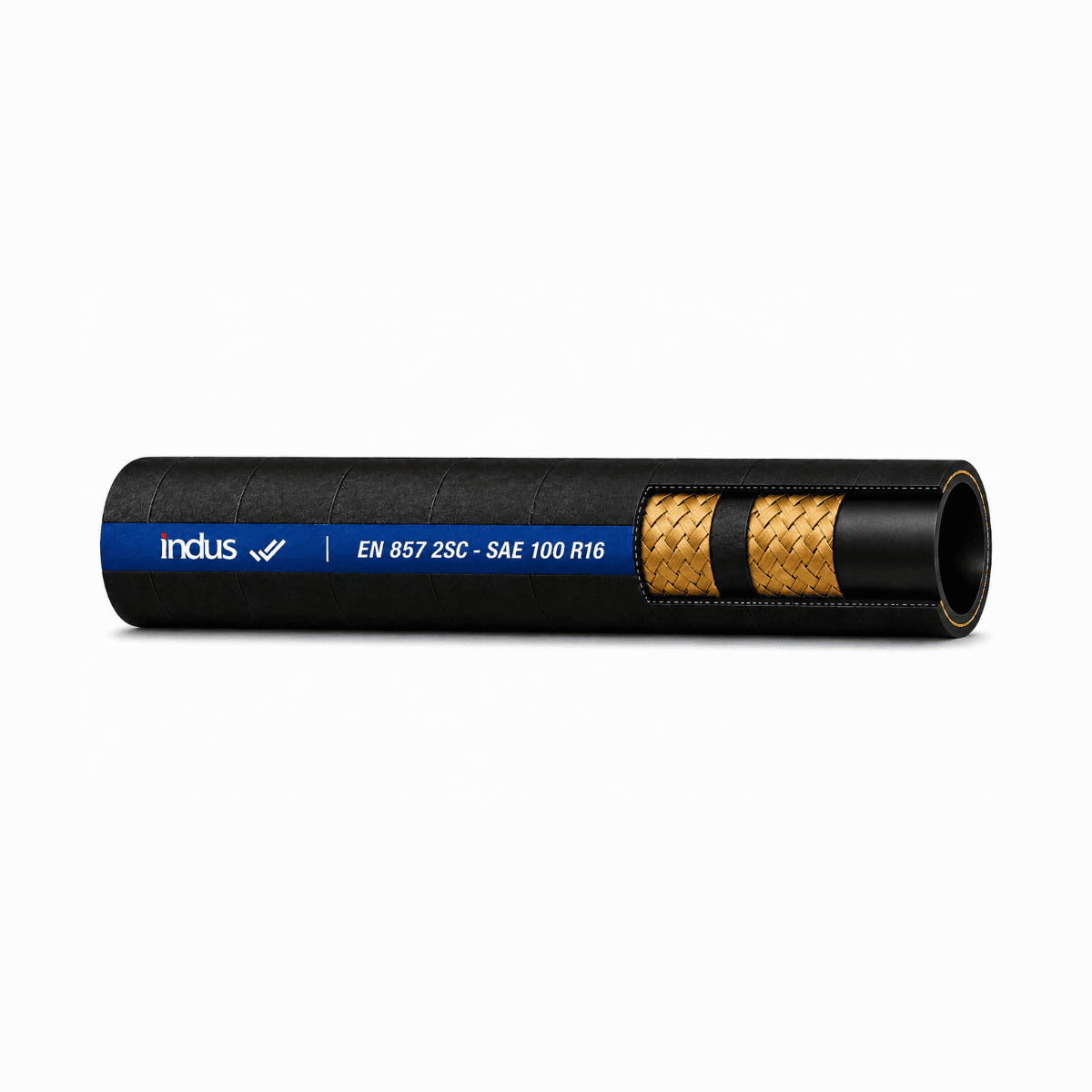
The cost of that shows up later, as a hose that failed early near a fitting. If a run keeps failing in the same tight bend, compact is worth considering before re-routing the machine. In our range that means 1SC for single-wire duty and 2SC for two-wire; both have a smaller outside diameter than standard braid, so the ferrule has to be the one specified for the compact hose.
Compact constructions


Common questions
- Does compact hose use different fittings?
- It uses fittings and ferrules specified for that hose, as any construction does. The crimp specification belongs to the hose-and-fitting combination — do not assume a 2SN ferrule suits 2SC because both are two-wire.
- Is compact hose more expensive?
- Usually somewhat, per metre. Against the cost of re-routing a machine or replacing an assembly that keeps failing in a tight bend, it is rarely the expensive option overall.
- Can I use compact hose everywhere instead of standard?
- Up to −16, generally yes on the numbers. Above that it is not manufactured, so standard braid or spiral takes over.
- Why is 2SC higher pressure than 2SN at −12?
- Different construction to a different standard — EN 857 rather than EN 853 — optimised for compactness rather than being a reduced version of standard braid. The pressure advantage at that size is a consequence of the design, not a rounding difference.