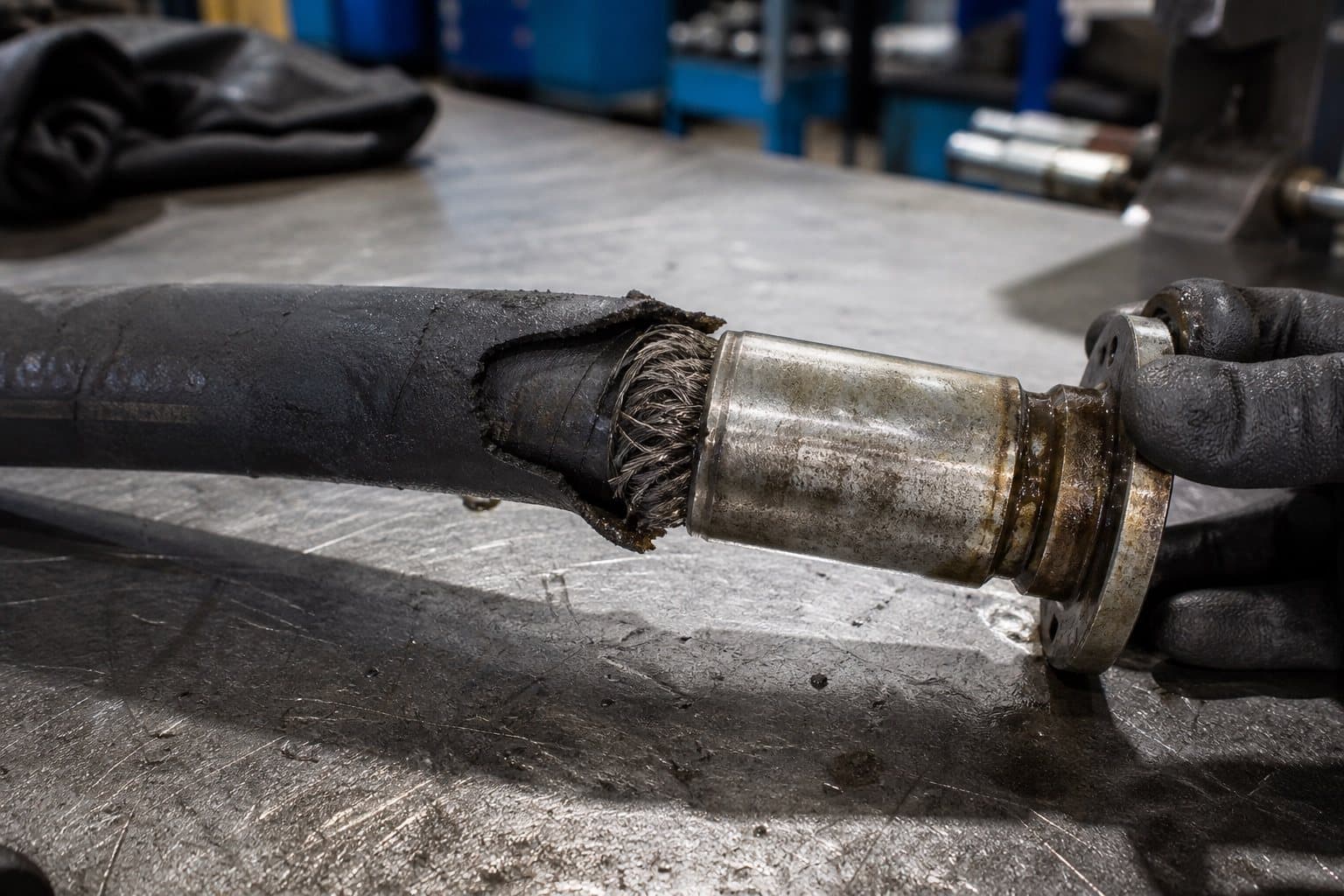
The most useful thing about a failed hose is where it failed. Mid-length says one set of things; within a hand’s width of the ferrule says an almost entirely different set — and the second is far more common than the first.
/01Why the location matters.
A hose assembly is not uniform along its length. The middle is hose. The last few centimetres at each end are hose plus a steel ferrule compressed onto it, and the transition between the two is the stiffest, most stressed part of the whole assembly.
That transition is where the reinforcement stops being free to move. Any flexing the routing imposes gets concentrated there, because there is nowhere else for it to go. It is also where the build quality of the assembly is decided, and where any error in the crimp lives.
/02Telling the four apart.
| Cause | What you find | When it shows up |
|---|---|---|
| Crimp too looseHighlighted | Tube pulled out of the ferrule, or visible movement between hose and fitting | Early — days to weeks |
| Crimp too tight | Wire cut or crushed at the ferrule mouth; failure right at the edge | Early to medium |
| Flexing at the ferrule | Cover polished or cracked in a band where it leaves the fitting | Late — after long service |
| Bend starting too close | Hose curved from the moment it exits the ferrule, cover strained on the outside of the curve | Medium to late |
/03The crimp is a measured dimension.
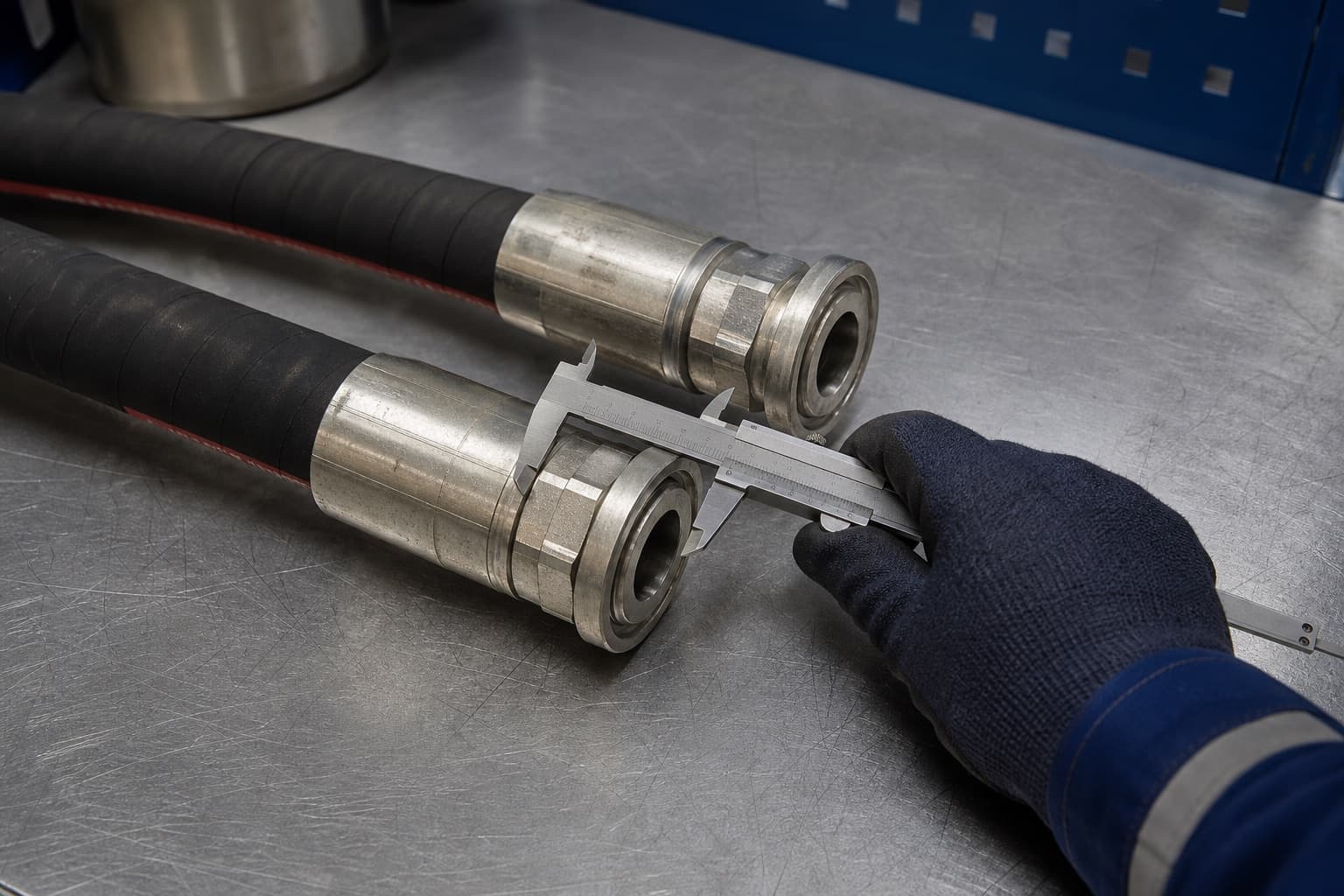
A crimp is not "tight enough". It is a diameter, specified for that combination of hose construction and ferrule, verified with callipers after the press releases. Too loose and the hose walks out of the fitting under pressure; too tight and the crimp cuts the reinforcement it is supposed to be gripping.
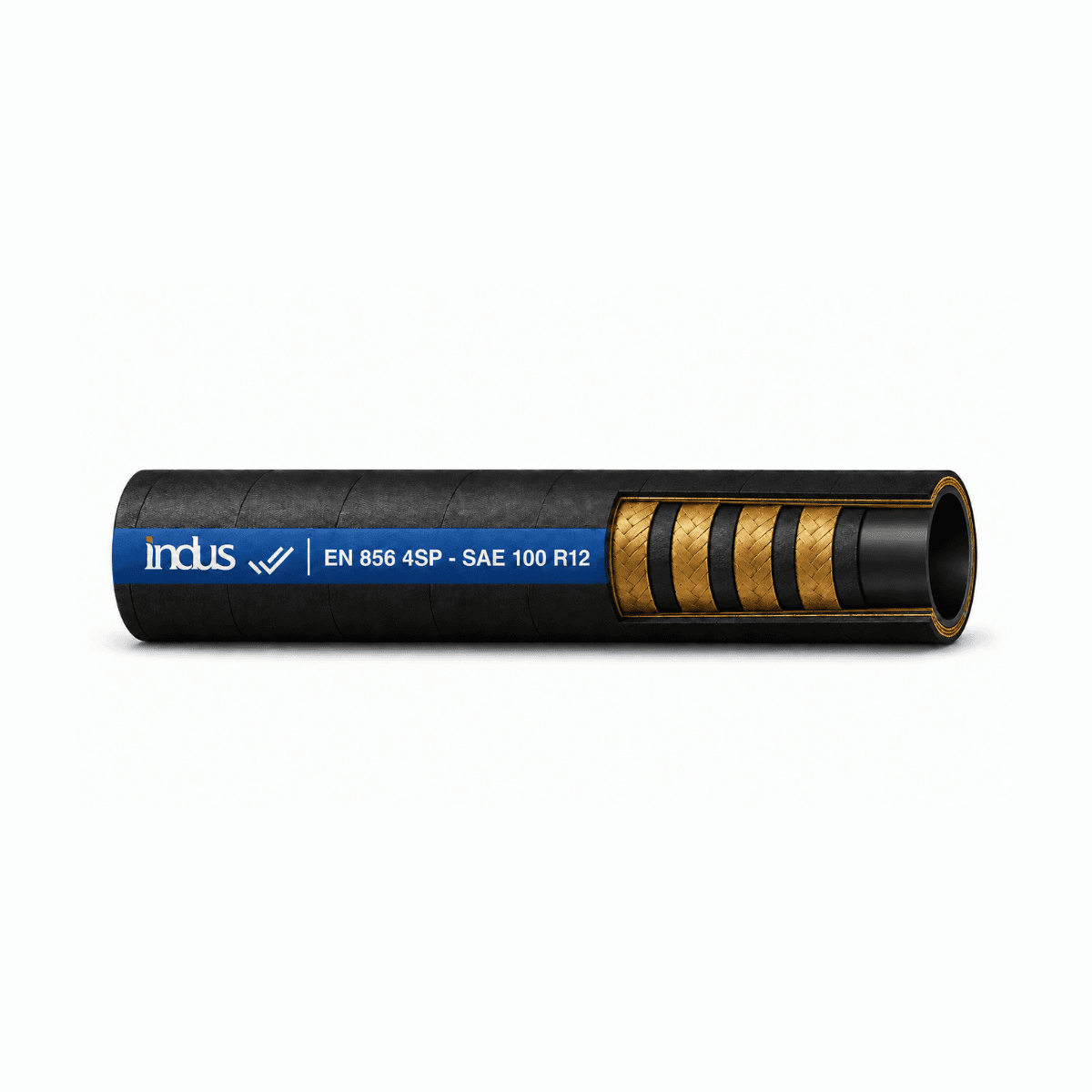
The tolerance is measured in tenths of a millimetre, which is why the die, the ferrule and the hose all have to be the matched set the specification assumes. A ferrule that fits physically is not evidence that it is the right ferrule. For two-wire hose that means the ferrule specified for it, such as the no-skive ferrule for R2AT and 2SN; for four-spiral hose, a skive interlock ferrule for 4SH.
/04What to change before fitting the replacement.
Work down until one applies
Fitting an identical replacement into an unchanged installation is a decision, not a default. Make it deliberately.
IfThe hose moves through an arc in service
Get the movement into the middle of the hose, not the first few centimetres.
A longer assembly, or an elbow fitting that lets the hose leave in the direction it needs to travel, moves the flexing away from the ferrule.
IfThe hose curves as it leaves the fitting
Use an elbow rather than bending the hose to achieve the same angle.
A 45° or 90° fitting turns the line at the fitting so the hose can run straight out of it. This is what elbow fittings are for.
IH-HOSE-R2-2SNIfIt failed within weeks of being built
Treat it as a build fault and ask for the crimp specification and the measured value.
An early failure at the ferrule is a build question until the build is ruled out.
IfThe same position has failed more than once
Stop replacing and review the installation.
Two failures at one position is not bad luck. Something about that routing is outside what the assembly can take.
Ferrules matched to construction

Common questions
- Is a burst at the fitting always the workshop’s fault?
- No. It is a build question when the failure is early and an installation question when it is late. A hose that ran for years and then failed at the ferrule was almost certainly flexing there the whole time — the build was fine and the routing was not.
- The tube pulled out of the fitting. What does that mean?
- Pull-out means the crimp was not gripping the hose adequately — either the crimp diameter was too large, the ferrule was wrong for that construction, or the hose was not inserted to full depth before crimping. All three are build faults.
- Can I re-use the fitting from a failed assembly?
- On a one-piece crimped fitting, no — the ferrule is deformed and the crimp cannot be repeated on it. Reusable fittings are a different design and are documented as such. Anything crimped is single use.
- Does a longer hose fix flexing at the fitting?
- Often, yes — a longer assembly lets the same movement spread over more length, so less of it concentrates at the ends. It has to be routed so the extra length does not create a new rub point, which is the usual way this fix goes wrong.