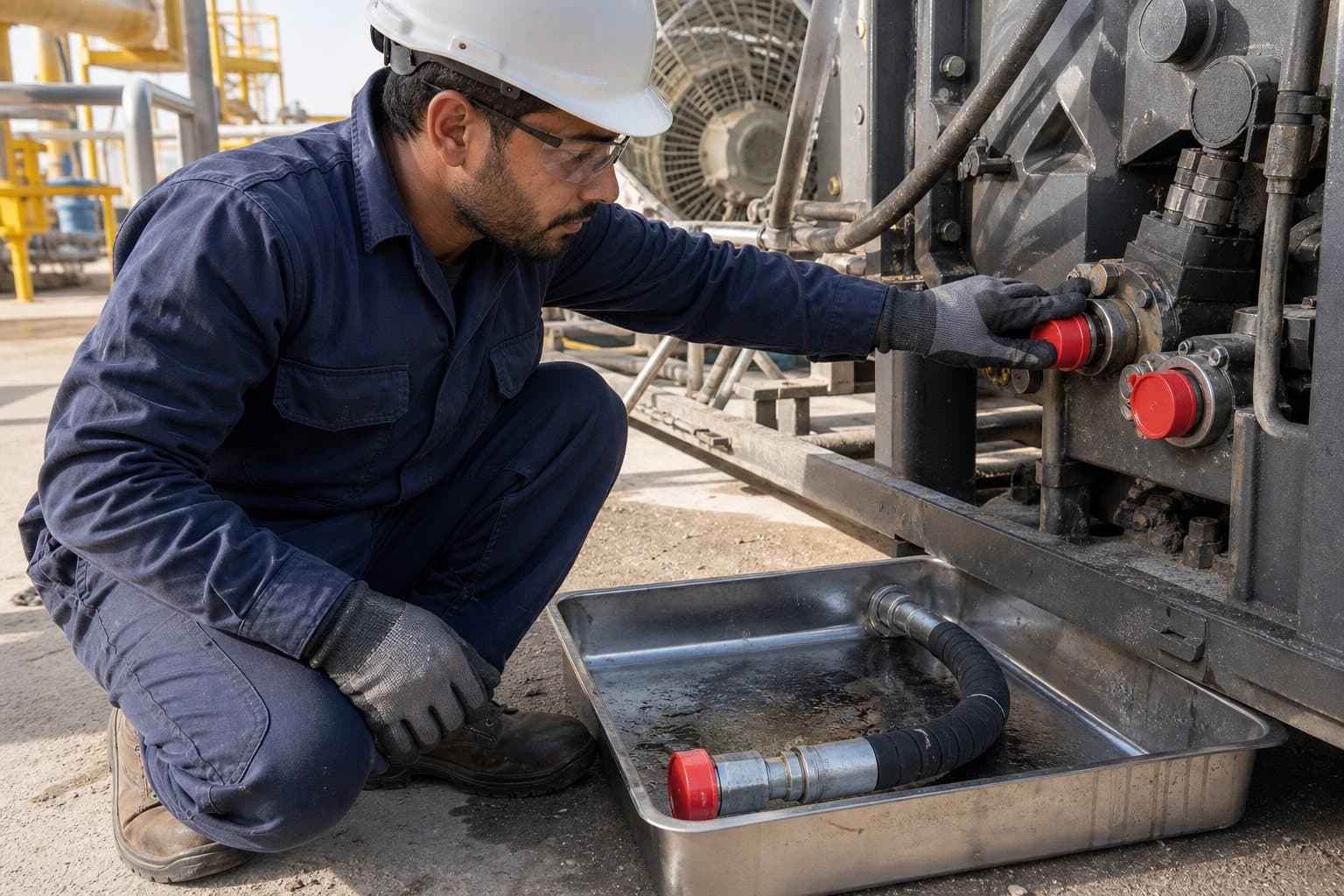
Hose changes happen where the machine stopped: a yard, a quarry face, a site road in a crosswind. It is the single dirtiest moment in a hydraulic system’s life and the one nobody counts, because nothing goes wrong for a month. This is the largest cluster of unanswered questions we found in the field and it deserves a procedure rather than good intentions.
/01Where it comes from.
| Source | What enters | How to stop it |
|---|---|---|
| The open port and open hose endsHighlighted | Airborne dust, sand, grit off the machine | Clean around the joint first, cap immediately |
| The failed assemblyHighlighted | Reinforcement wire, cover and tube fragments | Assume it happened; change filters after |
| The new assembly | Cutting debris, manufacturing residue, packaging dust | Buy assemblies capped; do not uncap until fitting |
| Top-up fluid | Whatever was in the drum and the funnel | Filtered transfer, clean containers |
/02The field procedure.
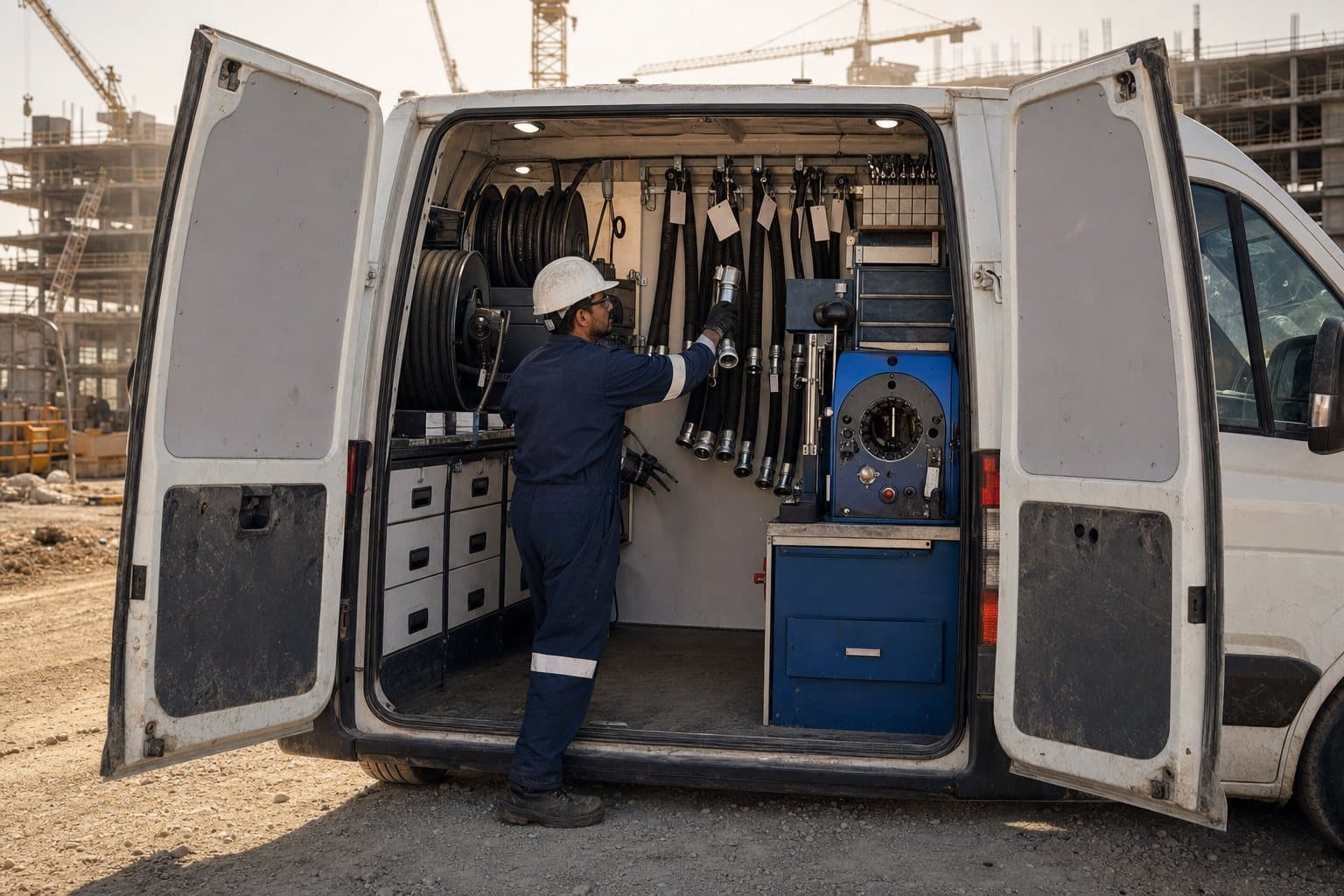
A hose change that does not cost you a pump
None of this adds much time. Most of it is order of operations.
IfBefore opening anything
Clean the whole area around both connections.
Degreaser and a rag, then dry. Whatever is on the outside of the joint goes inside the moment the joint is broken.
IfPosition the machine if you can
Ports downwind and, where possible, pointing down.
Free, and it removes most airborne ingress.
IfThe moment a port is open
Cap it. Every port, every time, even for two minutes.
Caps and plugs in the common sizes belong on the van. A rag stuffed in a port is worse than nothing — it sheds fibres.
IfBefore fitting the new assembly
Check it is capped, and keep the caps on until the moment of connection.
If it arrived uncapped, treat it as dirty and have it flushed rather than fitting it.
IfAfter the change
Run the circuit, then change the return filter.
This is the step that gets skipped. Whatever entered is now circulating, and the filter is the only thing that will remove it.
/03Why the bill arrives late.
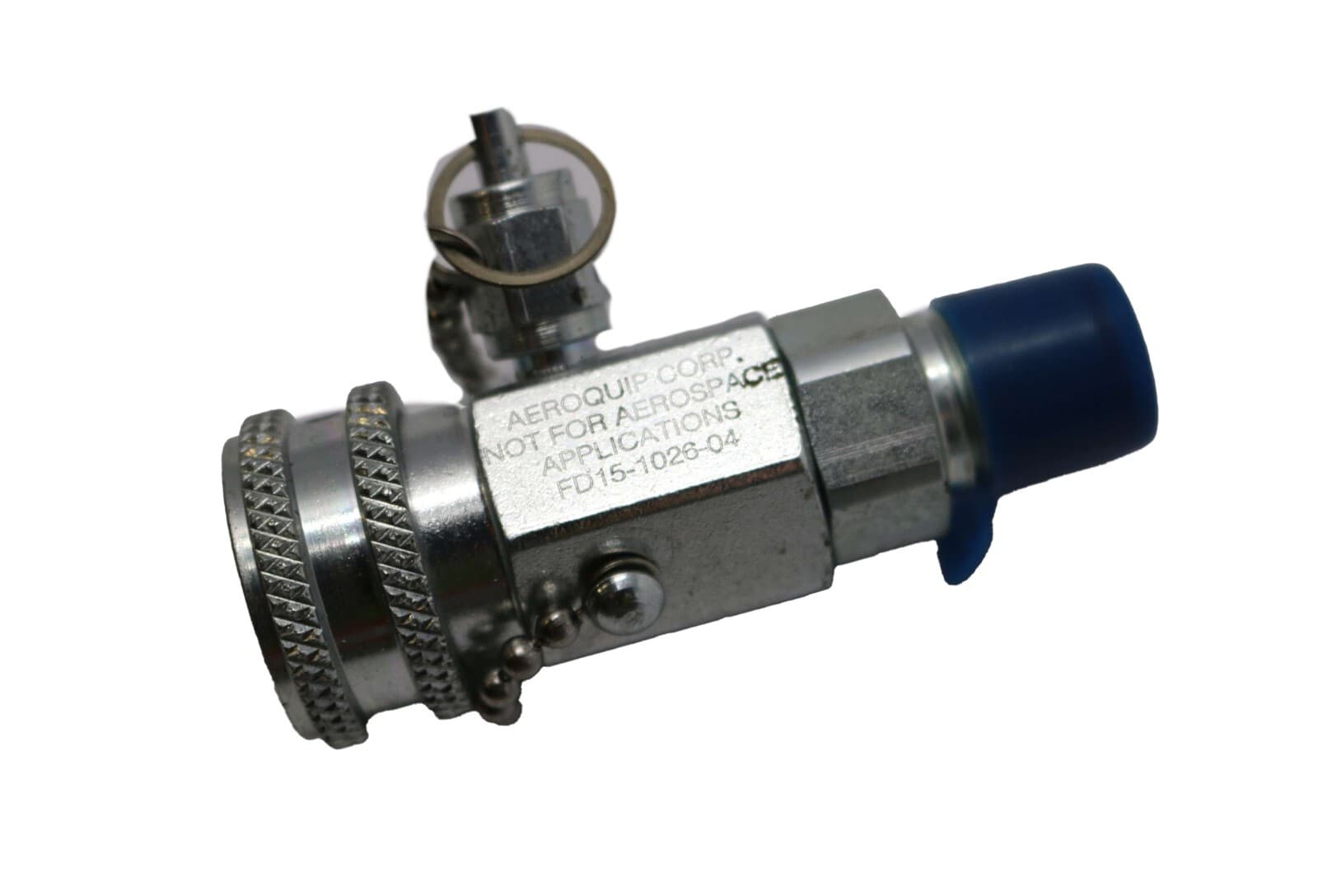
Contamination damage is cumulative and silent. Fine particles pass through clearances in pumps and valves, abrading them slightly on every pass. By the time a symptom appears — a slow circuit, a valve that sticks, a pump that whines — the hose change is a month back in the record and nobody connects the two. That is precisely why the discipline is hard to sustain: the feedback loop is too long to teach anyone anything. An oil sampling valve turns the guesswork into a particle count, and a return-line filter catches what the change let in.
| Symptom weeks later | Common contamination cause |
|---|---|
| Proportional or servo valve stickingHighlighted | Fine particulate, often including PTFE tape debris |
| Pump wear, falling output | Abrasive dust ingested at a hose change |
| Repeated filter blockageHighlighted | Debris from the original burst still circulating |
| Cylinder seal failure | Particles scoring the rod or bore |
| New hose fails early at the fitting | Debris trapped at the seat on assembly |
/04What to carry.
| Item | Why |
|---|---|
| Plastic caps and plugs, all common sizesHighlighted | The single highest-value item on this list |
| Degreaser and lint-free cloth | Rags shed fibres; lint-free does not |
| Spare return filter for the common machinesHighlighted | Removes the excuse for skipping the filter change |
| Clean drain tray and a sealed waste container | So the oil you catch does not become the oil you spill |
| Sealed top-up oil with a clean transfer pump | Drum-and-funnel top-ups undo everything else |
Common questions
- Is it really worth capping a port for five minutes?
- On a dusty site, yes. Ingress is a function of exposure and airborne concentration, and both are high here. The cap costs nothing and takes two seconds.
- Should I flush the system after a burst hose?
- Consider it whenever the failure was violent, when reinforcement wire was released, or where the machine has sensitive valving. At minimum, change the return filter and check it again shortly afterwards.
- Are new hose assemblies clean inside?
- Only if they were cleaned after cutting and capped afterwards. Ask how your supplier handles it — it is a reasonable question and the answer tells you a lot.
- Can I use a rag to plug a port?
- No. Rags shed fibres directly into the port, and fibres are difficult to filter out. Use a proper cap or plug.
- How soon should the filter be changed after a hose failure?
- Run the machine briefly to circulate, then change it. Check the replacement again after a short period — a second early blockage means debris is still coming through and the system needs more attention.