A grease is mostly oil, and the rest decides whether that oil stays where it is needed. The listing for every grease gives the same few facts — base oil, thickener, viscosity, grade, temperature — and each answers a different question about the job. Read in the right order, they narrow a range of sixty greases to two or three.
/01Base oil: temperature and compatibility.
| Base oil | Examples we list | Listed service range |
|---|---|---|
| Mineral oil | G-0010 (polyurea) | −30 °C to 170 °C |
| PAO (synthetic)Highlighted | G-4500 FMS, G-1033, PG-65, EM-50L | −55 °C to 150 °C across these |
| Ester / ester + PAO | BG-555, 7514 | −40 °C to 150 °C; −40 °C to 180 °C |
| Silicone | 33 Light, G-5133 M, 822M | −73 °C to 204 °C; −73 °C to 220 °C; −40 °C to 200 °C |
| Fluorosilicone | FS-841 (PTFE thickener) | −40 °C to 232 °C |
| PFPE | HP-670 (PTFE thickener) | −65 °C to 250 °C |
| PAG | G-3500, G-3407 | −40 °C to 150 °C; −40 °C to 200 °C |
Mineral and PAO greases cover most plant duty; PAO keeps working colder and lasts longer at temperature. Silicone greases hold their consistency across the widest temperature span — Molykote 33 Light is listed from −73 °C — but silicone oil carries less load between steel surfaces, so they suit light loads, rubber and plastics better than heavily loaded metal bearings. PFPE and fluorosilicone greases are the high-temperature and chemical-resistance end of the range.
/02Thickener: what holds the oil.
The thickener is the sponge that holds the oil and releases it under load. Simple lithium soap is the general-purpose standard; lithium complex, aluminium complex and polyurea are built for higher temperatures and longer life, and aluminium complex is the thickener behind the FM food-machinery greases on our listings (G-4500 FMS, G-1502 FM, G-0062 FM). Silica and PTFE are non-soap thickeners, used with silicone, fluorosilicone and PFPE oils. Mixing greases with different thickeners can soften or harden them, so purge rather than top up when changing product.
/03Base oil viscosity: speed and load.
The viscosity of the oil inside the grease matters as much as the grease itself. Slow, heavily loaded bearings and open gears need a thick oil to keep a film between the surfaces; fast bearings and cold starts need a thin one that does not churn or stiffen. Our listings show the full span: PG-65 at 17 cSt and BG-555 at 26 cSt at 40 °C at the thin end, G-4500 FMS at 100 cSt and G-1502 FM at 220 cSt in the middle, and EM-50L at 1,050 cSt and EM-D110 at 9,850 cSt at the thick end. The 1122 chain and open-air grease is listed at 1,500 mm²/s.
/04NLGI grade: consistency.
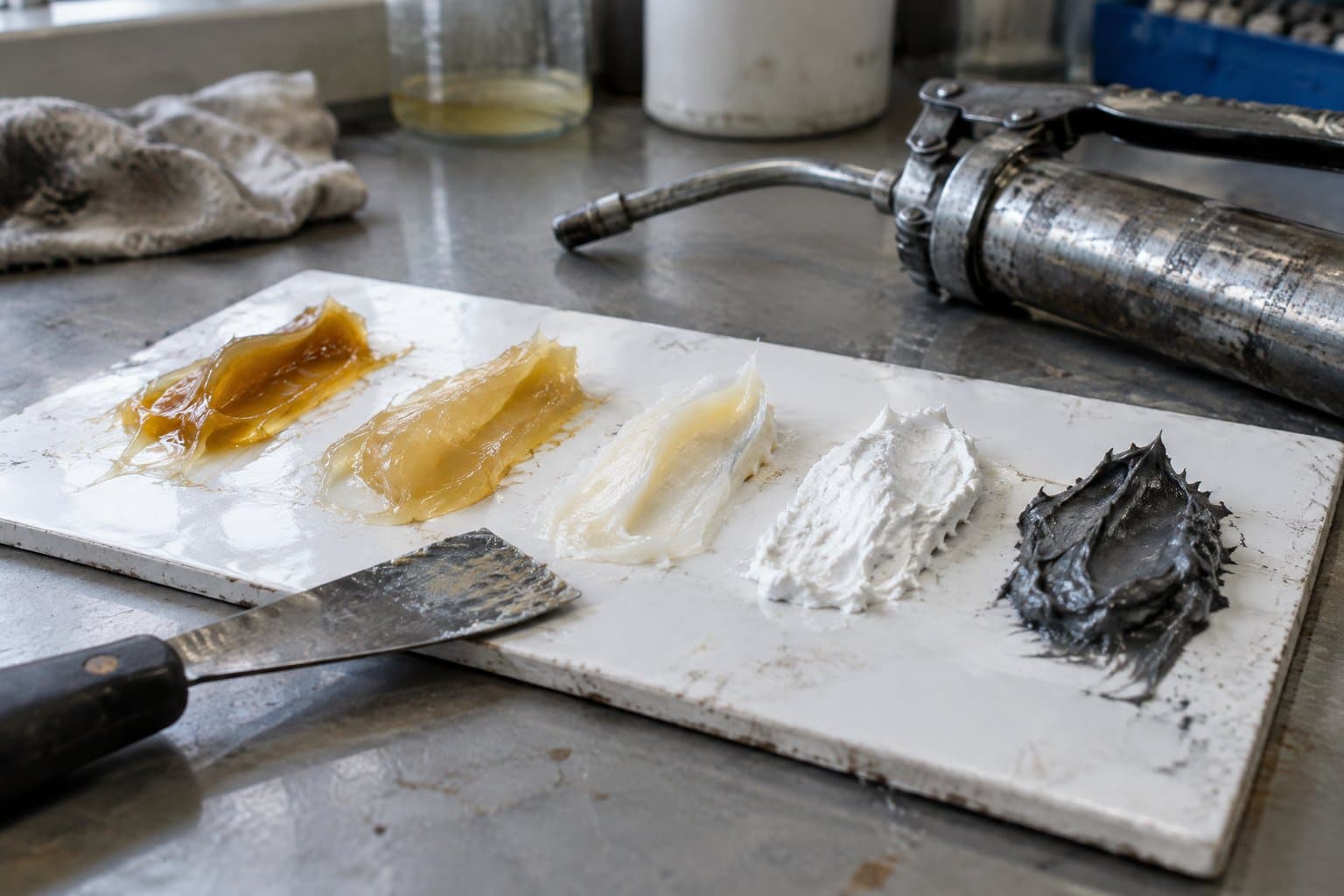
The NLGI grade measures how stiff a grease is, from semi-fluid grades through 2, the usual bearing grease, to stiffer grades above it. Our Molykote greases run from NLGI 0 (G-0060 FM, G-0061 FM) to 3, with many at 1 or 2. Softer greases flow and pump more easily, which is why centralised lubrication systems and cold climates favour them; stiffer greases stay put in vertical shafts, loose seals and vibrating equipment. The grade is not a quality rating — the same base oil and thickener can be made in several grades.
/05Check what the grease touches.
A grease that suits the bearing can still attack the seal, swell a plastic gear or contaminate a product. PAO greases such as PG-65 Plastislip are formulated with plastics in mind; silicone greases such as Molykote 55 O-Ring Grease (−65 °C to 175 °C) for rubber seals; 3451 and 3452 are listed as chemical-resistant bearing and valve greases with fluorinated thickeners. For food plants, the FM greases are the food-machinery grades — confirm the registration on the datasheet. The other Molykote types are covered in Molykote lubricant types explained.
A short route through the grease shelf
Confirm the final choice against the datasheet and the equipment maker's requirement.
IfGeneral plant bearings and slides, normal temperatures?
A lithium or aluminium complex grease on mineral or PAO oil, NLGI 2 — BR-2 Plus or G-4500 FMS.
IH-LUB-BR-2-PLUSIfExtreme cold, or light loads on rubber and plastic?
Silicone — Molykote 33 Light, listed from −73 °C.
IH-LUB-33-LIGHT-EXTREME-LOW-TEMPERATURE-GREASEIfBearings running above 200 °C?
PFPE HP-670 (to 250 °C) or Molykote 41 (to 290 °C).
IH-LUB-HP-670-GREASEIfPlastic gears and mechanisms?
PAO grease made for plastics — PG-65 Plastislip.
IH-LUB-PG-65-PLASTISLIP-GREASEIfFuels, solvents or chemicals in contact?
Fluorosilicone FS-841 or the chemical-resistant 3451.
IH-LUB-FS-841-GREASEIfFood machinery?
An FM grade such as G-4500 FMS, after checking its registration.
IH-LUB-G-4500-FMS-MULTI-PURPOSE-SYNTHETIC-GREASE
Frequently asked questions
- What does NLGI 2 mean?
- It is a consistency grade on the NLGI scale — the common grade for rolling bearings. Lower numbers are softer and flow more easily; higher numbers are stiffer.
- Is a higher dropping point always better?
- Not on its own. It indicates thermal stability of the thickener, but the usable limit is the listed service range, which sits well below the dropping point.
- Can silicone grease be used on steel bearings?
- At light loads, yes. Silicone oil carries less load between steel surfaces than mineral or PAO oil, so heavily loaded metal bearings are better served by those.
- Which Molykote grease works at the lowest temperature?
- On our listings, Molykote 33 Light and G-5133 M are rated from −73 °C.
Molykote greases mentioned
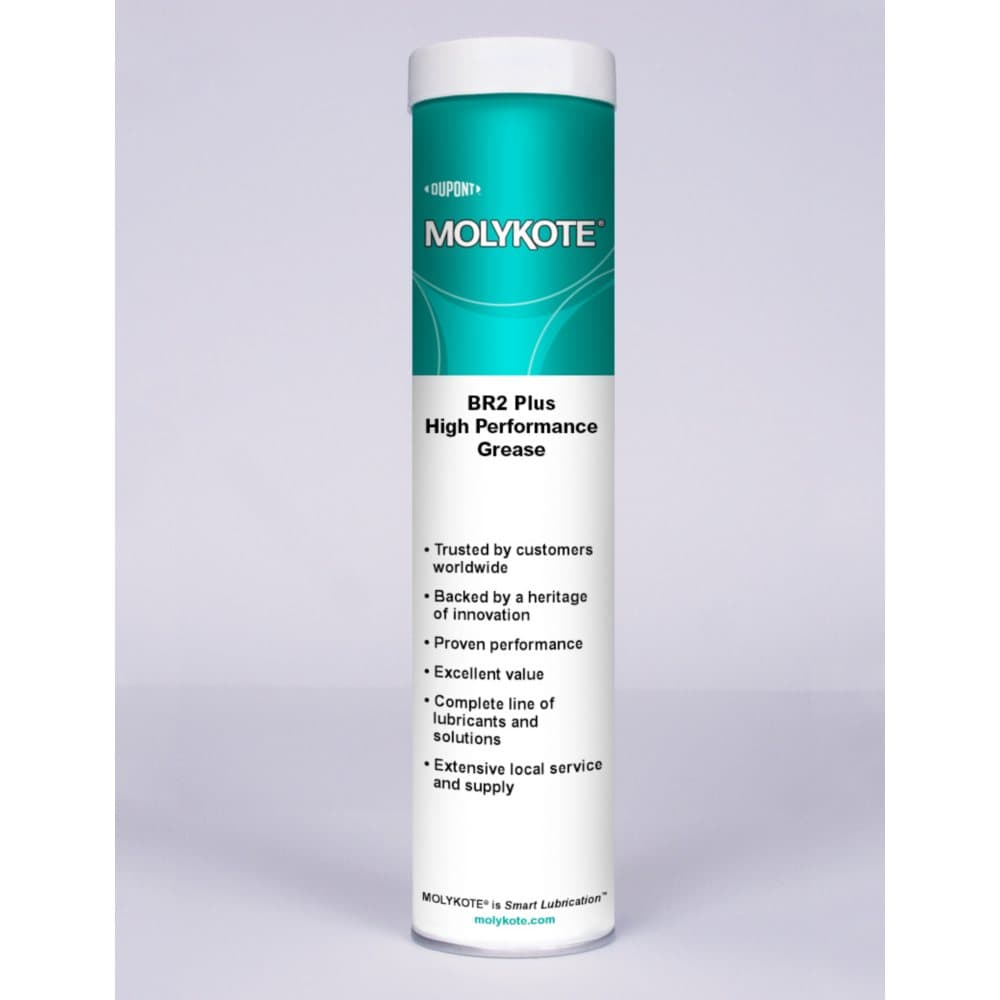 IH-LUB-BR-2-PLUSMolykote BR-2 PlusMolykote
 IH-LUB-G-4500-FMS-MULTI-PURPOSE-SYNTHETIC-GREASEMolykote G-4500 FMS Multi-Purpose Synthetic GreaseMolykote
 IH-LUB-33-LIGHT-EXTREME-LOW-TEMPERATURE-GREASEMolykote 33 Light Extreme Low Temperature GreaseMolykote
 IH-LUB-HP-670-GREASEMolykote HP-670 GreaseMolykote
 IH-LUB-41-EXTREME-HIGH-TEMPERATURE-BEARING-GREASEMolykote 41 Extreme High Temperature Bearing GreaseMolykote
 IH-LUB-PG-65-PLASTISLIP-GREASEMolykote PG-65 Plastislip GreaseMolykote
 IH-LUB-FS-841-GREASEMolykote FS-841 GreaseMolykote
 IH-LUB-55-O-RING-GREASEMolykote 55 O-Ring GreaseMolykote