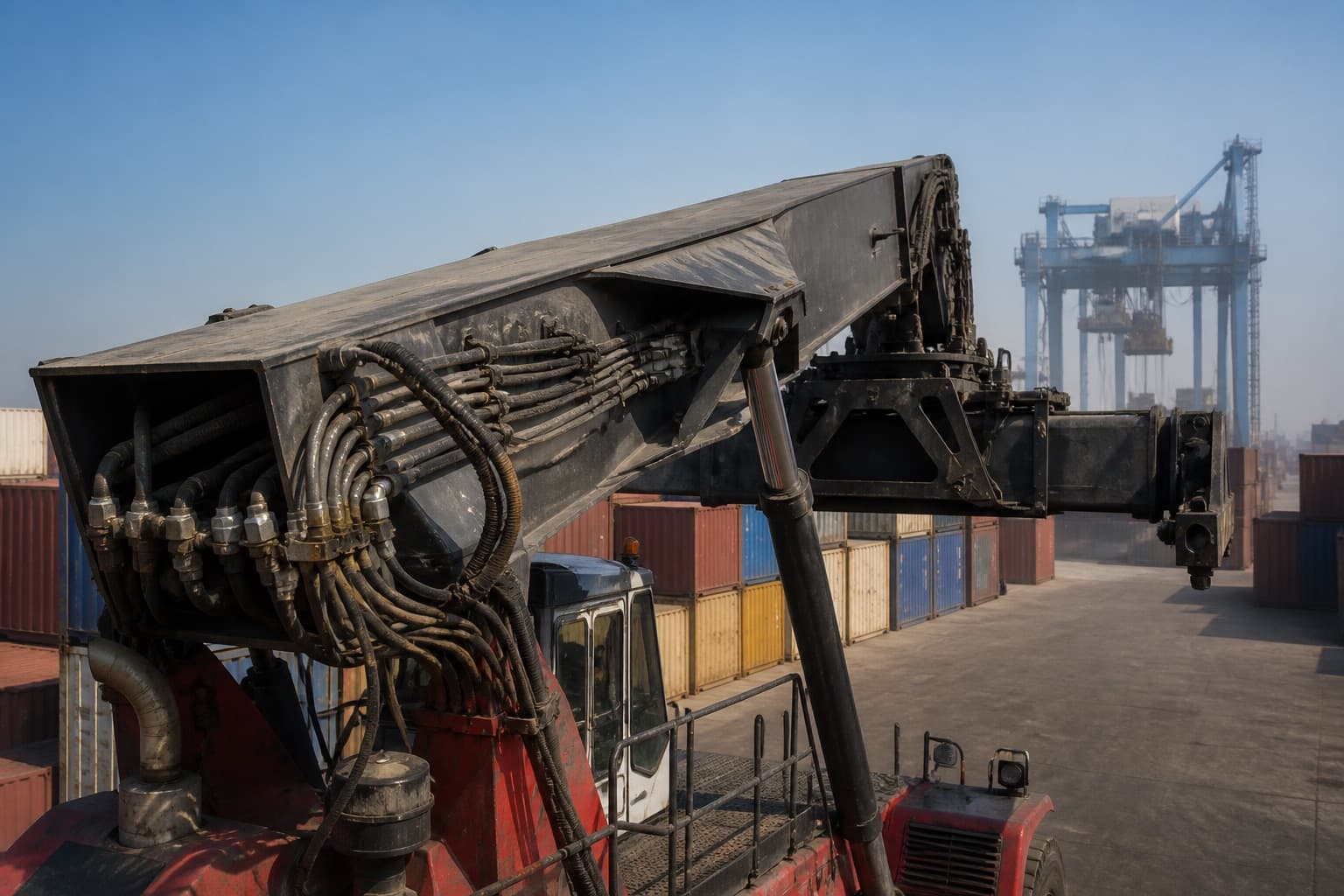
Container handling equipment gets the worst of both worlds in this region — a corrosive atmosphere and a duty cycle with no natural pause. The interesting part is that neither problem is solved by buying a different hose.
/01Where the cycles are.
| Circuit | Cycles | Notes |
|---|---|---|
| Spreader twistlocksHighlighted | Every container, both ends | Highest cycle count on the machine |
| Spreader sideshift and telescope | Most containers | Hoses that must extend and retract |
| Boom lift and telescope | Every lift | Long runs, high exposure |
| Stabilisers / suspension | Continuous | Low on the machine, salt spray |
| Drive and steer | Continuous | Machine immobile if lost |
The spreader is where the hydraulic work is concentrated, and it is at the end of a long boom in the weather. Spreader hoses accumulate cycles faster than anything else in the terminal, and they are the least convenient to reach.
/02Salt is the invisible half.
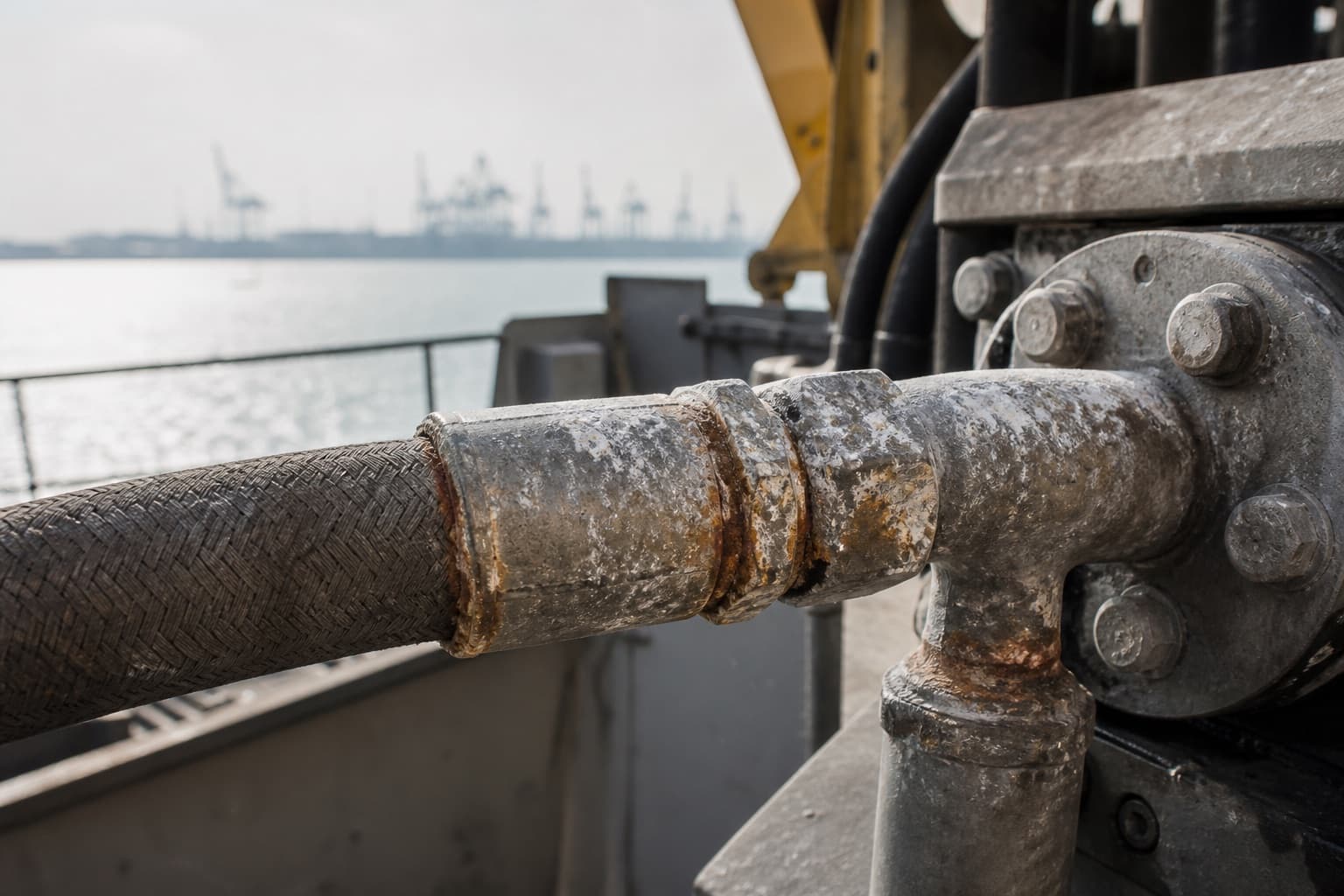
The practical response is not a corrosion-resistant hose, because hydraulic hose reinforcement is carbon steel in essentially every common construction. It is to treat any cover damage as a replacement trigger, and to replace on age where inspection access is poor. Exposed fittings are the other half: 316L stainless fittings on spreader and boom joints outlast plated steel in salt air.
/03Planning around a terminal that does not stop.
What makes planned replacement workable
The constraint is the window, so everything below is about shortening it.
IfAssemblies are not tagged
Tag them at the next opportunity — nothing else works without this.
Age-based replacement needs a build date, and the layline does not survive this environment.
IfSpreader hoses are replaced individually as they fail
Move to replacing the set.
They accumulate cycles together, so they reach the end together. One window instead of five interruptions.
IfAssemblies are made to order when a machine stops
Hold the common sets pre-built and dated.
Storage ages them, so date-mark and rotate — but a shelf assembly beats a stopped machine.
IfAccess to the spreader is the bottleneck
Bundle the hose work with whatever else needs that access.
The cost here is the window, not the hose.
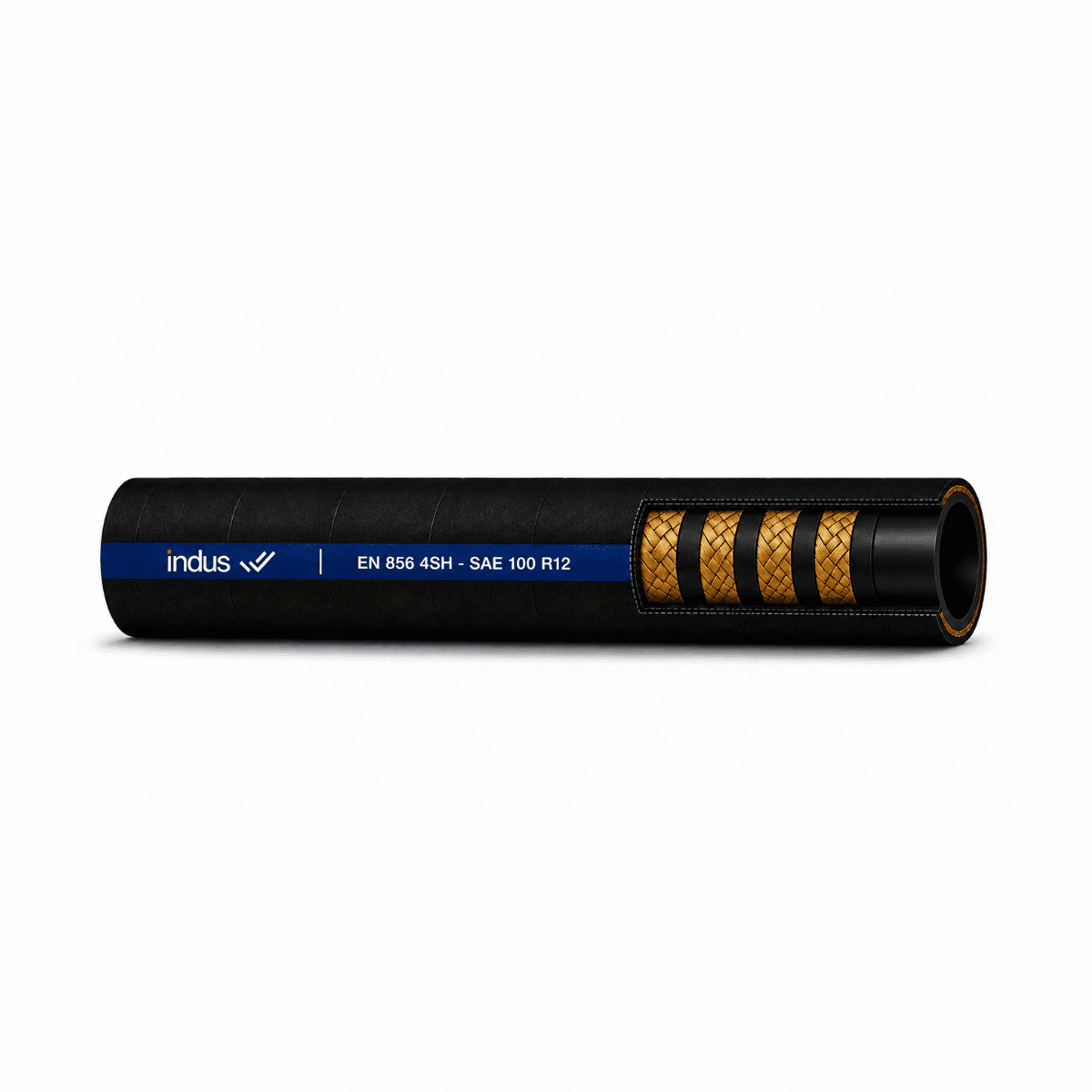
Grades used on container handling equipment


Common questions
- Is there a corrosion-resistant hydraulic hose for port use?
- Not as a variant of standard hose — the reinforcement is carbon steel in essentially all common constructions. Protecting the cover and replacing on age is the available control. Stainless fittings are worth specifying separately.
- How much does salt shorten hose life here?
- We do not publish a multiplier because it depends almost entirely on whether the cover has been breached. An intact cover in salt air is doing its job; a scarred one is on a much faster clock.
- Can you hold stock for our fleet?
- Yes, and we date-mark it so rotation is possible. For a terminal, having the set on a shelf is usually worth more than the shelf-life cost.
- Do you work to a terminal’s shift pattern?
- Yes. Planned hose work is easier to schedule than an unplanned stop, which is most of the argument for doing it this way.