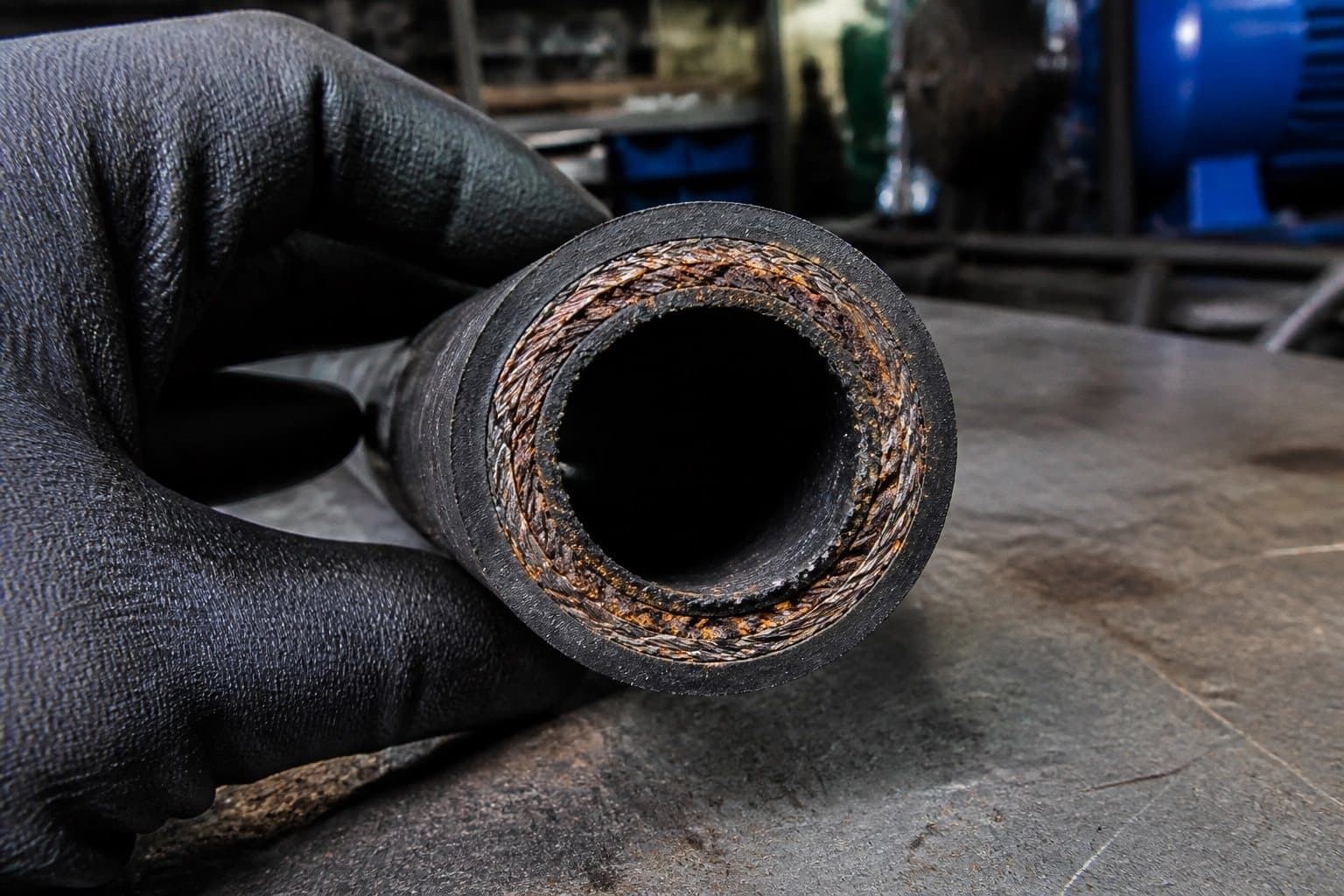
Almost every hydraulic hose failure gives some warning if you know what to look for. This one does not. The reinforcement rusts away underneath a cover that stays smooth, unmarked and entirely convincing, and the first symptom is the burst.
/01What the cover is actually for.
The cover on a wire-reinforced hose is a protective layer, not a sealed one. Its job is to keep abrasion, weather and sunlight off the reinforcement. It does that well while it is intact and it does almost nothing once it is not — because the space between the wires is a continuous path, and water that gets in at one point can travel along it.
That is why the corrosion is so often nowhere near the damage. A cut at a clamp can rust wire half a metre away, and by the time anybody investigates, the cut has been dismissed as cosmetic.
/02How the water gets in.
| Entry point | Where to look |
|---|---|
| Abrasion scar worn through the coverHighlighted | Against clamps, frames, other hoses — anywhere the hose touches something |
| Cut from installation or handling | Near the ends, and wherever the hose was pulled through a frame |
| Pinhole from a fluid leak elsewhere | Downstream of any spray or drip |
| Cover damage at the ferrule edge | Right where the cover meets the fitting |
| Pressure washing directly at the cover | Anywhere on a machine that gets washed down |
/03Why it is worse here.
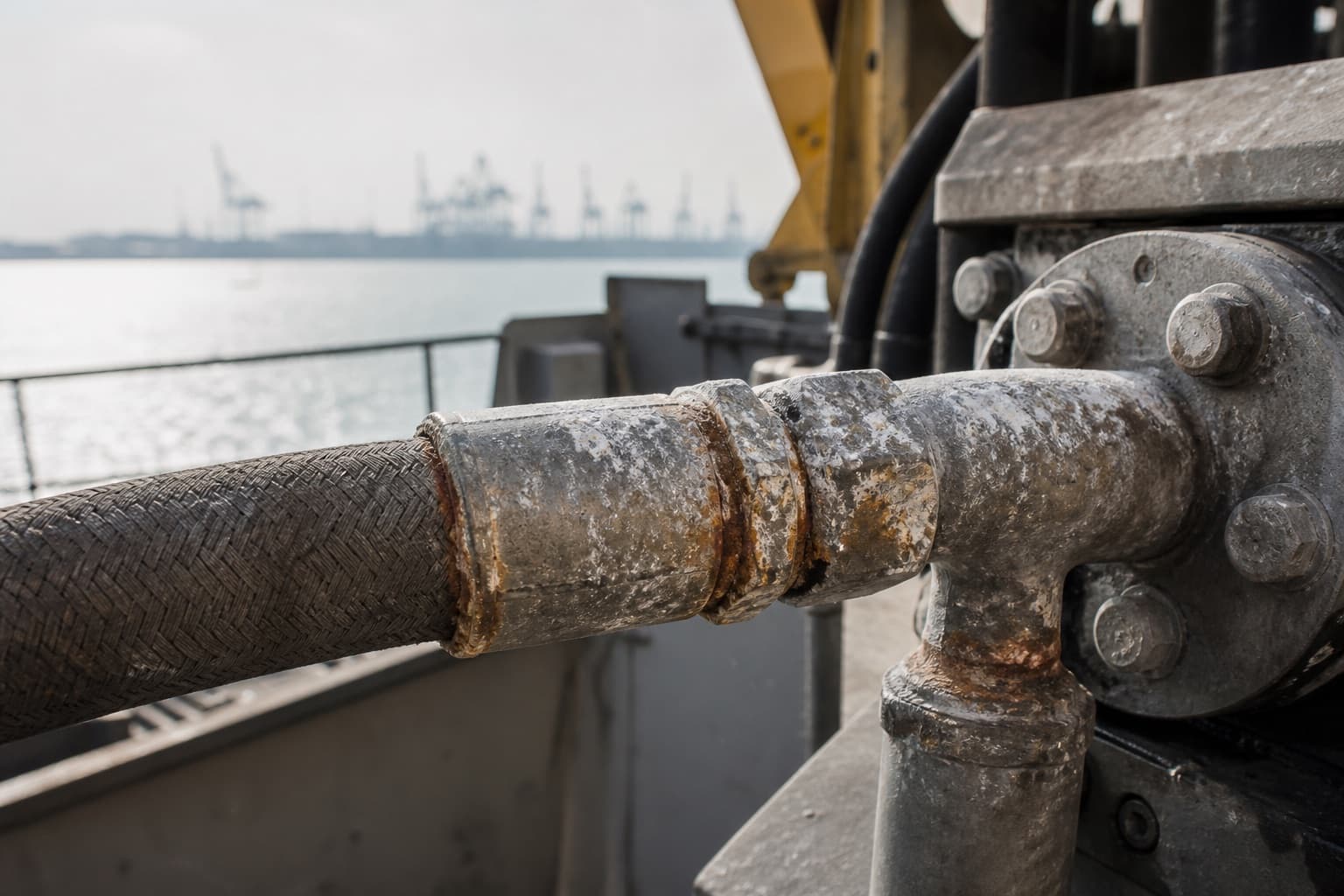
Corrosion needs moisture and oxygen, and salt accelerates it. A machine working within a few kilometres of the coast is in humid, salt-carrying air more or less permanently, and the daily temperature swing means condensation forms on and inside equipment overnight. The same hose in the same duty has a materially shorter reinforcement life at Jebel Ali than it does inland.
That does not mean a different hose is needed everywhere near the coast. It means cover damage matters more there, and an abrasion scar that would be a two-year problem inland is a much shorter one on the water. Where corrosion rather than pressure governs, the alternative is a different family: PTFE hose with a stainless braid, or a metallic hose.
/04What actually prevents it.
In order of how much difference each makes
None of these is exotic. The first two account for most of the available improvement.
IfThe hose touches anything
Fix the rub point, or sleeve the hose where it rubs.
Almost every entry path starts as abrasion. Removing the abrasion removes the entry path.
IfThe cover is cut or scarred anywhere
Treat it as a replacement item, not a cosmetic one.
A cut cover on a wire hose is the start of a corrosion path, even when the hose is otherwise perfect.
IfThe machine is washed down regularly
Change how, not whether — distance and angle.
Direct lance pressure at hose ends is the version that does damage.
IfWorking coastal or offshore
Shorten the inspection interval rather than changing the hose.
The mechanism is the same everywhere; the clock runs faster near salt water.
Sleeving and the one inspectable grade

Common questions
- Can I paint or coat a hose to stop corrosion?
- No. Coatings crack as the hose flexes and can attack the cover compound. The cover is already the protective layer — the answer is to stop damaging it, not to add another one on top.
- How do I check for corrosion without cutting the hose?
- On most constructions you cannot, which is the problem. What you can do is inspect the cover for any breach and treat every one as significant, and replace on age where the environment is aggressive rather than waiting for evidence that never appears.
- Is stainless reinforcement available?
- For hydraulic hose the reinforcement is carbon steel in essentially all common constructions. Where corrosion resistance is the governing requirement the answer is usually a metallic or PTFE hose with stainless braid, not a variant of a rubber hose.
- Does a rusted hose burst suddenly or leak first?
- Suddenly is the common case, which is why this mode matters. The reinforcement carries the pressure; when enough of it has gone, the failure is not gradual.