
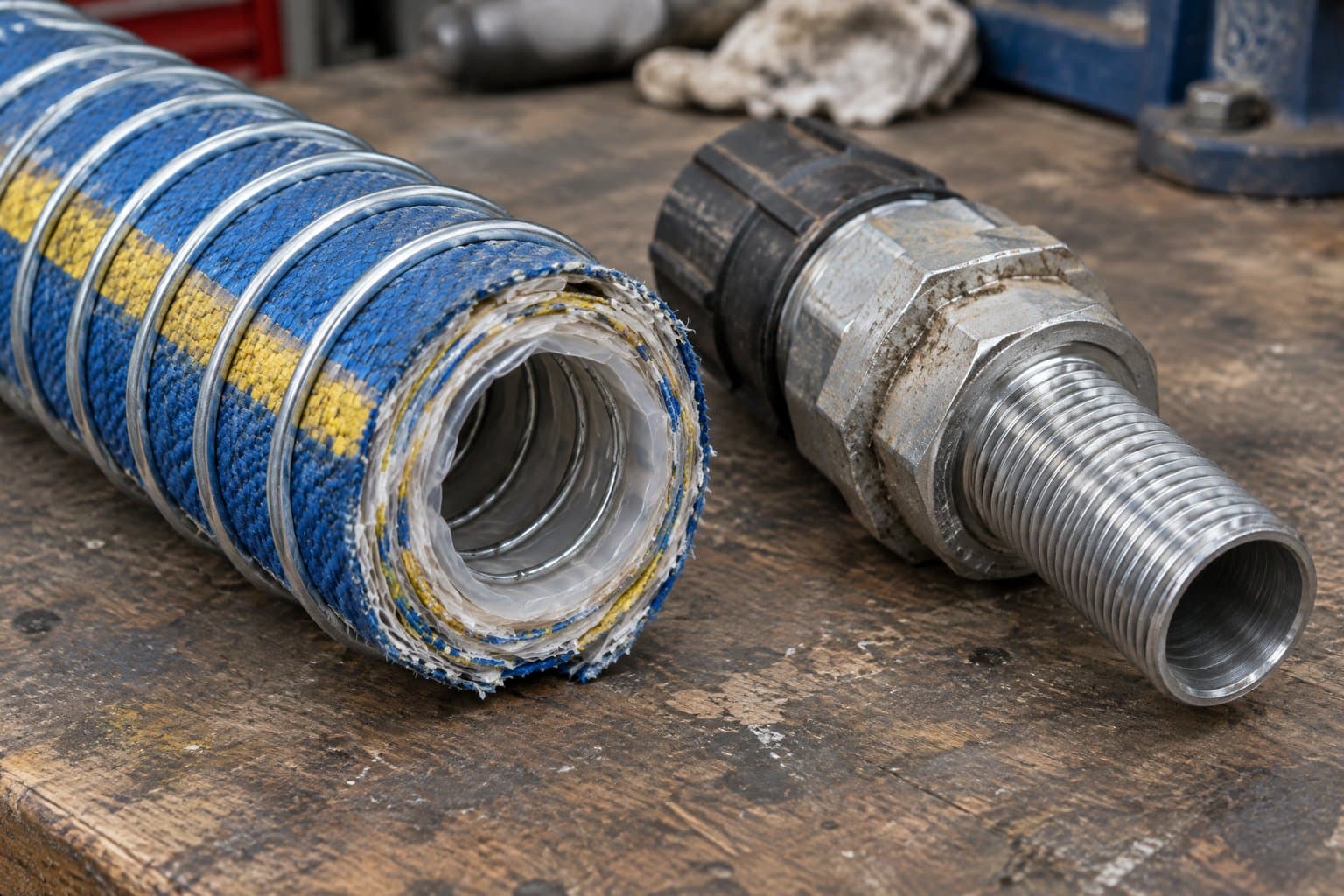
Composite hose is the one industrial hose that is not a rubber hose with something added. It has no bonded wall at all — just layers of film and fabric wrapped between two steel or aluminium wires and sealed into the fittings at each end. That construction is why it is light, why its liner can be matched to the product, and why its fittings are a different part from everything else on the shelf.
/01How it is built.
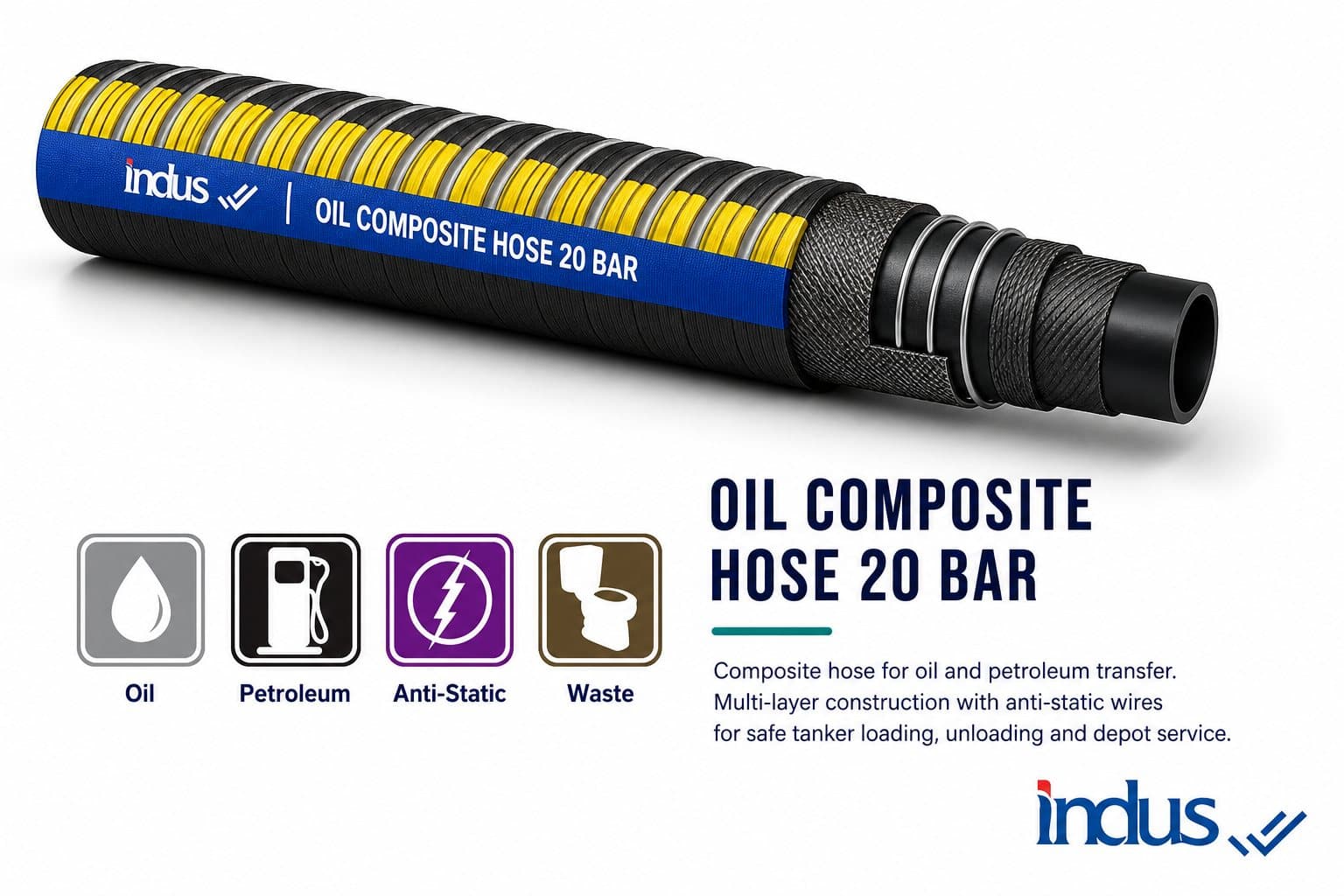
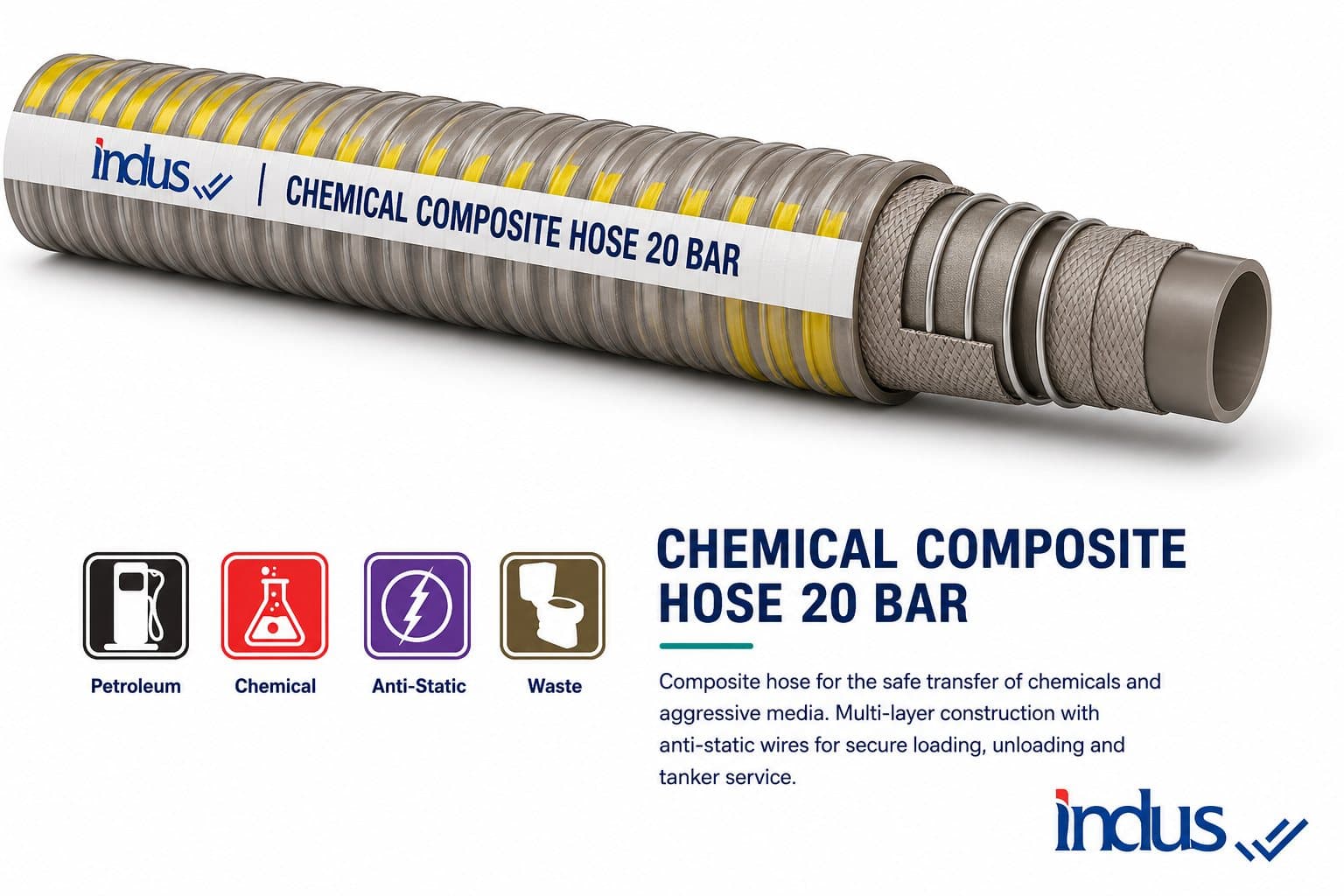
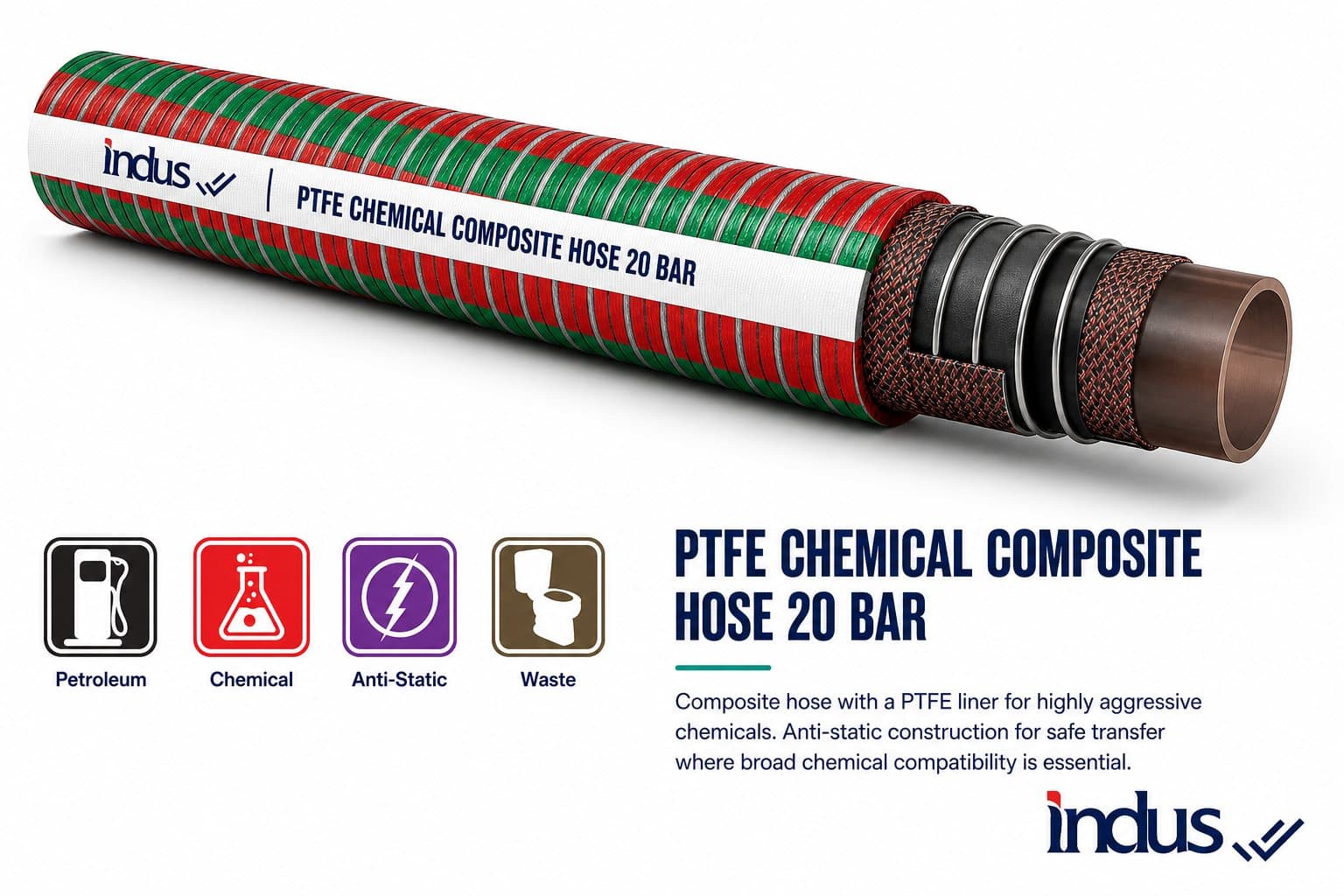
An internal wire helix sits in the bore and gives the hose its shape and suction strength. Over it go layers of polymer film — polypropylene, polyethylene, polyester and, in the PTFE grade, a PTFE lining — and layers of fabric for strength. An external wire helix wound between the internal turns clamps the whole stack together, and a weatherproof PVC cover finishes it. Because nothing is vulcanised, the films can be selected for the product being carried.
| Hose | Rating | Sizes | Temperature |
|---|---|---|---|
| A901GG oil composite | 20 bar, 80 bar burst, SF 4:1 | 1" – DN100 | −30 to +80 °C |
| A906PG chemical composite | 20 bar, 80 bar burst, SF 4:1 | 1" – DN100 | −30 to +80 °C |
| A911SG PTFE chemical compositeHighlighted | 20 bar, 80 bar burst, SF 4:1 | 1" – DN100 | −30 to +120 °C |
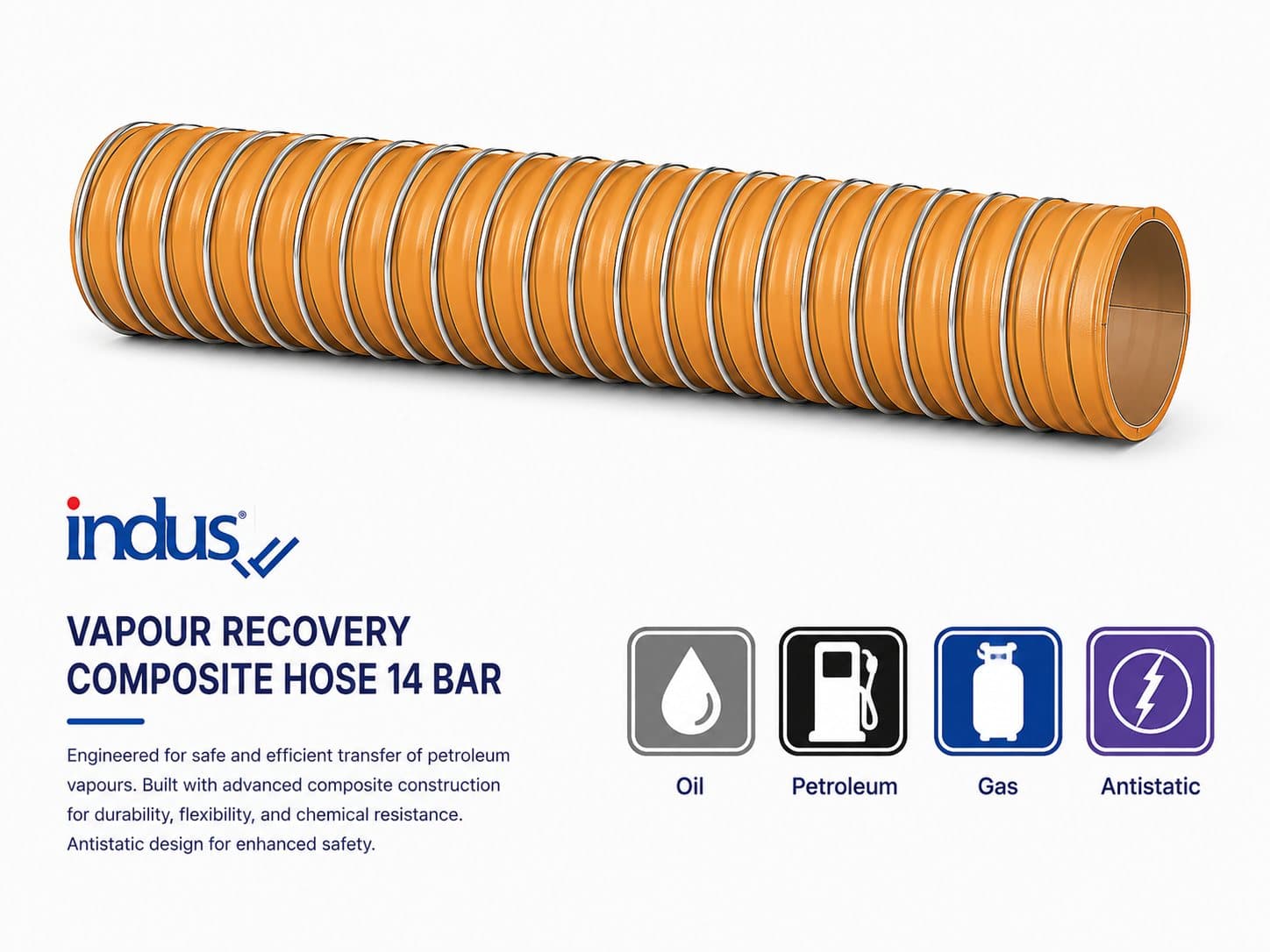
| A901AG vapour recovery | 14 bar, 56 bar burst, EN 13765:2015 Type 3 | DN75, DN100 | −30 to +80 °C |
/02Why it is used.
Two properties matter on a transfer job. It is lighter than a rubber hose of the same bore, which counts on hoses handled by people at a tanker, a rail car or a ship's manifold rather than by a crane. And it tends to weep before it fails: a damaged layer leaks slowly instead of letting go suddenly, which on flammable or aggressive transfer is worth a great deal. The vapour recovery grade adds an internal aluminium wire and polypropylene layers for returning fuel vapour to a tank.
/03Fittings that thread into the wire.
A rubber hose is gripped by squeezing its wall onto a barb. Composite hose has no wall to squeeze, so its fittings engage the wire instead: a spiral tail is threaded into the hose along the internal helix, and a ferrule or a lug nut on a female liner clamps the films and the outer wire down onto it. Our composite fittings — cam lock C and E with spiral tails, SS female liners with lug nuts, hex male tails with BSP or BSPT threads and a flanged tail to ASME B16.5 — are made for composite hose; Sunpool publishes no working pressure for the fittings themselves, so the assembly is rated with the hose. Stainless versions are supplied with 3.1 certificates and leak-tested.
/04Handling and storage.
The trade-off is toughness. Composite is less tolerant of being crushed, dragged over a quay edge or driven over than a rubber hose of the same bore. Support it on saddles where it crosses an edge, keep it off sharp ground, store it straight or on a reel rather than kinked, and inspect the outer wire and cover for crushing after every job. A kink or a crushed section is a reason to retire the length.
Frequently asked questions
- Which standard covers composite hose?
- EN 13765. Our vapour recovery composite hose is printed EN 13765:2015 Type 3, and our composite fittings are listed to the same standard.
- Is composite hose stronger than rubber hose?
- Not in toughness. It is lighter and tends to weep before failing, but it tolerates crushing, dragging and kinking less well than rubber.
- Can I fit a standard cam lock to composite hose?
- Only one made for composite hose, with a spiral tail that engages the internal wire. Our cam lock C and E spiral-tail fittings are made for exactly that.
- What temperature can composite hose take?
- Our oil, chemical and vapour recovery composites are rated −30 to +80 °C; the PTFE chemical composite is rated to +120 °C.
Composite hose
Composite hose fittings
 IH-COMP-CAMLOCK-TYPE-C-X-SPIRAL-TAIL-FOR-COMPOSTCamlock Type C X Spiral Tail For Composite HoseSunpool
 IH-COMP-CAMLOCK-TYPE-E-X-SPIRAL-TAIL-FOR-COMPOSICamlock-Type E X Spiral Tail For Composite HoseSunpool
 IH-COMP-COMPOSITE-HOSE-FEMALE-LINERSS Composite Hose Female LinerSunpool
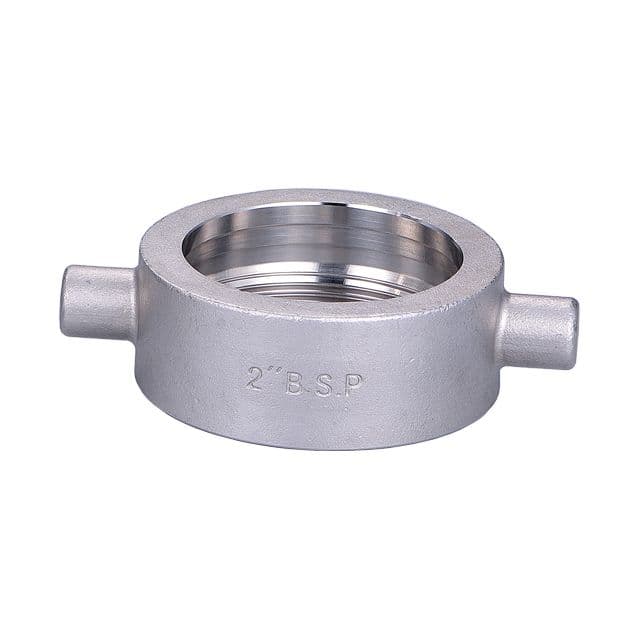 IH-COMP-LUG-NUT-FOR-FEMALE-LINERSS Lug Nut For Female LinerSunpool
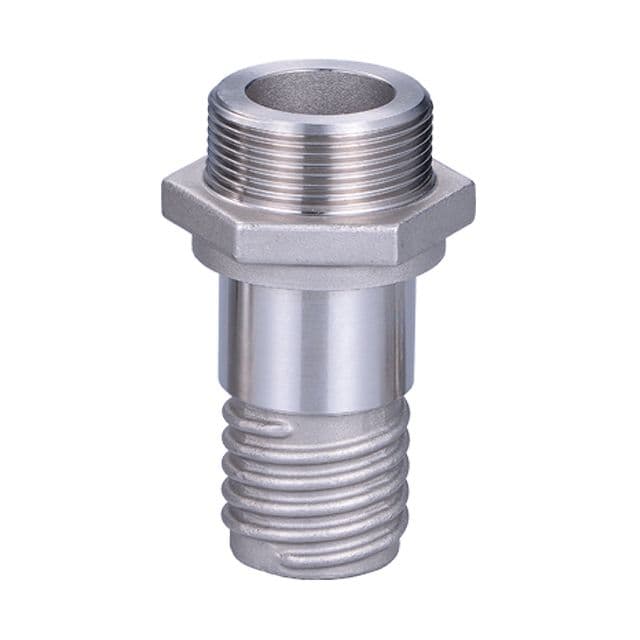 IH-COMP-HEX-MALE-COMPOSITE-HOSE-FITTINGSS Hex Male Composite Hose FittingSunpool
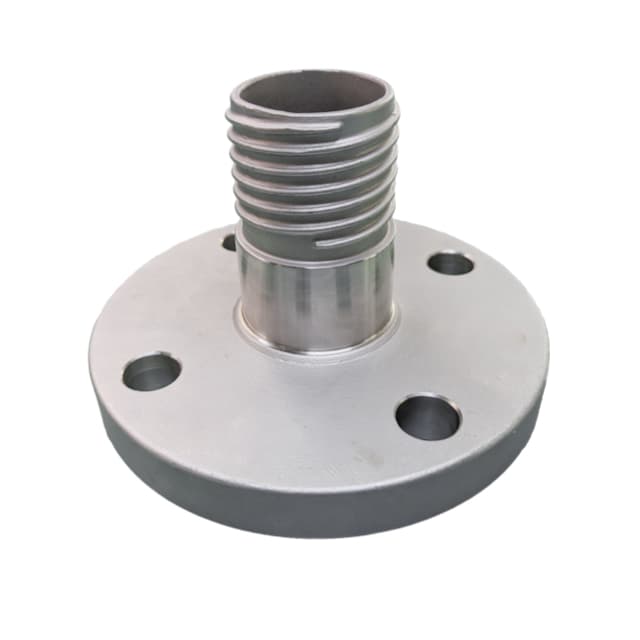 IH-COMP-SPIRAL-HOSE-TAIL-X-FLANGESpiral hose tail x FlangeSunpool


