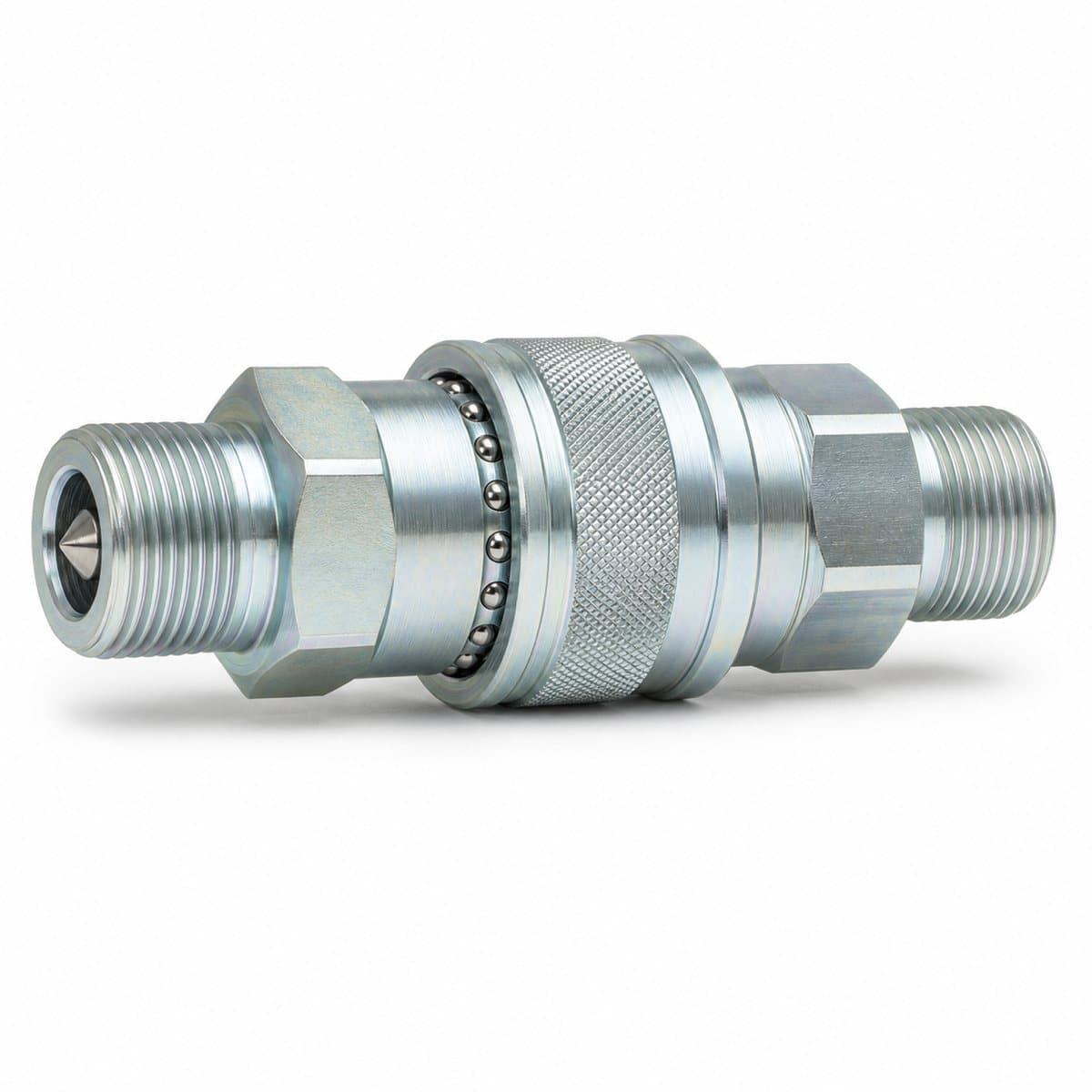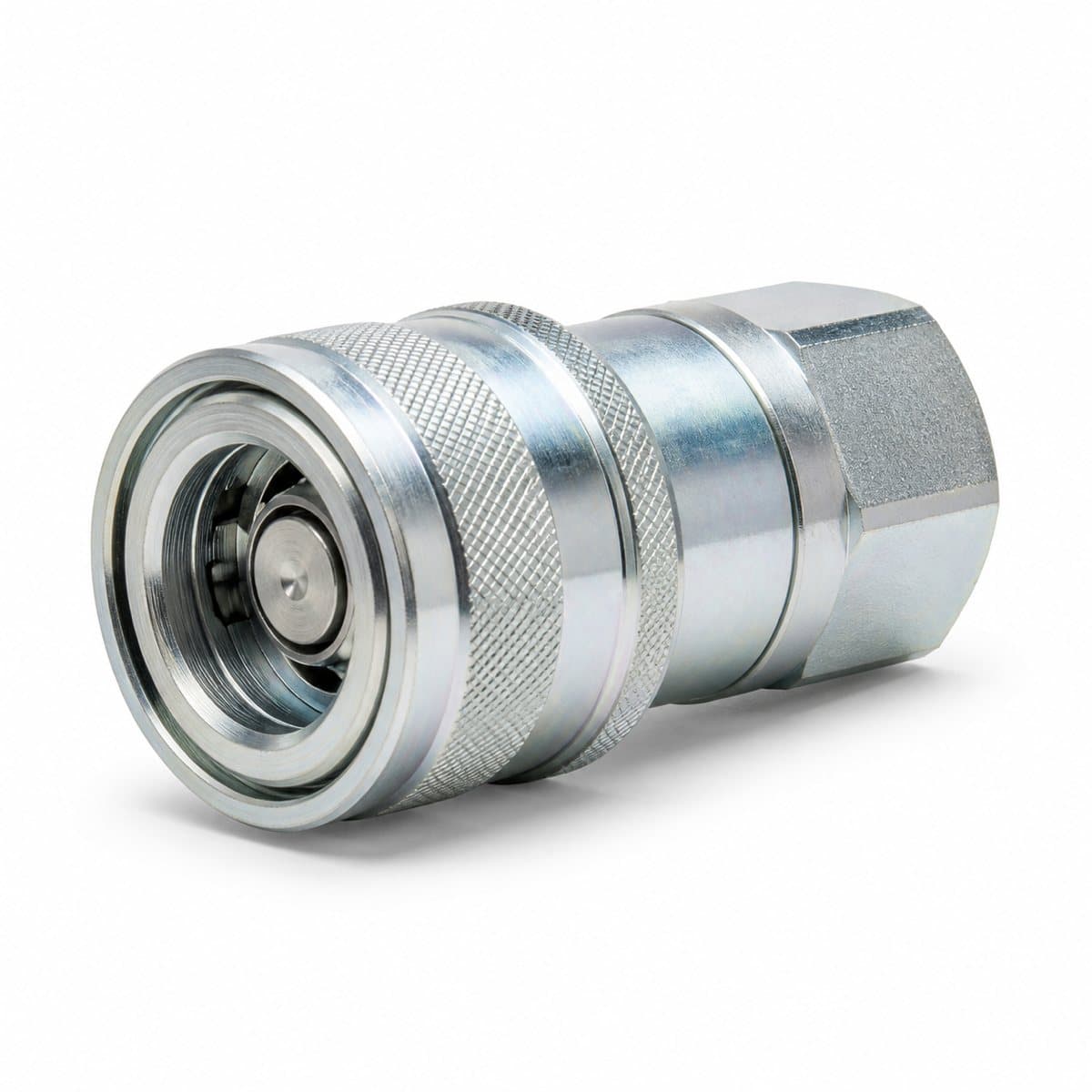
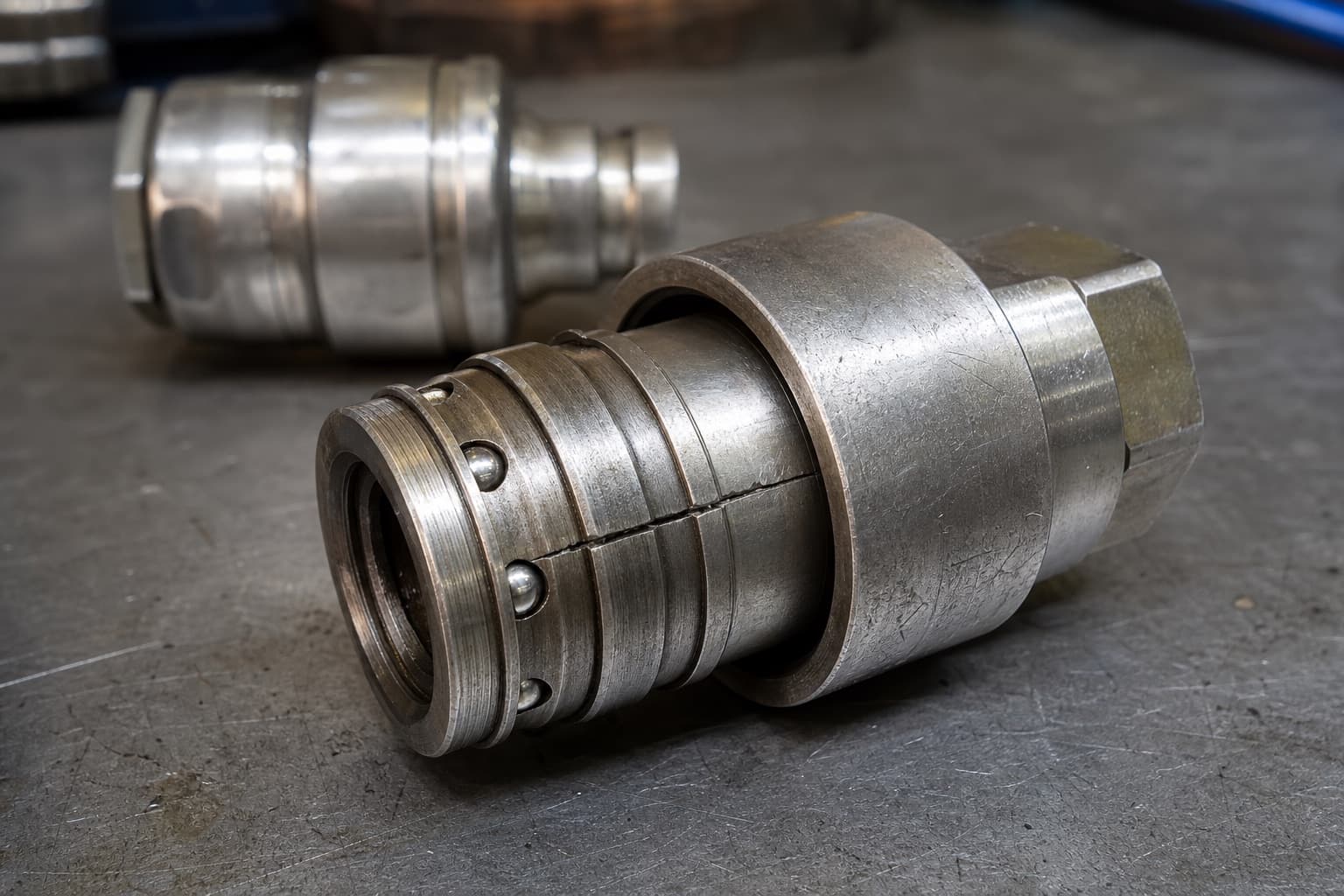
It arrives at the counter as a coupler with a clean longitudinal crack down one side, usually with the customer convinced they were sold a bad part. They almost never were. The female body carries a groove for the locking balls, and that groove is the thinnest section in the whole assembly — so whatever pressure the coupler was subjected to found it.
/01Pressure against a closed poppet.
This is the most common cause and the least obvious. With the coupler disconnected, the poppet closes and the line is sealed. If the operator then works the control lever, the pump delivers into a dead end. There is no flow, so there is no noise, no heat and no movement to warn anyone — and the pressure at the coupler goes to whatever the relief valve allows, which may be far above what the coupler is rated to hold statically in that condition.
| Scenario | Why nobody notices |
|---|---|
| Attachment removed, auxiliary lever bumpedHighlighted | No attachment to move, so nothing looks wrong |
| Auxiliary circuit left in detentHighlighted | The lever stays where it was put |
| Testing a circuit with the coupler capped | Deliberate, and the rating is easy to overlook |
| Machine transported with a control locked | It happens on the truck, not on site |
/02Trapped fluid with nowhere to go.
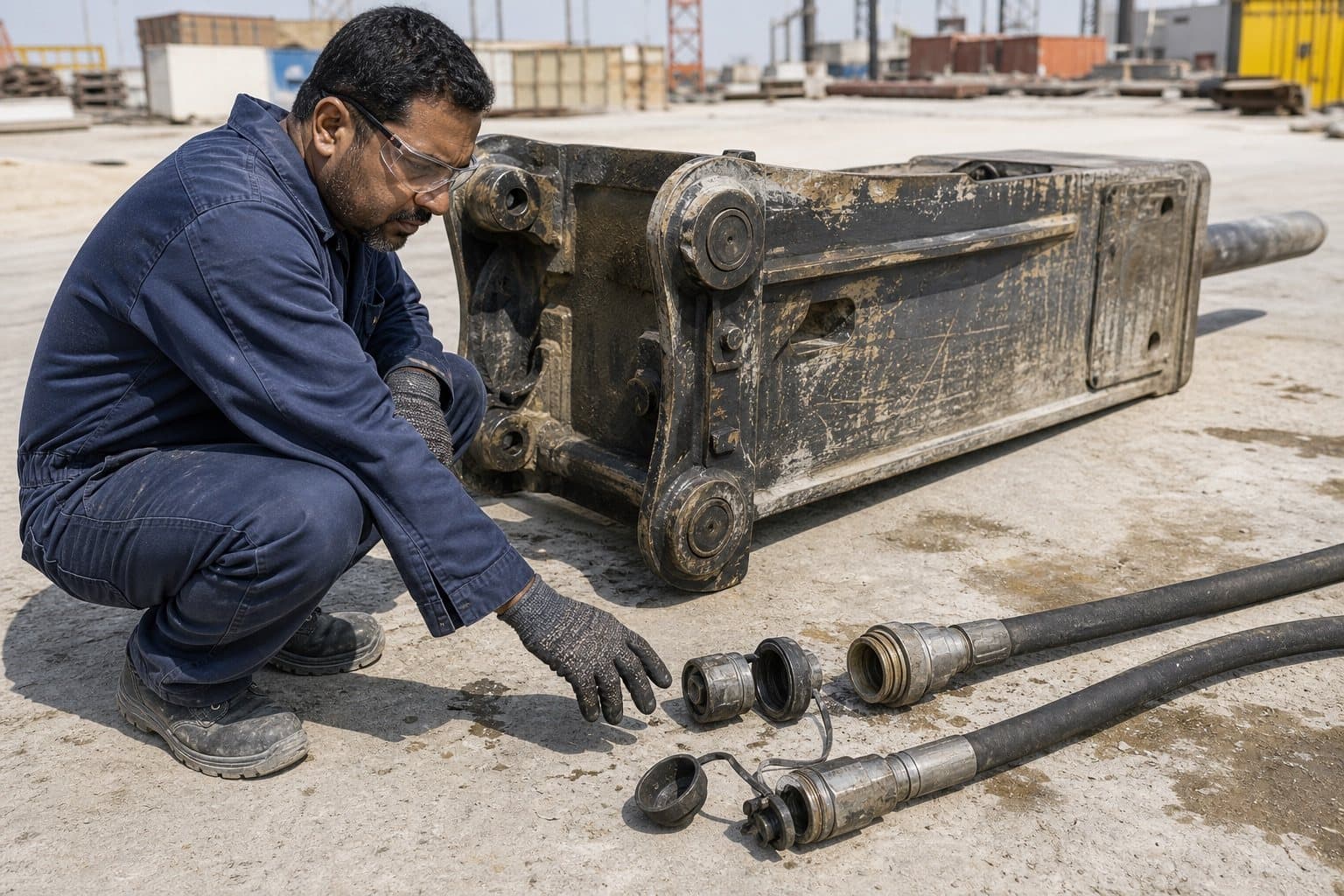
A disconnected coupler seals a fixed volume. Oil expands as it warms, and it is very nearly incompressible, so the expansion appears as pressure instead of as volume. In the Gulf, an attachment lying in direct sun on a dark yard surface goes through a large temperature swing across a working day. Where equipment operates in freezing conditions, water that has found its way into a coupler cavity does the same thing far more violently when it turns to ice.
| What you see | Most likely cause |
|---|---|
| Clean longitudinal split at the ball grooveHighlighted | Overpressure — poppet closed against pump or thermal expansion |
| Bulged body before it split | Sustained overpressure rather than a spike |
| Deformed ball track, sleeve stiff, then crackedHighlighted | Repeated forced connection |
| Cracked with corrosion in the fracture face | The crack was there for some time before it let go |
| Male half also damaged | Forced connection, or the pair was mismatched |
/03Fatigue from being forced.
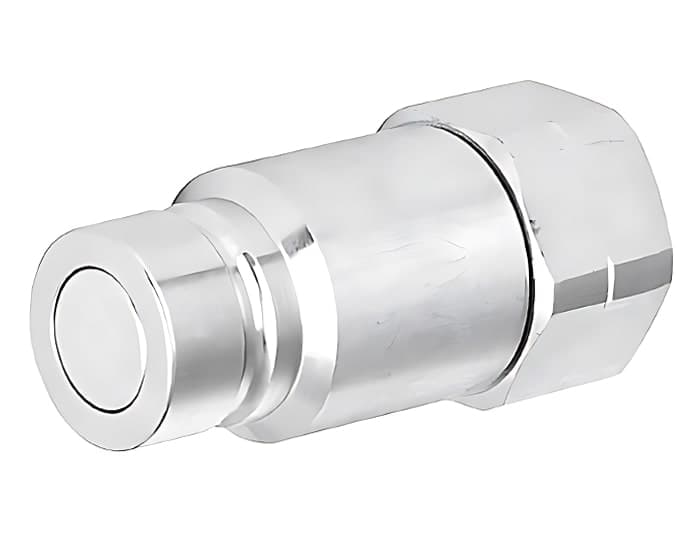
A coupler that will not connect is usually holding trapped pressure, and the common response is a hammer. That does not just risk injury — it deforms the ball track and the sleeve, and from then on the locking balls sit in a distorted groove and concentrate load where the section is thinnest. The crack that appears months later is attributed to the coupler, and it was caused in the yard by a mallet. Couplers built to connect against residual pressure exist for exactly this duty — the connect-under-pressure farm coupler is one — and a flat-face ISO 16028 coupler is easier to keep clean.
/04Stopping it happening again.
| Measure | Which cause it addresses |
|---|---|
| Neutral the auxiliary control before disconnecting, and leave it thereHighlighted | Pressure against a closed poppet |
| Store attachments and loose hoses in shade | Thermal expansion |
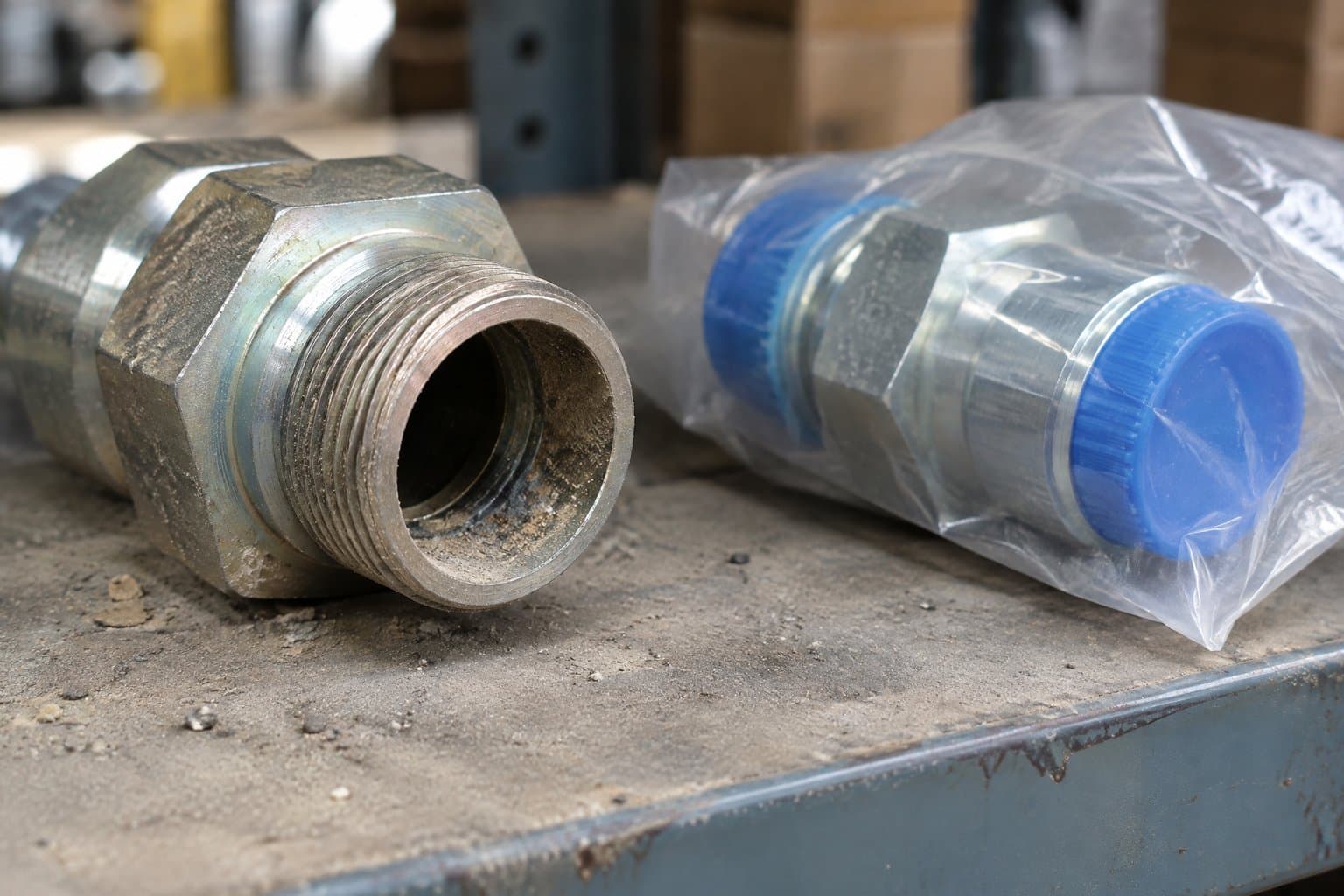
| Fit rated plugs, not dust caps, where a circuit stays pressurised | Pressure against a closed poppet |
| Pressure-eliminator or screw-to-connect couplersHighlighted | Forced connection and trapped pressure together |
| Replace couplers as matched pairs | Mismatch and uneven ball loading |
| Retire any coupler that has been hammeredHighlighted | Fatigue, before it becomes a crack |
Common questions
- Was I sold a defective coupler?
- Occasionally, but rarely. A clean split at the ball groove is the signature of overpressure at the thinnest section, and the three ways that pressure arises are all things that happen in service.
- It is cracked but not leaking. Can I finish the shift?
- No. A cracked pressure-carrying part can separate under load, and the failure mode is a jet of fluid and two halves parting. Replace it.
- Should I replace both halves?
- Yes. Whatever cracked one half loaded the other, and a mismatched replacement is how the next failure starts.
- Is this more common in the UAE than elsewhere?
- The thermal expansion route is, because surface temperatures on equipment standing in direct sun are far above air temperature. The freezing route is not relevant here.
- Would a higher-rated coupler solve it?
- It raises the threshold without addressing the cause. If pressure is being applied against a closed poppet, the right fix is the procedure and the plug, not a stronger part to break later.