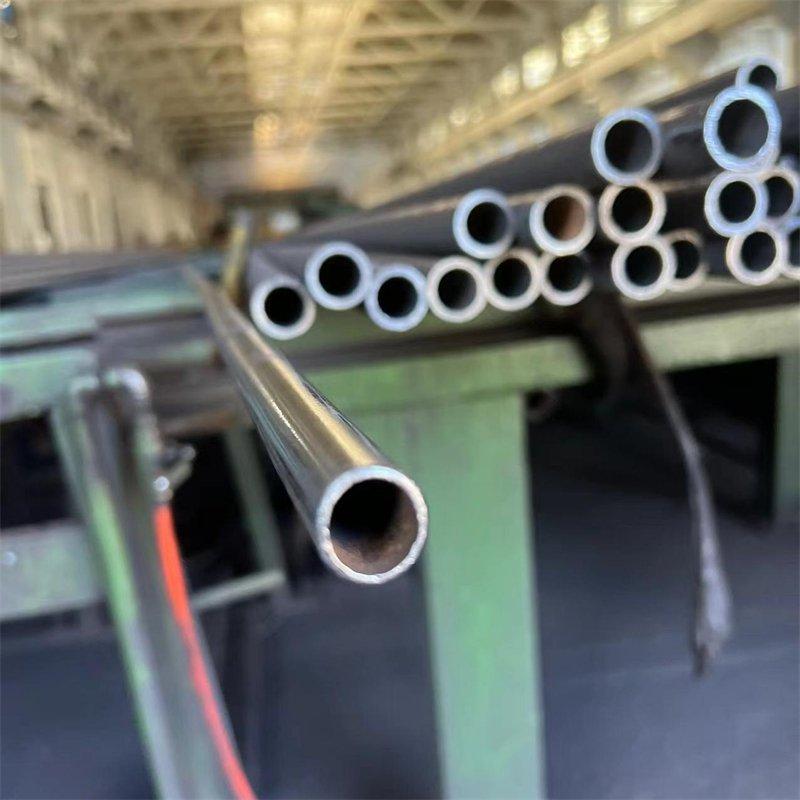
Seamless steel pipe looks the same on the rack whether it is going into a flowline or down a well, but the two are bought to different API standards with different grades, ends and tests. Mixing them up on an enquiry is a common source of wrong quotations.
/01Side by side.
| Point | API 5L line pipe | API 5CT casing and tubing |
|---|---|---|
| ISO equivalent | ISO 3183 | ISO 11960 |
| Purpose | Transport: pipelines, flowlines, gathering lines | Wells: casing strings and production tubing |
| Grades | B, X42, X46, X52, X56, X60, X65 … | J55, K55, N80-1, N80Q and higher |
| Product levels | PSL1 and PSL2 (Annex H for sour service) | PSL1 to PSL3 |
| Ends | Plain or bevelled for welding | Threaded and coupled to API 5B, or plain |
| Sized by | NPS and wall or schedule (ASME B36.10M) | OD and weight per foot |
| Key test | Hydrostatic test; PSL2 adds toughness | Hydrostatic and drift test |
/02Line pipe.
The number in an X-grade is the minimum yield strength in thousands of psi: X52 is 52 ksi. PSL2 adds tighter chemistry and carbon-equivalent limits, mandatory notch toughness and more testing; sour-gas gathering lines are ordered PSL2 to Annex H. Our API 5L listing covers grades B to X65 PSL1 and PSL2 by NPS and schedule.
/03Casing and tubing.
Casing lines the borehole and tubing carries production inside it. Both are ordered by OD, weight per foot, grade and connection, and every length is drift-tested with a mandrel to prove the inside diameter. Our API 5CT listing covers J55, K55 and N80 in tubing and casing sizes.
/04Plant piping: A53, A106, A333.
Inside the fence, process and utility piping is usually bought to ASTM: A106 for high-temperature process and steam lines, A53 for water, air, utility and fire-water piping, and A333 for low-temperature service such as LNG, LPG and ethane lines, with Charpy impact testing.
Common questions
- Can API 5L pipe be used as casing?
- No. Casing must meet API 5CT, including its threads, drift and test requirements.
- What does X52 mean?
- API 5L grade with a minimum yield strength of 52,000 psi.
- What is the difference between PSL1 and PSL2?
- PSL2 has tighter chemistry, mandatory toughness testing and more inspection. Sour service is ordered PSL2 to Annex H.
- Is A106 the same as API 5L?
- They overlap in chemistry, and dual-certified pipe exists, but A106 is a plant-piping standard for high temperature and API 5L a line-pipe standard. Order to the one your specification names.
- What is a drift test?
- A mandrel of specified diameter is passed through each length of casing or tubing to prove the minimum inside diameter.