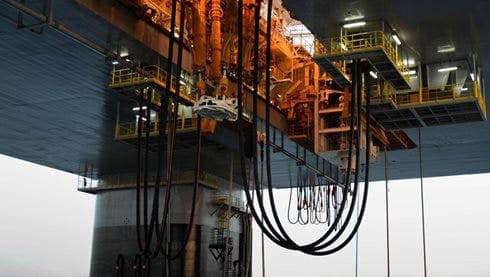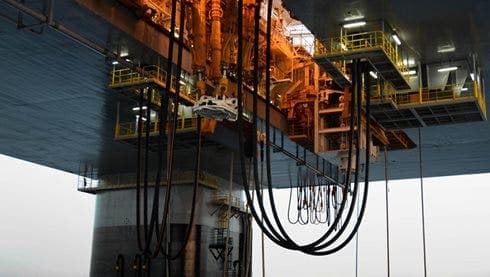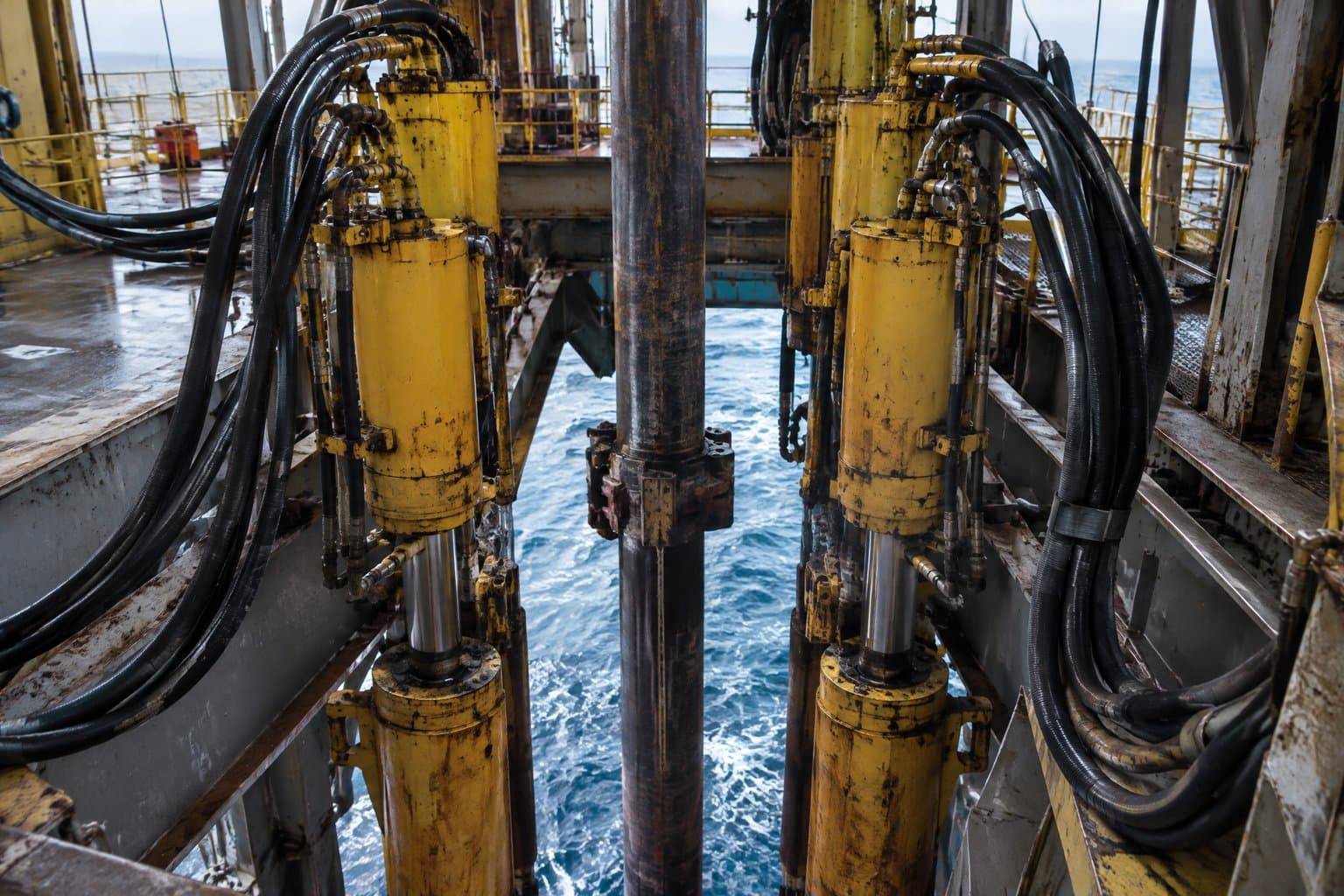
On a floating drilling rig the riser has to stay in tension while the vessel heaves, and the drill string has to stay steady on bottom while the derrick rises and falls. Hydraulic tensioners and compensators do that, stroking with every wave, and the hoses that feed them flex with every stroke. Few hoses anywhere see as many working cycles, which is what this family is built for.
/01What the hose does.
Tensioner and compensator systems store energy in high-pressure gas-over-oil accumulators and move hydraulic fluid in and out of cylinders as the vessel moves. The hoses that link them carry that fluid at pressure while bending and straightening thousands of times a day. Pressure is steady and moderate by oilfield standards; the cycle count is enormous, and it is fatigue at the reinforcement and the end fittings that ends a hose's life.
| Hose | Rating | Bore | Temperature |
|---|---|---|---|
| Riser tensioner hoseHighlighted | 5,000 psi WP, 12,500 psi MBP | 2" – 4" | −30 to +82 °C |
| Drill string compensator hose | 5,000 psi WP, 12,500 psi MBP | 2" – 4" | −30 to +82 °C |
| Hydraulic tensioner and compensator assemblies | 5,000 psi WP, 12,500 psi MBP | 1" – 4" | −30 to +82 °C |
/02How it is built.
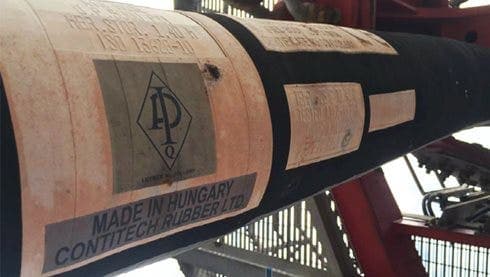
All three are built with a hydraulic-fluid-compatible synthetic rubber liner and multiple plies of high-tensile steel cable, listed as heavy-cycle rated on the riser tensioner and drill string compensator hoses, with flanged couplings. The 2.5:1 ratio between working pressure and minimum burst on our listings is the same as on API 7K rotary hose, and our listings give API Spec 7K as a cross-reference for the family.
/03Cycle count decides the life.
Because the hose never stops moving, a replacement interval set by calendar alone can be wrong in either direction. A rig in a sheltered location and one in heavy seas put very different cycle counts on the same hose in the same year. Track the hose's service — time and conditions — and replace on age and duty, using any failures and inspection findings to refine the interval. Inspect for cover damage, chafe at clamps and guides, movement at the end fittings and weeping at the flanges whenever access allows.
/04Ordering a replacement.
Send the system (tensioner or compensator), the bore, the length, the flange type and rating at each end, the fluid and the documentation the rig requires. These are certified assemblies built and tested as complete units, not field builds. The wider picture of rig hose standards is in the oilfield hose guide.
Frequently asked questions
- What pressure is riser tensioner hose rated for?
- Ours is rated 5,000 psi working with a 12,500 psi minimum burst, from 2" to 4".
- What is the difference between tensioner and compensator hose?
- They serve different systems — the riser tensioners and the drill string compensator — but share the construction and rating on our listings: 5,000 psi, steel cable plies, flanged.
- Why do tensioner hoses fail?
- Mostly fatigue from continuous flexing, at the reinforcement and the end fittings, plus external damage at clamps and guides. Cycle count matters more than pressure.
- Which standards apply?
- Our listings give API Spec 7K as a cross-reference for this family. Specify the standard and documents your rig requires with the order.