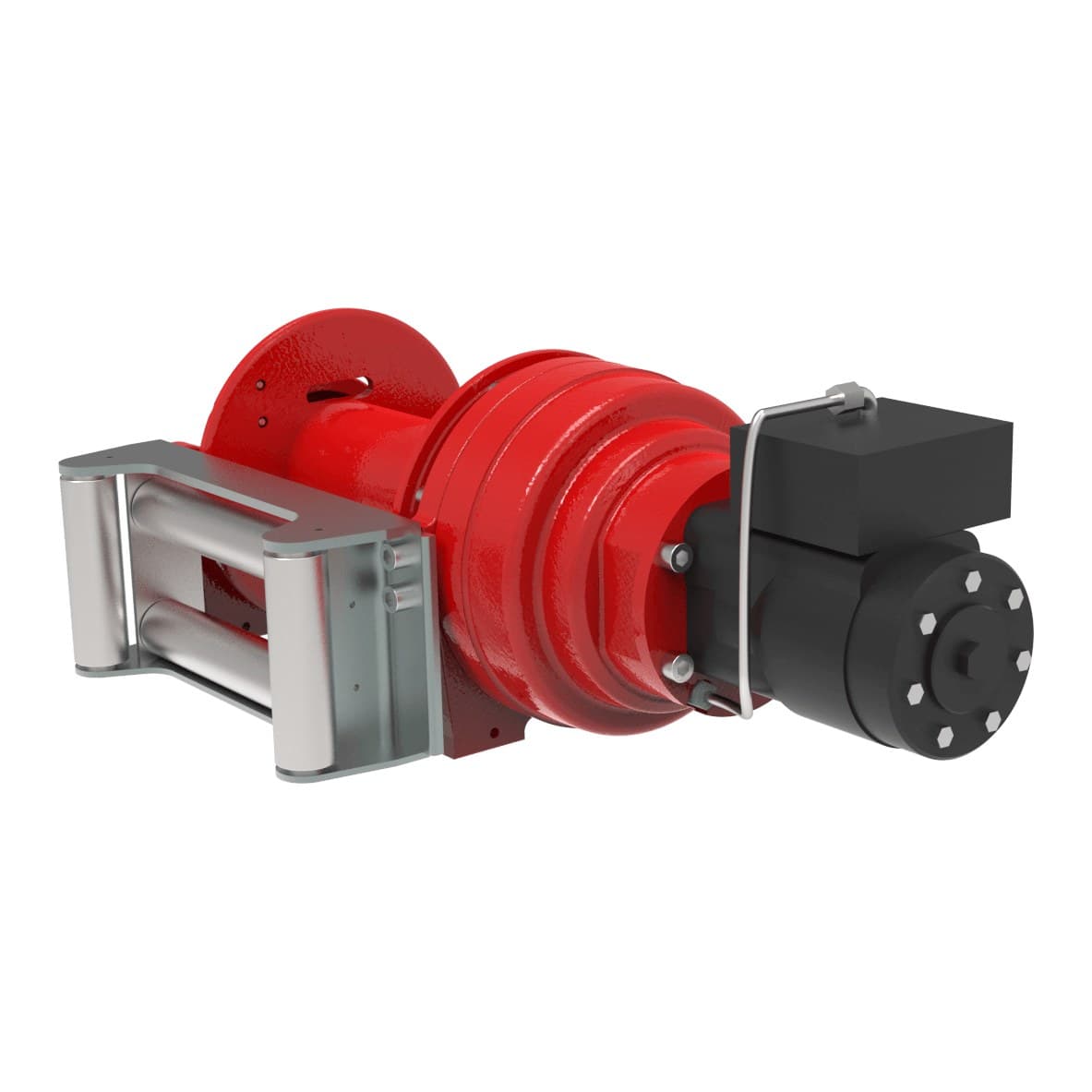
On a tow truck or recovery body, the winch does the work the crane cannot: dragging a vehicle out of sand, a ditch or a wadi, or up onto a bed. The pull needed depends less on the vehicle’s weight than on what holds it — a stuck truck in soft sand can need more pull than its own weight. Choosing the winch means sizing that pull and then fitting it for how it will be used.
/01Size the pull.
Recovery winches are rated by their first-layer line pull. Dinamic Oil’s T series runs from 2,700 daN (T27 IN) to 30,000 daN (T300) on 10 to 26 mm cable. As the cable builds up on the drum, pull falls and speed rises, so check the datasheet’s figure for the layer the winch will really be working from — with most of the cable paid out, that is usually one of the first two. A single snatch block anchored to the casualty and the cable returned to the truck roughly doubles the pull, at half the cable speed, less the sheave’s losses.
/02Fit it for the job.
| Option | What it does | When to choose it |
|---|---|---|
| Drum freewheelHighlighted | Disconnects the drum so the cable can be pulled out by hand | Always on recovery work; manual, pneumatic or hydraulic |
| Fairlead (C2) | Guides the cable with horizontal and vertical rollers | Pulls at an angle to the truck |
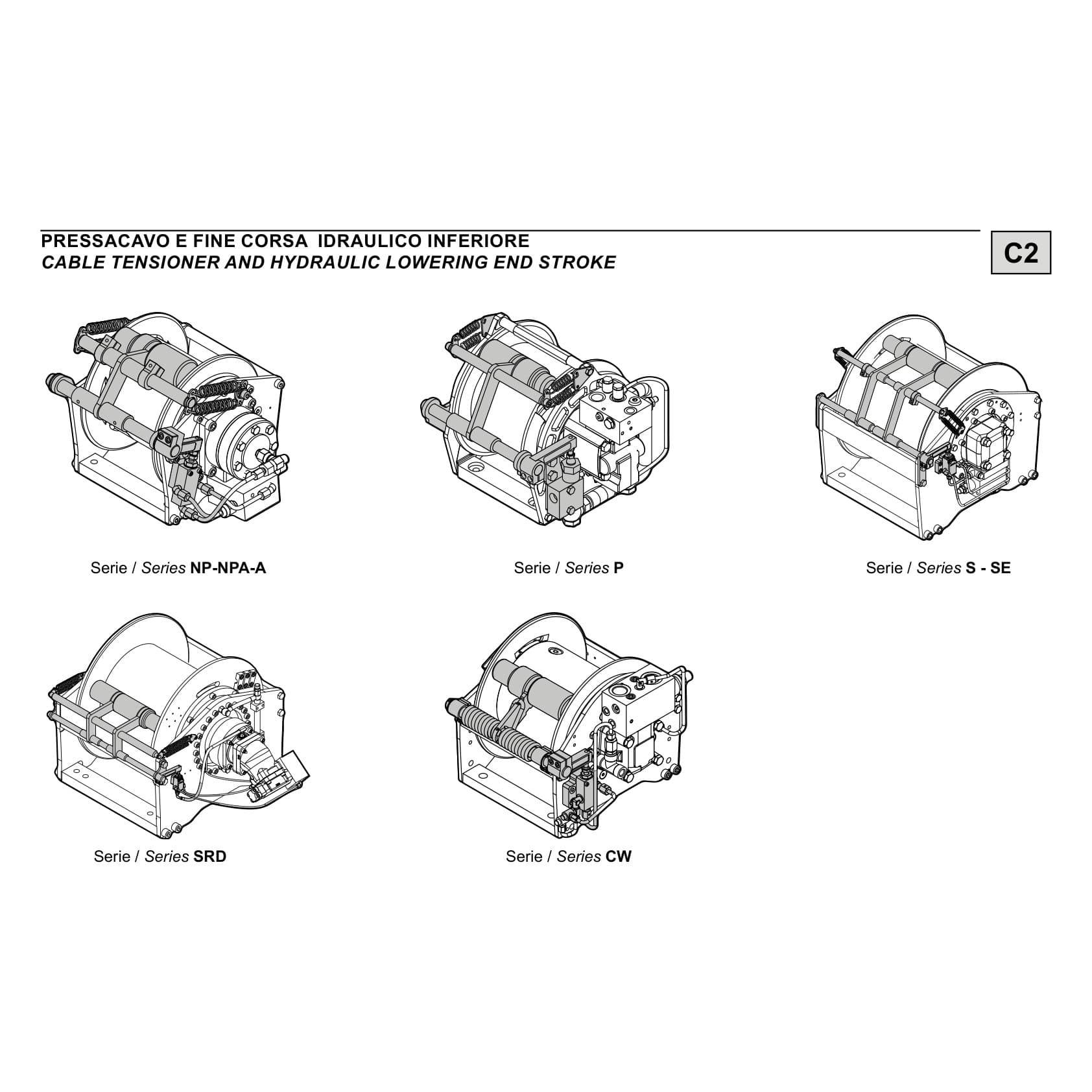
| Cable tensioner (B) | Presses the cable onto the drum when there is no load | Even spooling when rewinding slack cable |
| Rotation and exit | Clockwise or counterclockwise, cable over or under the drum | To suit where the winch sits on the body |
Every T series winch has an orbit hydraulic motor with a pilot-operated overcentre valve mounted on it, so the load cannot run the cable back, and a negative multi-disc brake that locks the drum whenever the motor stops. The motor, brake and planetary gearbox are separate modules on the drum, which keeps installation and maintenance simple.
/03Cable and care.
Use the cable diameter the winch is built for, in a construction made for drums: Dinamic Oil recommends 6x36 Warrington Seale with a steel core (IWRC) to ISO 2408, 2,160 N/mm² wire, with a thimble and pressed-sleeve end. Keep at least five wraps on the drum. Run the winch from a pump that delivers its rated flow at its pulling pressure, keep the return-line back-pressure under 5 bar, and check the gear oil level every 250 hours — first change at 500 hours, then once a year.
Common questions
- Can I fit a bigger cable for more strength?
- No. The drum, brake and rating are built around the listed cable diameter; a larger cable reduces capacity and spools badly.
- Why does the winch need an overcentre valve?
- It holds the load against the motor, so a vehicle on a slope cannot drag the cable back out when the operator stops.
- How fast is a recovery winch?
- Slow by design: 4.5 to 12 m/min on the first layer across the T series, faster on outer layers.
- Is a pneumatic freewheel worth it?
- On trucks with an air system it saves the operator climbing up to the winch to disengage the drum.
- What oil does it use?
- Gear oil ISO VG 150 in the gearbox, checked every 250 hours and changed yearly after the first 500 hours.