
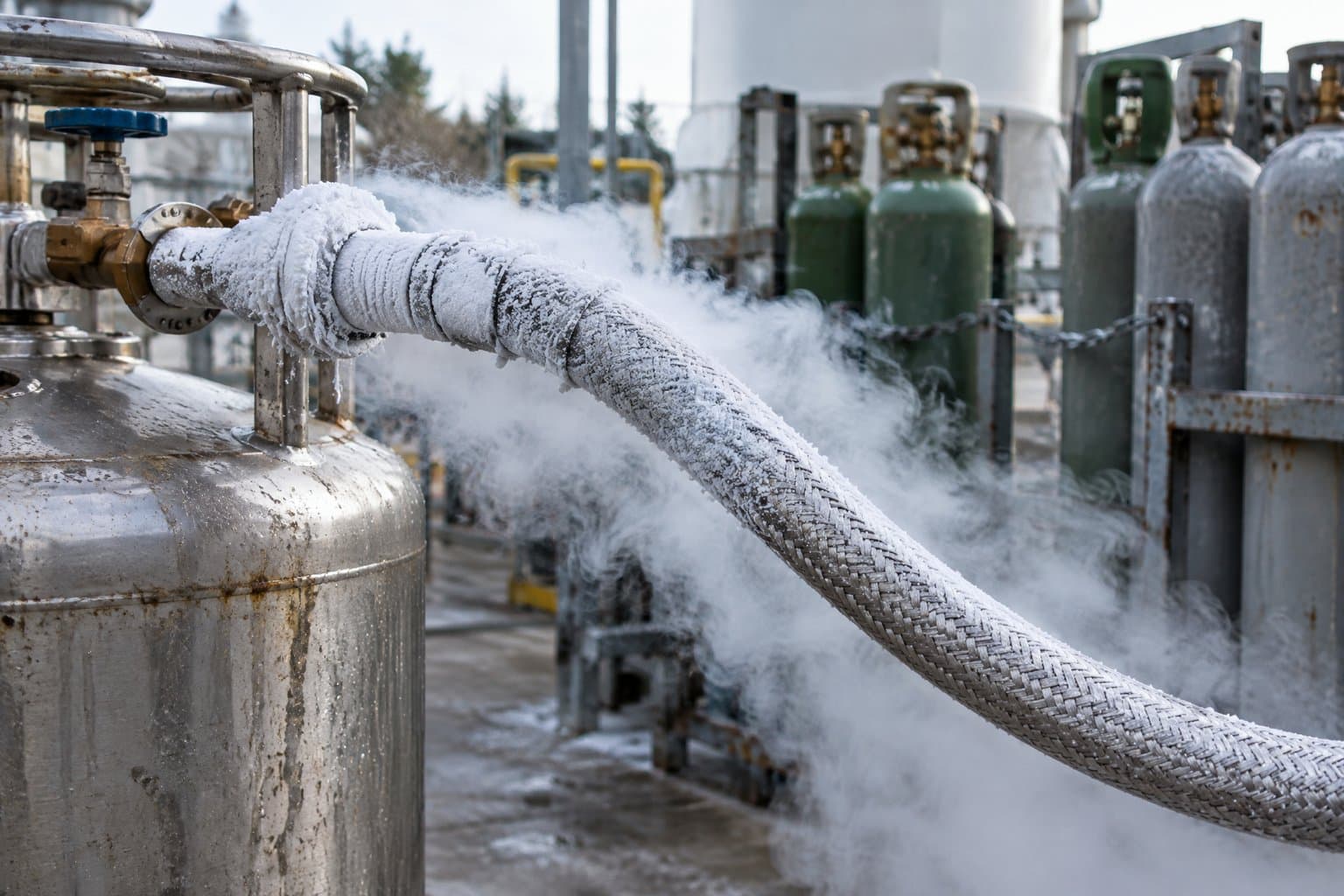
At −196 °C a rubber hose is no longer a hose — it is brittle enough to shatter. Every cryogenic transfer line, from a nitrogen dewar to an LNG truck, is therefore a stainless steel metal hose. What separates one from another is the gas, the cleanliness it demands, the pressure, and the certifications that come with the duty.
/01By gas.
| Service | Hose | Rating | Sizes |
|---|---|---|---|
| Liquid nitrogen (LIN) | Thorburn LIN transfer hose, 316L, double braid | 35 bar, −196 to +60 °C | DN13 – DN100 |
| Liquid argon (LAR) | Witzenmann LAR transfer hose, 316L, double braid | 30 bar, −186 to +60 °C | DN13 – DN100 |
| Liquid oxygen (LOX)Highlighted | Thorburn LOX transfer hose, 316L, double braid | 35 bar, −183 to +60 °C | DN13 – DN100 |
| LNG unloading | Thorburn LNG unloading hose, 316L, double braid | 30 bar, −162 to +60 °C | DN50 – DN200 |
| LNG marine transfer | Senior Flexonics LNG marine hose, 316L, double braid | 50 bar, −162 to +60 °C | DN100 – DN250 |
| CO₂ dewar transfer | Thorburn CO₂ connector, single braid | 50 bar, −78 to +60 °C | DN13 – DN25 |
| CO₂ process plant | Thorburn CO₂ connector, double braid | 100 bar, −78 to +60 °C | DN25 – DN100 |
/02Oxygen is the special case.
Liquid and gaseous oxygen turn ordinary contamination — a film of oil, a fleck of grease, a fibre — into a fuel. Hose for oxygen service must be cleaned and kept clean for oxygen, sealed and bagged until it is installed. Our LOX transfer hose lists CGA-440 and CGA G-4.1, the Compressed Gas Association's oxygen-cleaning practice, together with UL536; our industrial oxygen service hose (CGA96) carries CGA-8.1-M86, CGA96, CGA G-4.1 and UL536. Never substitute a general-purpose metal hose on an oxygen line.
/03Couplings, insulation and frost.
Cryogenic hose ends in couplings that seal at temperature. Our Thorburn T52 non-valved cryogenic couplings come in a liquid-phase version (DN13 to DN100, 35 bar) and a vapour-return version (DN13 to DN50, 14 bar), both rated to −200 °C and listed with CGA-8.1-M86. An uninsulated cryogenic hose frosts heavily and boils off product; the ThermaCover cryogenic insulation cover fits host hoses from DN25 to DN200 and is rated to −200 °C. Keep frosted hose away from people — cold burns from bare metal at these temperatures are immediate.
/04Handling and certification.
Metal hose at cryogenic temperature is stiffer than at ambient, and the corrugations are where fatigue starts: move it only when warm where possible, never twist it, and support long runs. Specify the certification the duty requires when ordering — CGA references for industrial gases, and for marine LNG our Senior Flexonics hose lists the IGC Code with BV, DNV or Lloyd's approval selectable.
Frequently asked questions
- Can rubber hose carry liquid nitrogen?
- No. Rubber becomes brittle at cryogenic temperatures. Liquid nitrogen hose is stainless metal hose — ours is rated to −196 °C.
- What makes a hose suitable for oxygen?
- Oxygen-compatible materials and cleaning for oxygen service. Our LOX hose lists CGA G-4.1 cleaning and CGA-440.
- What pressure are cryogenic hoses rated for?
- Our liquid transfer hoses are rated 30–50 bar; the CO₂ process connector is rated 100 bar. Check the listing for your gas and size.
- Do cryogenic hoses need insulation?
- Usually. Uninsulated hose frosts and boils off product. Our ThermaCover cryogenic insulation cover fits DN25 to DN200 hose and is rated to −200 °C.
Cryogenic hose and couplings
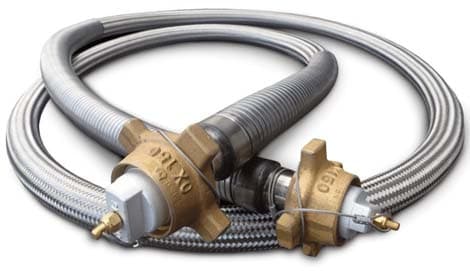 IH-MH-THORBURN-CRYO-LINThorburn Cryogenic Liquid Nitrogen (LIN) Transfer HoseThorburn Flex
 IH-MH-WITZENMANN-CRYO-LARWitzenmann Cryogenic Liquid Argon (LAR) Transfer HoseWitzenmann
 IH-MH-THORBURN-CRYO-LOXThorburn Cryogenic Liquid Oxygen (LOX) Transfer HoseThorburn Flex
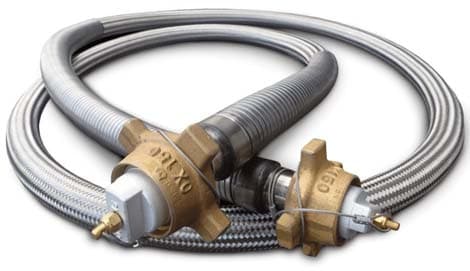 IH-MH-THORBURN-CRYO-LNG-UNLOADThorburn Cryogenic LNG Unloading HoseThorburn Flex
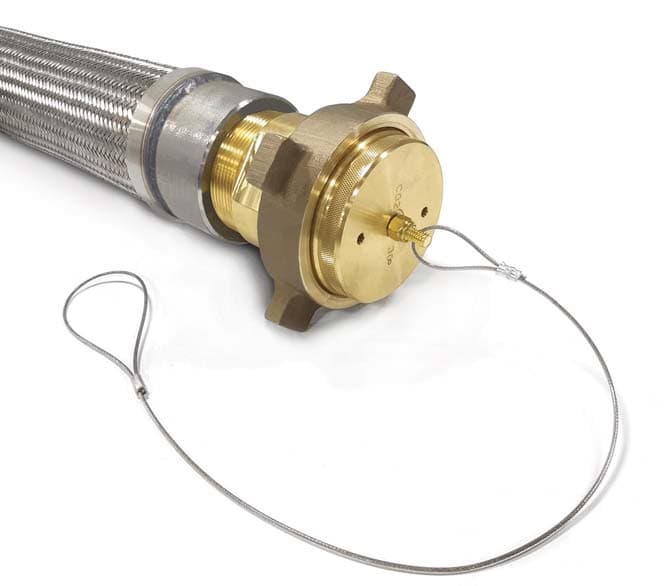 IH-MH-THORBURN-CRYO-CO2-PROCESSThorburn Cryogenic CO₂ Connector — Process PlantThorburn Flex
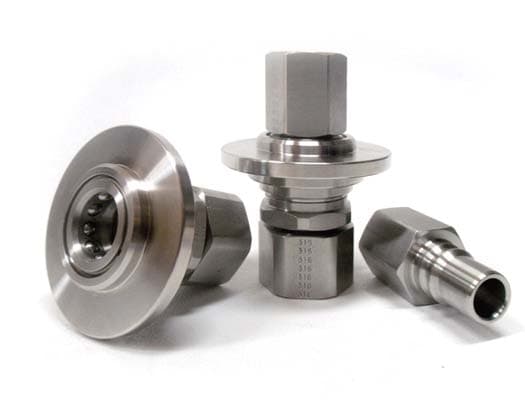 IH-MH-THORBURN-T52-CRYO-LIQUIDThorburn T52 Non-Valved Cryogenic Coupling — Liquid PhaseThorburn Flex
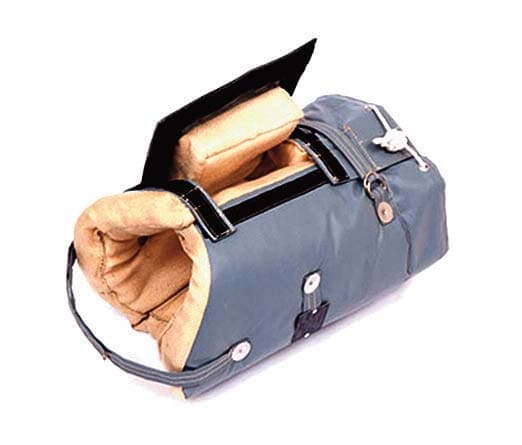 IH-MH-THORBURN-THERMACOVER-CRYOThorburn ThermaCover Cryogenic Insulation CoverThorburn Flex
 IH-MH-THORBURN-CGA96-O2Thorburn CGA96 Industrial Oxygen Service HoseThorburn Flex


