
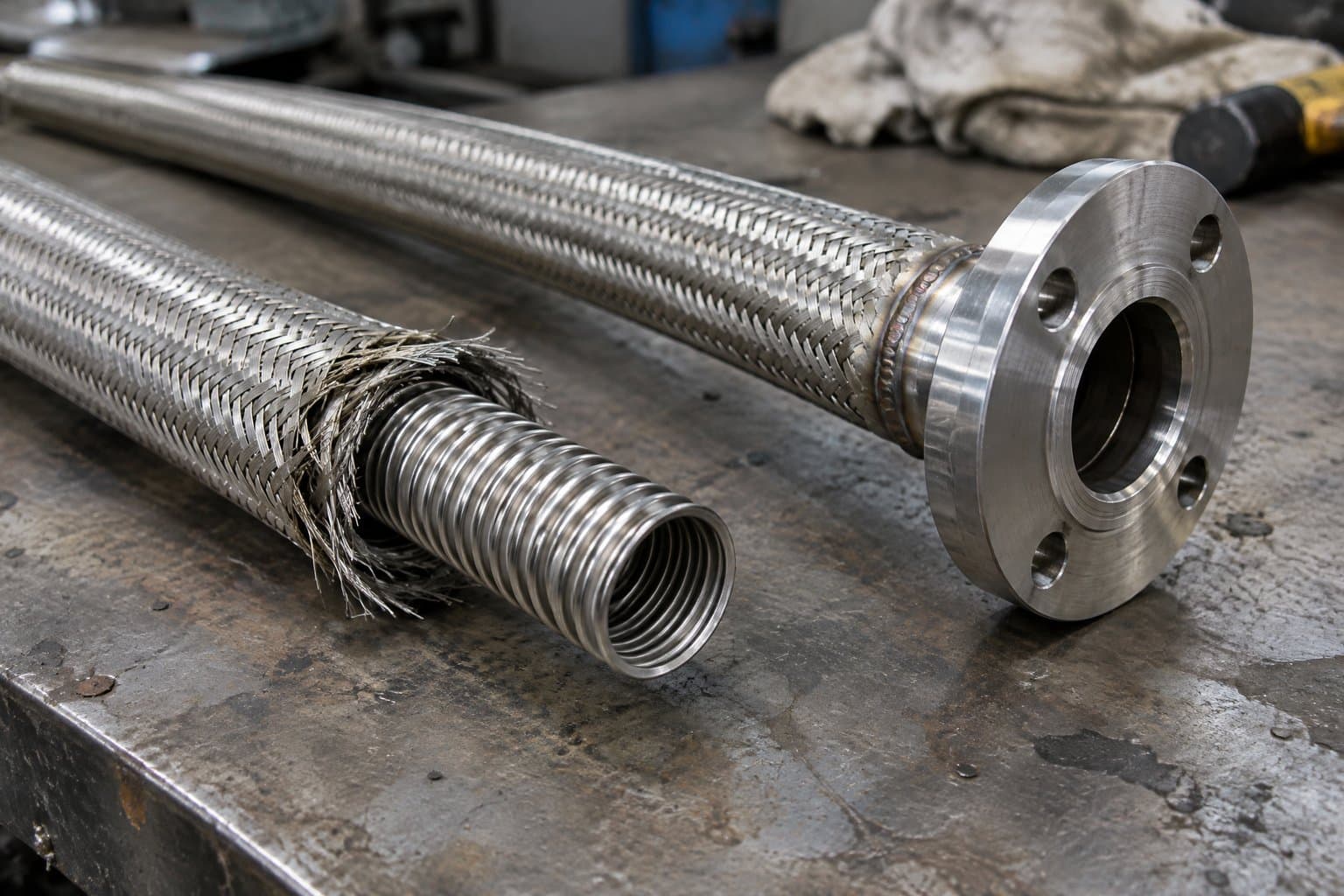
Where a rubber hose meets its limits — heat, cryogenic cold, aggressive media, fire risk, permeation — the answer is usually metal. A corrugated stainless hose is two parts doing two jobs: a thin corrugated core that bends and keeps the medium in, and a braid that stops the core stretching like a spring under pressure. Almost everything about choosing one follows from that split.
/01Core and braid.
Pressurise an unbraided corrugated core and it tries to extend, the way a bellows does. The braid — woven stainless wire over the core, welded to the end fittings — stops that, and in doing so carries most of the pressure load. That is why the same core is rated so differently with and without braid. On our Thorburn S9x series, the 316L core is rated up to 13 bar unbraided (S91), 146 bar with a single 304 braid (S92) and 215 bar with a double braid (S92Z).
| Construction | Model | Up to (smallest size) | Sizes |
|---|---|---|---|
| Unbraided core | S91 | 13 bar | DN6 – DN350 |
| Single 304 braidHighlighted | S92 | 146 bar | DN6 – DN350 |
| Double 304 braid | S92Z | 215 bar | DN6 – DN300 |
| Single 316L braid (premium) | S93 | 146 bar | DN6 – DN350 |
| Double 316L braid (premium) | S93Z | 215 bar | DN6 – DN300 |
/02316L or 321, 304 or 316L braid.
Our stainless corrugated hoses are built on 316L or 321 cores. 316L is the general corrosion-resistant choice; 321 is titanium-stabilised stainless, chosen for sustained high-temperature service. The S95 and S96 series mirror S91 and S92 with a 321 core. Braid is 304 as standard and 316L on the premium S93 series, for corrosive atmospheres where the braid is exposed. All are listed from −200 to +650 °C. Where stainless itself is not enough — chlorine, hot chlorides, strong acids — the next step is an exotic alloy core.
/03Annular or helical.
Most metal hose is annular: each corrugation is a separate ring. It flexes well, resists pressure and vibration, and is the norm for process and pressure service. Helical corrugations spiral along the hose like a thread; the hose is extra-flexible and drains fully, which suits low-pressure, frequently moved or drainable runs — our Thorburn S65 Extra Flex is helical 321 with a 304 braid, up to 35 bar, DN25 to DN250. Commercial grades such as our Adflex (up to 100 bar, DN6 to DN300) and the close-pitch Hyparflex (triple braid, up to 175 bar) sit alongside.
/04Installing metal hose.
Metal hose fails at the installation more often than in service. It must never be twisted: torsion on a corrugated core concentrates stress at the corrugations and fatigues them quickly, so make up the second end with the hose relaxed, using a union or a floating flange. Keep movement in one plane, respect the dynamic bend radius rather than the static one when the hose moves, and do not let it bend sharply at the end fitting. A hose that absorbs vibration needs a live length — the S91, S95 and S96 listings give 102 mm.
Frequently asked questions
- What does the braid on a metal hose do?
- It stops the corrugated core extending under pressure and carries most of the pressure load. On our S9x series it takes the rating from 13 bar unbraided to 146 bar single braid and 215 bar double braid.
- What temperature can stainless metal hose handle?
- Our stainless corrugated hoses are listed from −200 to +650 °C. The end fittings and any gaskets may set a lower limit.
- Is 321 or 316L better for metal hose?
- 316L is the general corrosion-resistant choice; 321 is stabilised for sustained high-temperature service. Choose by the medium and the temperature.
- Which standard covers corrugated metal hose?
- ISO 10380, which our metal hose listings cite. Many also list CSA B51 and NACE MR0175 / ISO 15156 compliance where relevant.
Stainless corrugated hose
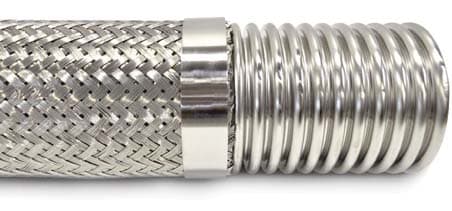 IH-MH-THORBURN-S91-316L-UBThorburn S91 — Type 316L SS Annular, Unbraided Inner CoreThorburn Flex
 IH-MH-THORBURN-S92-316LThorburn S92 — Type 316L SS Annular, Single Braid (304 SS)Thorburn Flex
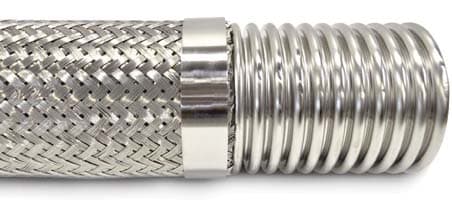 IH-MH-THORBURN-S92Z-316LThorburn S92Z — Type 316L SS Annular, Double Braid (304 SS)Thorburn Flex
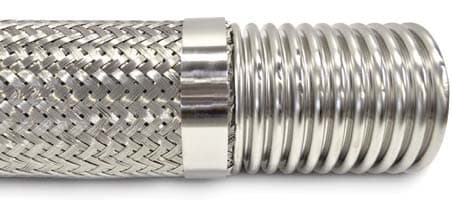 IH-MH-THORBURN-S93-316LThorburn S93 — Type 316L SS Annular, Single Braid (316L SS — Premium)Thorburn Flex
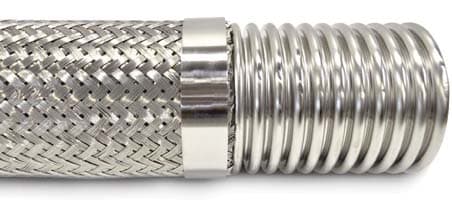 IH-MH-THORBURN-S96-321Thorburn S96 — Type 321 SS Annular, Single Braid (304 SS)Thorburn Flex
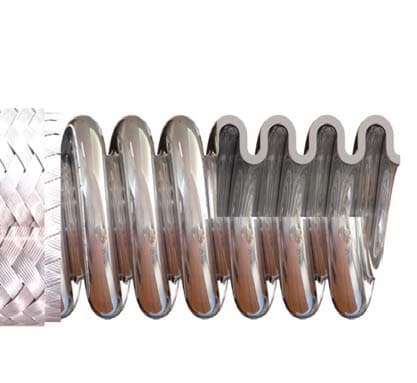 IH-MH-THORBURN-S65-XFLEX-321Thorburn S65 — Extra Flex Helical, Type 321 SS with 304 SS BraidThorburn Flex
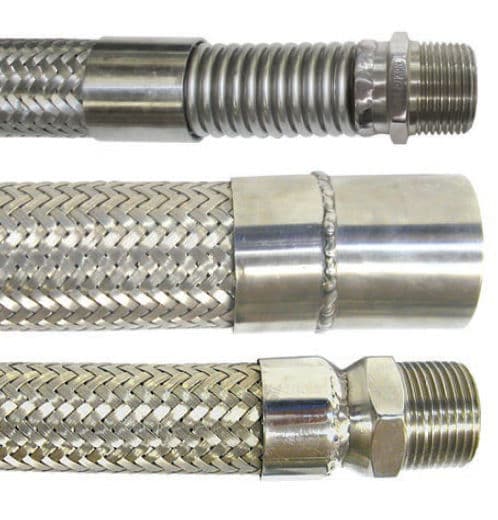 IH-IH-METALLIC-ADFLEXAdflex Commercial Grade Metallic HoseDixon
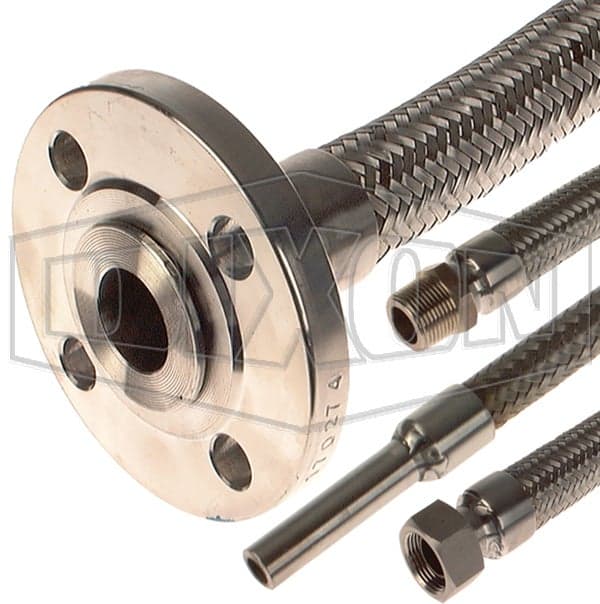 IH-IH-METALLIC-HYPARFLEXHyparflex Close Pitch Metallic HoseDixon


