
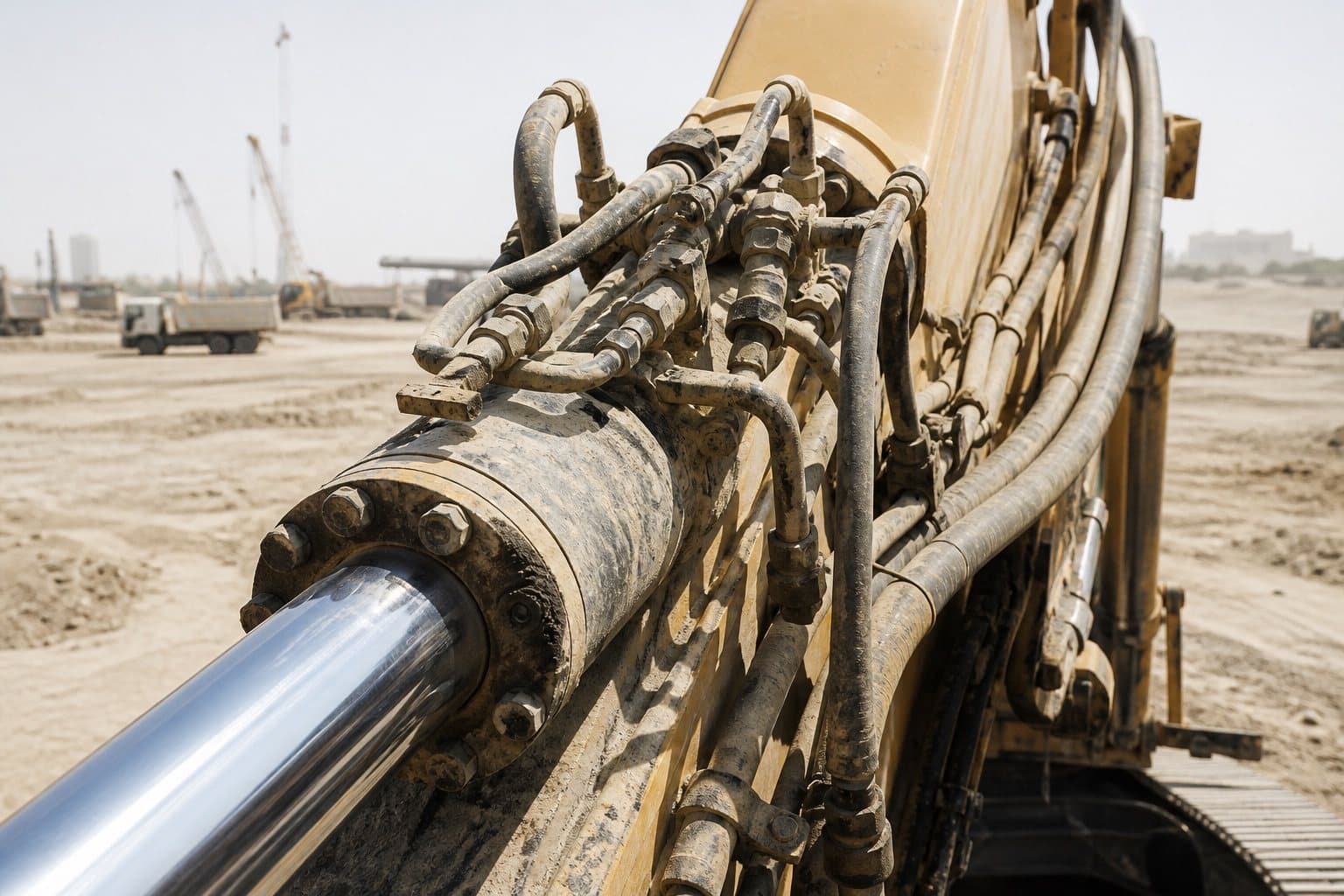
Does hose really wear out faster in the UAE?
Yes, and for four separate reasons that compound: ambient heat ages rubber continuously, sun and ozone crack covers that are never touched, sand turns every contact point into a grinding point, and salt-laden humid air corrodes reinforcement wherever a cover has been breached. Only the last one is invisible, which is why it is the one that causes failures without warning.
Manufacturer guidance on hose life is written for temperate conditions. It is not wrong — it is answering a question about a different environment, and the gap between that environment and a Mussafah summer is where a surprising amount of unplanned downtime lives.
| Factor | What it attacks | Visible? |
|---|---|---|
| Ambient heat | Cover and tube compound — ageing is cumulative | Eventually — hardening and crazing |
| UV and ozone | Cover, on the sun-facing side and on the outside of bends | Yes |
| Sand | Cover, at every contact point and inside clamps | Yes |
| Salt air and condensation | Steel reinforcement, through any breach in the cover | No — this is the dangerous one |
Most of the available improvement is not in buying different hose. Routing, shielding, shading, clamping and storage account for more hose life in this climate than any grade change, and all of them are cheaper. The higher-rated construction is the right answer where heat genuinely cannot be designed out — not as the first move.
Hydraulic hose by grade
Rated to 100 °C, 121 °C and 204 °C, stocked in Dubai.
SS316L fittings
For coastal and offshore service.
Fleet working in heat, sand or salt?
Tell us where the machines work and where the hoses run. The answer is usually shielding, clamping and a shorter interval rather than a different hose — and we will say so when it is.
Plant-down? Call +971 52 2477942 — 24/7
