
Category
Suction Hoses
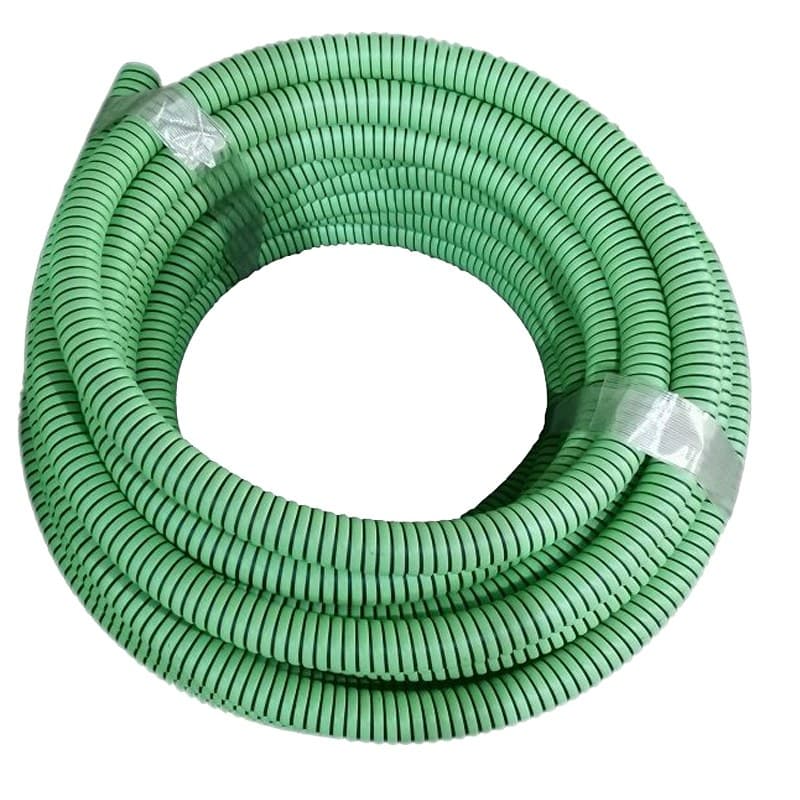
Lay flat hose collapses under vacuum, so every pump in a lay flat system draws through a rigid-helix suction hose. Our EPDM/PE suction hose holds open at up to 0.95 bar vacuum and doubles as a discharge hose, from 1" to 6".
Size range
Every size above is a part number you can quote from. Open any listing for its full table.
Delivery
Suction Hoses across the Gulf
Ex-stock from Dubai, delivered within 3 working days in the UAE.
Lay flat hose is the easiest large-bore line to move: empty, it rolls flat, so several hundred metres travel on one reel and a container holds a whole dewatering or transfer system. It ships from Dubai as bulk coils up to 400 m or as made-up assemblies with the couplings fitted and tested, with the size table and pressure rating for each bore. Send the flow, the line length and the lift, and we will size the bore before quoting.
Beyond the Gulf
- East Africa
- Kenya, Madagascar, Mozambique
- Southern Africa
- South Africa, Zimbabwe, Namibia
From the blog
Written about this range
Industrial hose
Suction hose vs lay flat hose: why a pump needs both, and which goes where
Lay flat hose cannot be used on a pump’s suction side: under vacuum, atmospheric pressure flattens it and seals the inlet. Every lay flat system needs a rigid-helix suction hose on the inlet and lay flat on the discharge. This guide explains why, how much suction lift is realistic, and how to lay out the two sides of a dewatering or transfer pump.
5 min read
Industrial hose
Antistatic fuel transfer hose: earthing, bonding and lay flat for diesel lines
Diesel flowing through a hose generates static charge. If the hose or a coupling is electrically isolated, that charge can build until it sparks. How bonded (M) and conductive (Ω) hoses differ, how to earth a temporary fuel line, and where an antistatic lay flat hose fits at drilling camps, rigs and remote sites.
6 min read
Industrial hose
Over-pumping and water main bypass: lay flat hose for sewer and mains work
When a sewer is relined or a water main is repaired, the flow has to go somewhere else. Over-pumping moves sewage around the work; a temporary overland main keeps customers in drinking water. Both are often laid in lay flat hose. How each is planned, what UK hygiene rules require for temporary drinking-water mains, and why the two kinds of hose must never meet.
5 min read