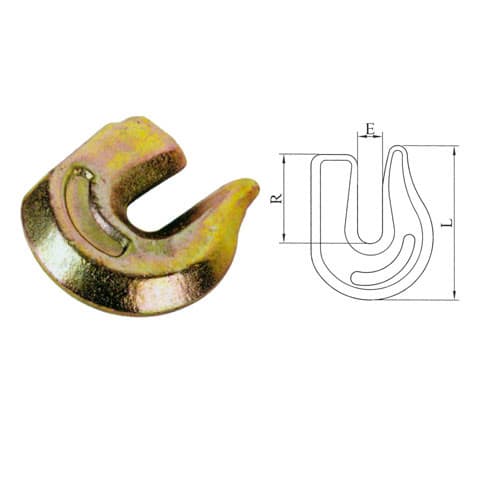
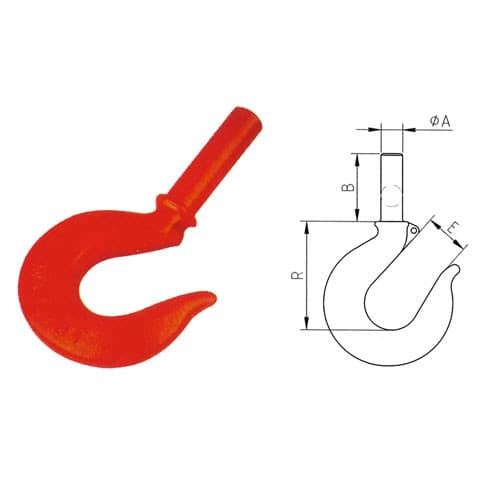
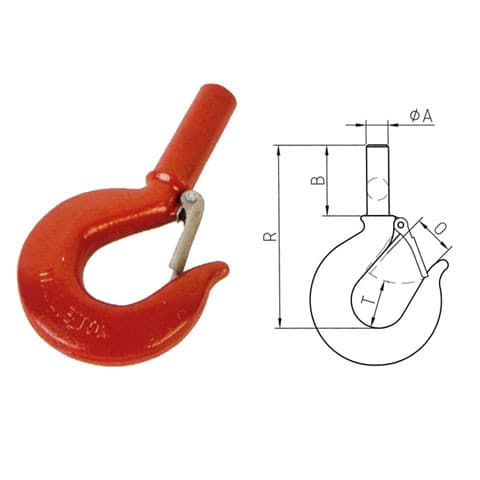
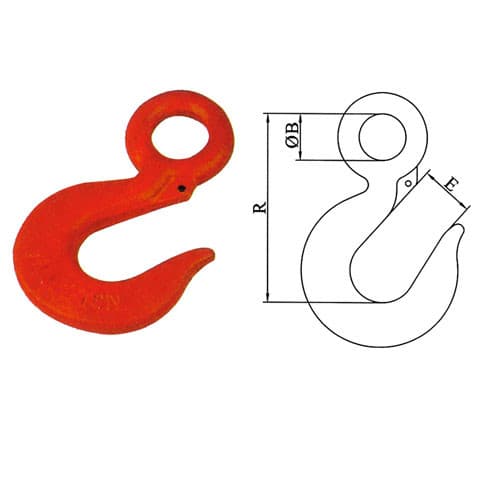
T Shank Hook
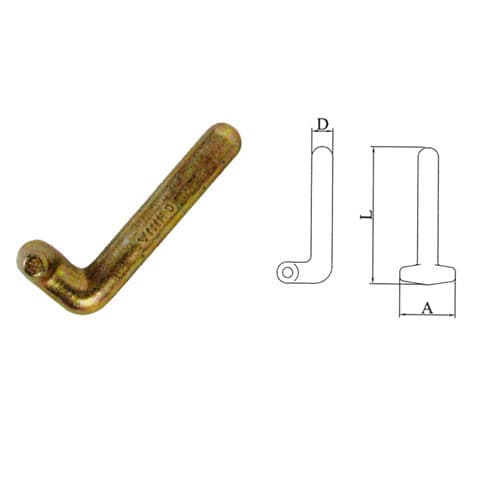
T Shank Hook, in 1 size, 5/16″. Load rating on request. Indus part numbers, manufacturer's test certificate.
Key features
- Product type: T Shank Hook
- Size range: 5/16″
- Size range
- 5/16″
Product description
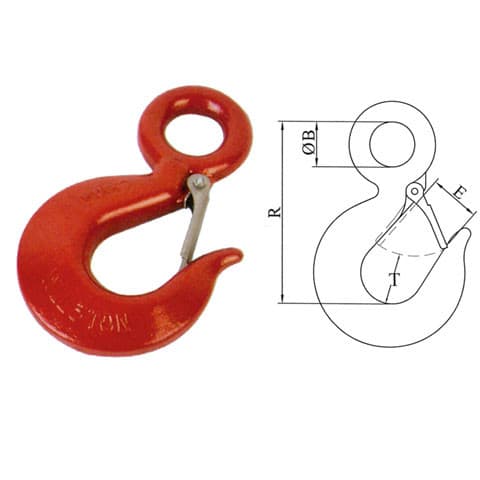
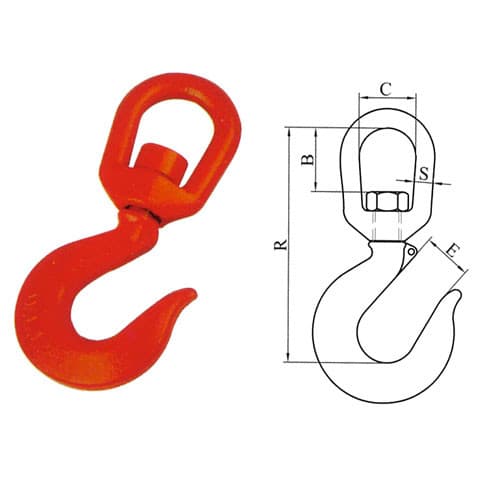
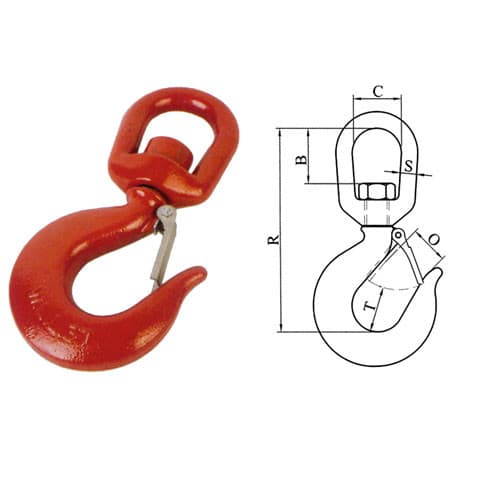
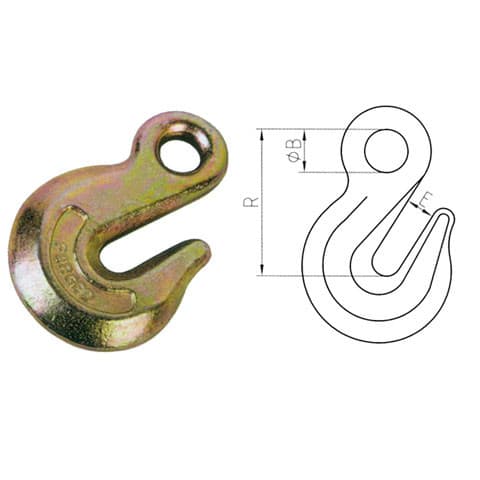
A lifting hook carries a load in its bowl — on a hoist, a sling leg or a chain.
Sizes
1 size, 5/16″. Every size has its own Indus part number in the table below.
No load rating is published for this range. Tell us the duty and we will confirm the rating with the quotation. Do not use it to lift until you have that rating in writing.
Choosing a size
Seat the load at the bottom of the bowl, never on the tip, and use a latch wherever it could bounce free.
Ordering
Quote the Indus part number from the size table, or send the size you need. Each consignment ships with the manufacturer's test certificate; say on the RFQ if your site needs anything more.
Identification
| Parameter | Value |
|---|---|
| Product type | T Shank Hook |
| Sizes | 1 |
Dimensions
| Parameter | Value |
|---|---|
| Size range | 5/16″ |
Compliance
| Parameter | Value |
|---|---|
| Certification | Manufacturer's test certificate |
Shipping & lead time
Sizes & part numbers
1 size- Indus part no.IH-LR-HK-TSH-031
- Size
- 5/16″
- A (mm)
- 41
- D (mm)
- 15.9
- L (mm)
- 101
- Weight (kg)
- 0.22
Size — Nominal size as the manufacturer states it. A — Dimension A on the manufacturer dimension drawing. D — Dimension D on the manufacturer dimension drawing. L — Dimension L on the manufacturer dimension drawing. Weight — Weight as the manufacturer publishes it. Ask us for the dimension drawing if you need it stamped.
WLL is the most the part may carry in service. Proof and breaking loads are test figures — never lift to them. Each load is shown in the unit the manufacturer rates the part in, and a size ships with the manufacturer’s test certificate.
What is the T Shank Hook and what is it used for?▾
How are the Indus part numbers for the T Shank Hook structured?▾
What sizes does the T Shank Hook come in?▾
How do I choose the right size of T Shank Hook?▾
What is the working load limit of the T Shank Hook?▾
What is the T Shank Hook made from?▾
Does the T Shank Hook come with a test certificate?▾
What should the T Shank Hook be used with?▾
How should the T Shank Hook be inspected and used safely?▾
Where is the T Shank Hook typically used?▾
How does the T Shank Hook differ from the Shank Hoist Hook — 319 Pattern?▾
Do you stock the T Shank Hook in Dubai?▾
Shipped worldwide from our Dubai warehouse. Transit, routes and documentation for 136 destinations
The same part, in the designations used across European and Gulf trade catalogues.
- de
- Schlauchtülle
- fr
- douille cannelée
- es
- espiga portamanguera
- it
- portagomma
From the blog
Written about this range
Lifting & rigging
Lifting hook types: eye, clevis and swivel hooks, sling vs grab hooks, and latches
Hooks are chosen on two things: how they attach (eye, clevis, shank or swivel) and what they do (a sling or slip hook holds a load in its bowl; a grab hook grips a chain link). Use a grab hook to shorten a chain and the sling loses 20% unless the hook is a cradle type. Here is how the types differ, and when a hook comes out of service.
6 min read
Lifting & rigging
Crosby pattern numbers decoded: G-209, G-2130, S-320 and what the letters mean
G-209, S-209, G-2130, A-342 — Crosby’s catalogue numbers have become the trade’s shorthand for rigging shapes. The letter tells you the finish or material; the number tells you the shape. Here is the key, a table of the common numbers, and why a part made to a Crosby pattern is not a Crosby part.
4 min read
Lifting & rigging
Stainless steel lifting chain: Grade 60 ratings, where it is worth it, and its limits
Stainless steel chain lifts where galvanised alloy chain would rust or contaminate: food plants, water treatment, marine and offshore. It carries less than Grade 80 at the same size, and chlorides in warm air can crack it. Ratings from our Grade 60 table, where stainless is worth it, which stainless chain to avoid for lifting, and how to look after it.
3 min read