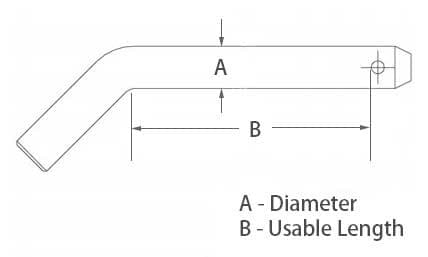
Every pinned joint on a trailer hitch, a three-point linkage or a bolt-type shackle depends on something small to keep the pin in. Lose the retainer and the pin walks out. These parts are cheap and easy to overlook — which is why the right one, fitted every time, matters. This guide explains the family and draws the line between a retaining pin and a lifting component.
/01The family.
| Pin | How it retains | Typical use |
|---|---|---|
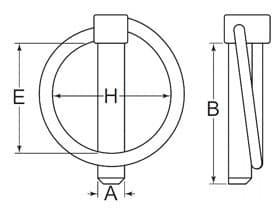
| Lynch pin | A spring ring snaps over the end of the pin it retains | Hitch pins, axles, linkage pins |
| R-clip (coil tension or snap pin) | A single spring wire clips through a cross-hole and over the pin | Clevis and hitch pins, quick removal |
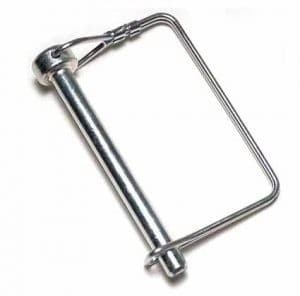
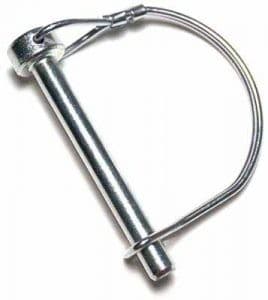
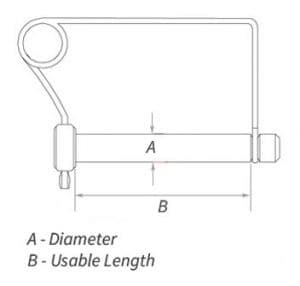
| Wire lock pinHighlighted | A locking wire swings over the pin end so it cannot shake out | Pins under vibration |
| Hitch pin (straight or bent) | The load pin itself, retained by one of the above | Towing, trailers, implements |
| Cotter (split) pin | Bent ends through a cross-hole | Shackle nuts, castellated nuts |
/02On lifting gear.
In lifting, retainers have one job: to keep the load pin where it belongs. A bolt-type shackle is used with its nut and cotter pin — makers state that where a part is designed for a cotter, it must be fitted, and their rule for bolt-type shackles is to always use the nut and cotter. Replace a lost cotter with one of the right size, never with wire or a nail. See how to rig a shackle correctly and G-209 vs G-2130 vs G-213.
/03Material and finish.
Our retaining pins are carbon steel with an electro-galvanised (zinc-plated) finish, with stainless steel versions in AISI 304 or 316 for marine and washdown use. Galvanised pins are cheap and easily replaced; stainless resists corrosion where pins sit in salt air. See stainless vs galvanized rigging in the Gulf.
Common questions
- What is a wire lock pin used for?
- To retain a pin where vibration could shake a clip loose — the locking wire swings over the end and holds it.
- Can a hitch pin be used for lifting?
- No. Hitch pins are towing and machinery pins, not load-rated lifting components.
- Do bolt-type shackles need a cotter pin?
- Yes. Use the nut and cotter pin every time.
- What sizes do wire lock pins come in?
- Our galvanised and stainless wire lock pins each come in 72 sizes, listed with dimensions.
- Galvanised or stainless?
- Galvanised for general use; stainless (304 or 316) where pins sit in salt air or washdown.