
Endless Wire Rope Sling — 10–240 mm
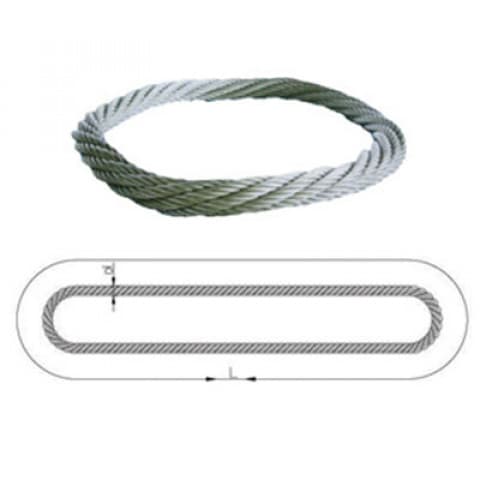
Endless Wire Rope Sling, in 43 sizes, 10 mm to 240 mm, WLL 10 to 4,880 . Indus part numbers, manufacturer's test certificate.
Key features
- Product type: Endless Wire Rope Sling
- Size range: 10 mm to 240 mm
- Working load limit: 10 to 4,880
- Size range
- 10 mm to 240 mm
- Working load limit
- 10 to 4,880
Product description
Steel wire rope slings for lifting with cranes and hoists.
Sizes and ratings
43 sizes, 10 mm to 240 mm. Working load limit 10 to 4,880 . Minimum breaking load 60 to 29,275 kN. Every size has its own Indus part number in the table below, with the loads in the unit the manufacturer rates them in.
Choosing a size
Choose on the rated load for the way you will rig it — the angle between legs cuts what each leg may carry — and inspect before every use.
Ordering
Quote the Indus part number from the size table, or send the size and working load you need. Each consignment ships with the manufacturer's test certificate; say on the RFQ if your site needs anything more.
Identification
| Parameter | Value |
|---|---|
| Product type | Endless Wire Rope Sling |
| Sizes | 43 |
Dimensions
| Parameter | Value |
|---|---|
| Size range | 10 mm to 240 mm |
Performance
| Parameter | Value |
|---|---|
| Working load limit | 10 to 4,880 |
| Minimum breaking load | 60 to 29,275 kN |
Compliance
| Parameter | Value |
|---|---|
| Certification | Manufacturer's test certificate |
Shipping & lead time
Sizes & part numbers
43 sizes- Indus part no.IH-LR-WS-END-10MM
- Size
- 10 mm
- WLL single leg (kN)
- 10
- WLL 2-leg ≤45° (kN)
- 18
- WLL 2-leg 45–90° (kN)
- 14
- WLL 4-leg ≤45° (kN)
- 36
- WLL 4-leg 45–90° (kN)
- 28
- Min breaking load (kN)
- 60
- Weight (kg/m)
- 0.29
- Indus part no.IH-LR-WS-END-12MM
- Size
- 12 mm
- WLL single leg (kN)
- 16
- WLL 2-leg ≤45° (kN)
- 30
- WLL 2-leg 45–90° (kN)
- 22
- WLL 4-leg ≤45° (kN)
- 60
- WLL 4-leg 45–90° (kN)
- 44
- Min breaking load (kN)
- 100
- Weight (kg/m)
- 0.48
- Indus part no.IH-LR-WS-END-15MM
- Size
- 15 mm
- WLL single leg (kN)
- 23
- WLL 2-leg ≤45° (kN)
- 41
- WLL 2-leg 45–90° (kN)
- 32
- WLL 4-leg ≤45° (kN)
- 82
- WLL 4-leg 45–90° (kN)
- 64
- Min breaking load (kN)
- 140
- Weight (kg/m)
- 0.71
- Indus part no.IH-LR-WS-END-18MM
- Size
- 18 mm
- WLL single leg (kN)
- 30
- WLL 2-leg ≤45° (kN)
- 54
- WLL 2-leg 45–90° (kN)
- 42
- WLL 4-leg ≤45° (kN)
- 108
- WLL 4-leg 45–90° (kN)
- 84
- Min breaking load (kN)
- 180
- Weight (kg/m)
- 0.98
- Indus part no.IH-LR-WS-END-21MM
- Size
- 21 mm
- WLL single leg (kN)
- 39
- WLL 2-leg ≤45° (kN)
- 70
- WLL 2-leg 45–90° (kN)
- 55
- WLL 4-leg ≤45° (kN)
- 140
- WLL 4-leg 45–90° (kN)
- 110
- Min breaking load (kN)
- 235
- Weight (kg/m)
- 1.11
- Indus part no.IH-LR-WS-END-24MM
- Size
- 24 mm
- WLL single leg (kN)
- 51
- WLL 2-leg ≤45° (kN)
- 92
- WLL 2-leg 45–90° (kN)
- 70
- WLL 4-leg ≤45° (kN)
- 184
- WLL 4-leg 45–90° (kN)
- 140
- Min breaking load (kN)
- 305
- Weight (kg/m)
- 1.44
- Indus part no.IH-LR-WS-END-27MM
- Size
- 27 mm
- WLL single leg (kN)
- 64
- WLL 2-leg ≤45° (kN)
- 115
- WLL 2-leg 45–90° (kN)
- 90
- WLL 4-leg ≤45° (kN)
- 230
- WLL 4-leg 45–90° (kN)
- 180
- Min breaking load (kN)
- 385
- Weight (kg/m)
- 1.82
- Indus part no.IH-LR-WS-END-30MM
- Size
- 30 mm
- WLL single leg (kN)
- 79
- WLL 2-leg ≤45° (kN)
- 142
- WLL 2-leg 45–90° (kN)
- 110
- WLL 4-leg ≤45° (kN)
- 284
- WLL 4-leg 45–90° (kN)
- 220
- Min breaking load (kN)
- 475
- Weight (kg/m)
- 2.25
Show all 43 sizesShow fewer sizes
Size — Nominal size as the manufacturer states it. WLL single leg — Working load of one leg hanging vertically. WLL 2-leg ≤45° — Working load of a two-leg sling with each leg up to 45° from vertical. WLL 2-leg 45–90° — Working load of a two-leg sling with each leg 45° to 90° from vertical. WLL 4-leg ≤45° — Working load of a four-leg sling with each leg up to 45° from vertical. WLL 4-leg 45–90° — Working load of a four-leg sling with each leg 45° to 90° from vertical. Min breaking load — Minimum breaking load. A test figure — never lift to it. Weight — Weight per metre, as published. Ask us for the dimension drawing if you need it stamped.
WLL is the most the part may carry in service. Proof and breaking loads are test figures — never lift to them. Each load is shown in the unit the manufacturer rates the part in, and a size ships with the manufacturer’s test certificate.
What is the Endless Wire Rope Sling and where is it used?▾
How do I read Endless Wire Rope Sling part numbers such as IH-LR-WS-END-10MM?▾
Which sizes does the Endless Wire Rope Sling come in?▾
How should I pick the size of Endless Wire Rope Sling for my job?▾
What load rating does the Endless Wire Rope Sling carry?▾
What material and finish does the Endless Wire Rope Sling have?▾
What standard and certificate apply to the Endless Wire Rope Sling?▾
Which parts connect to the Endless Wire Rope Sling?▾
How do I install and check the Endless Wire Rope Sling?▾
How does the Endless Wire Rope Sling compare with the Flemish Eye Wire Rope Sling?▾
Can you export the Endless Wire Rope Sling from Dubai?▾
Is the Endless Wire Rope Sling available from stock in Dubai?▾
Shipped worldwide from our Dubai warehouse. Transit, routes and documentation for 136 destinations
From the blog
Written about this range
Rigging capacity charts
Wire rope sling capacity chart: WLL by diameter, hitch and number of legs
Working load limits for single, two-leg and four-leg wire rope slings from 6 mm to 70 mm, Flemish-eye slings by hitch to 105 mm, and soft-eye slings at 5:1 and 6:1 to 110 mm — with the mode factors, the reasons two 12 mm slings can carry different ratings, and the limits on heat and bending.
9 min read
Rigging capacity charts
Sling angle chart: how the angle changes the load in each leg
Two sling legs do not each carry half the load unless they hang straight down. At 45° from vertical each leg carries 71% of the load; at 60° each carries all of it. Here is the chart, the one-line formula behind it, and how rating tables for multi-leg slings build it in.
7 min read
Lifting & rigging
Ferrule-secured eye vs Flemish eye vs hand splice: wire rope terminations compared
Every way of making an eye in wire rope keeps a different share of the rope’s strength. Sockets keep all of it; ferrule-secured and Flemish eyes about 90% or better; a hand splice less, and less again as the rope gets bigger. Here is the efficiency table, how each eye is made, and where each one belongs.
4 min read
Engineers viewing this also looked at
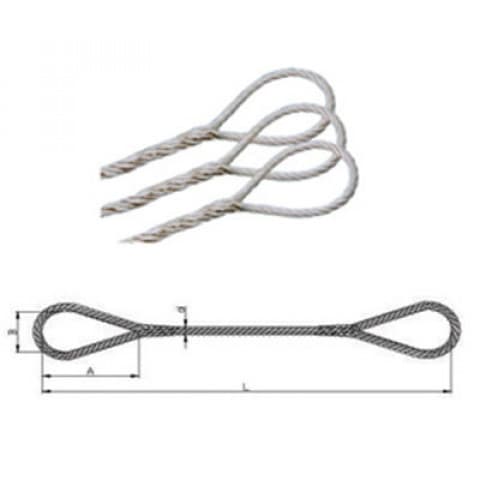
Hand-Spliced Soft Eye Wire Rope Sling — 0.24–81.7 t WLL
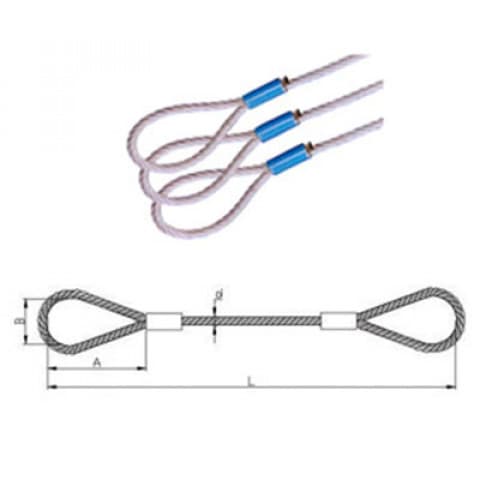
Swaged Soft Eye Wire Rope Sling (Ferrule Secured) — 0.25–116.7 t WLL
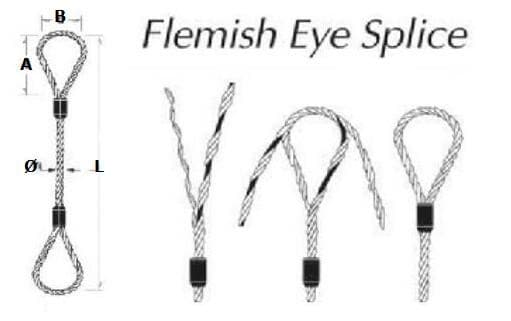
Flemish Eye Wire Rope Sling — 1.2–123 t WLL, EN 13414
Four-Leg Wire Rope Sling — 6–56 mm, EN 13414
Single Leg Wire Rope Sling with End Fittings — 6–70 mm, EN 13414
Two-Leg Wire Rope Sling — 6–70 mm, EN 13414