
Wire rope sling charts look interchangeable and are not. The rating depends on the rope inside the sling, how its eyes are made and the design factor it was rated to — so a chart is only good for the sling it was written for. The charts below are the ones for the slings we list, each labelled with the construction it applies to.
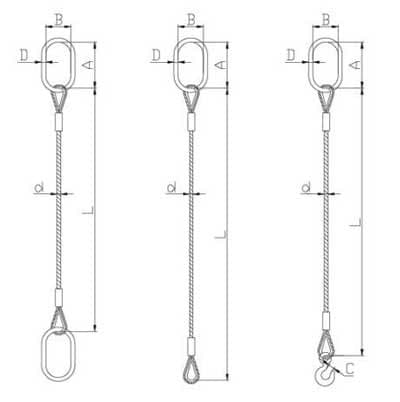
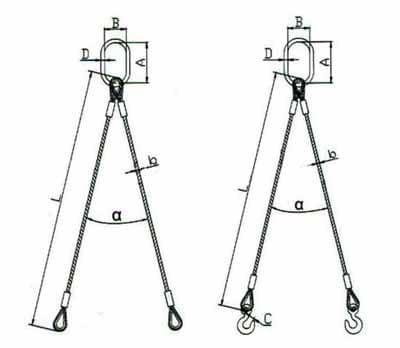
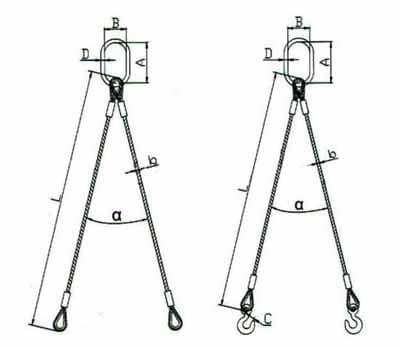
/01Single and multi-leg slings (EN 13414).
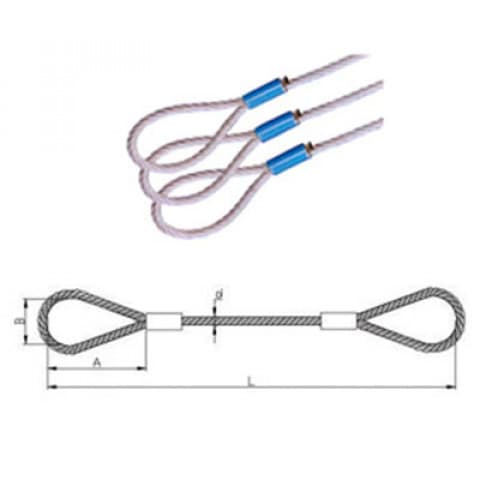
Ferrule-secured wire rope slings with end fittings, rated to EN 13414 at a 5:1 design factor. Our listings state these in kilonewtons; the chart converts them to tonnes and rounds down, so no converted figure is higher than the one on the product page.
| Rope | Single leg | 2-leg, 0–45° | 2-leg, 45–60° | 4-leg, 0–45° | 4-leg, 45–60° |
|---|---|---|---|---|---|
| 6 mm | 0.29 | 0.41 | 0.29 | 0.62 | 0.44 |
| 8 mm | 0.49 | 0.7 | 0.49 | 1.05 | 0.75 |
| 10 mm | 0.8 | 1.12 | 0.8 | 1.69 | 1.21 |
| 12 mm | 1.2 | 1.68 | 1.2 | 2.52 | 1.8 |
| 14 mm | 1.6 | 2.24 | 1.6 | 3.36 | 2.4 |
| 16 mm | 2.2 | 3.05 | 2.2 | 4.62 | 3.3 |
| 18 mm | 2.7 | 3.77 | 2.7 | 5.67 | 4.05 |
| 20 mm | 3.3 | 4.58 | 3.3 | 6.93 | 4.95 |
| 24 mm | 4.99 | 6.99 | 4.99 | 10.4 | 7.49 |
| 28 mm | 6.99 | 9.78 | 6.99 | 14.6 | 10.4 |
| 32 mm | 9 | 12.5 | 9 | 18.8 | 13.4 |
| 38 mm | 11.9 | 16.8 | 11.9 | 25.1 | 17.9 |
| 40 mm | 13.4 | 18.8 | 13.4 | 28.3 | 20.2 |
| 44 mm | 14.9 | 21 | 14.9 | 31.5 | 22.5 |
| 52 mm | 22 | 30.7 | 22 | 45.8 | 33 |
| 56 mm | 26.2 | 36.6 | 26.2 | 55 | 39.3 |
| 64 mm | 34.1 | 47.8 | 34.1 | — | — |
| 70 mm | 40.7 | 57.1 | 40.7 | — | — |
Four-leg slings in our listings stop at 56 mm. For larger multi-leg slings, ask; they are made to order.
/02How the hitch changes the rating.
EN 13414 slings are rated by mode factors applied to the single-leg straight rating. On our 16 mm single-leg sling:
| How the sling is used | Factor | 16 mm sling (t) |
|---|---|---|
| Single leg, straight | 1.0 | 2.2 |
| Single leg, choked | 0.8 | 1.76 |
| Basket, legs parallel | 2.0 | 4.4 |
| Basket, legs 0–45° from vertical | 1.4 | 3.08 |
| Basket, legs 45–60° from vertical | 1.0 | 2.2 |
| 2-leg sling, 0–45° | 1.4 | 3.05 |
| 2-leg sling, 45–60° | 1.0 | 2.2 |
| 3- or 4-leg sling, 0–45° | 2.1 | 4.62 |
| 3- or 4-leg sling, 45–60° | 1.5 | 3.3 |
- Choke. The rope bends sharply through its own eye, so the choked rating is 80% of straight. A multi-leg sling with its legs choked loses the same 20%. Let the choke draw up by itself — forcing it down against the load overloads the eye.
- Basket. Doubling applies only while both legs hang vertical. As they spread, the basket follows the same angle bands as two separate legs. A basket around a small diameter also bends the rope hard; the sling maker’s basket rating assumes the load is large enough to bend around.
- Beyond 60°. Not rated. Use longer legs or a spreader beam.
/03Flemish-eye slings by hitch.
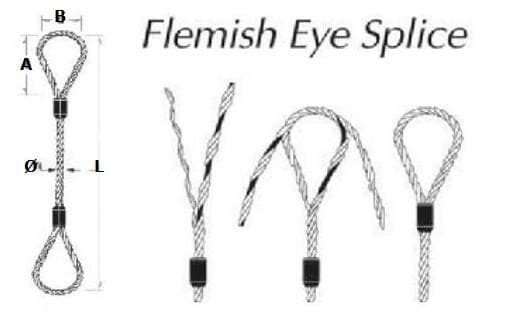
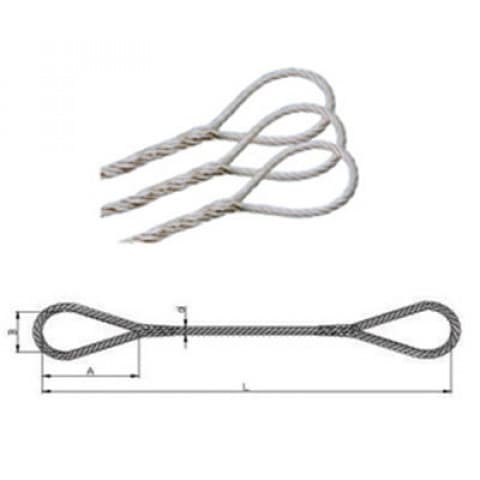
Flemish-eye slings have each eye formed by unlaying the rope, looping it back and relaying the strands, then securing the tail with a pressed sleeve. Our listings rate them by hitch from 10 mm to 105 mm rope.
| Rope | Vertical | Choke | Basket |
|---|---|---|---|
| 10 mm | 1.2 | 0.9 | 2.4 |
| 12 mm | 1.8 | 1.4 | 3.6 |
| 14 mm | 2.3 | 1.8 | 4.6 |
| 16 mm | 3 | 2 | 6 |
| 18 mm | 4 | 3 | 8 |
| 20 mm | 5 | 4 | 10 |
| 22 mm | 6 | 5 | 12 |
| 24 mm | 7 | 6 | 14 |
| 26 mm | 8 | 7 | 16 |
| 28 mm | 9 | 8 | 18 |
| 30 mm | 11 | 9 | 22 |
| 32 mm | 12 | 10 | 24 |
| 34 mm | 14 | 11 | 28 |
| 36 mm | 15 | 12 | 30 |
| 38 mm | 17 | 14 | 34 |
| 40 mm | 19 | 15 | 38 |
| 42 mm | 21 | 17 | 42 |
| 45 mm | 24 | 19 | 48 |
| 50 mm | 30 | 24 | 60 |
| 52 mm | 32 | 26 | 64 |
| 56 mm | 37 | 30 | 74 |
| 60 mm | 43 | 34 | 86 |
| 65 mm | 50 | 40 | 100 |
| 70 mm | 58 | 47 | 116 |
| 75 mm | 67 | 53 | 134 |
| 80 mm | 76 | 61 | 152 |
| 85 mm | 86 | 69 | 172 |
| 90 mm | 96 | 77 | 192 |
| 95 mm | 107 | 86 | 214 |
| 100 mm | 119 | 95 | 238 |
| 102 mm | 120 | 96 | 240 |
| 105 mm | 123 | 99 | 246 |
The basket column is twice vertical and, again, only holds while both legs hang straight. The choke column runs from 67% to 89% of vertical, depending on size.
/04Soft-eye slings at 5:1 and 6:1.
Single-part soft-eye slings — an eye at each end and nothing else — rated from the rope’s minimum breaking load at two design factors. The ferrule-secured and hand-spliced versions use the same rope, but the spliced sling is rated lower at every size except 8 mm, where the two match — a splice holds less of the rope’s strength than a pressed ferrule.
| Rope | Rope MBL (t) | Ferrule, 5:1 | Spliced, 5:1 | Ferrule, 6:1 | Spliced, 6:1 |
|---|---|---|---|---|---|
| 5 mm | 1.25 | 0.25 | 0.24 | 0.2 | 0.2 |
| 6 mm | 1.8 | 0.36 | 0.34 | 0.3 | 0.28 |
| 7 mm | 2.46 | 0.5 | 0.48 | 0.4 | 0.38 |
| 8 mm | 3.21 | 0.6 | 0.6 | 0.5 | 0.5 |
| 9 mm | 4.07 | 0.8 | 0.72 | 0.7 | 0.6 |
| 10 mm | 5.03 | 1 | 0.9 | 0.8 | 0.75 |
| 11 mm | 6.08 | 1.2 | 1.1 | 1 | 0.9 |
| 12 mm | 7.23 | 1.5 | 1.3 | 1.2 | 1.1 |
| 13 mm | 8.49 | 1.7 | 1.5 | 1.4 | 1.3 |
| 14 mm | 9.85 | 2 | 1.8 | 1.6 | 1.5 |
| 16 mm | 12.85 | 2.6 | 2.3 | 2.1 | 1.9 |
| 18 mm | 16.32 | 3.3 | 2.9 | 2.7 | 2.4 |
| 20 mm | 20.09 | 4 | 3.6 | 3.4 | 3 |
| 22 mm | 24.27 | 4.9 | 3.9 | 4.1 | 3.2 |
| 24 mm | 28.96 | 5.8 | 4.6 | 4.8 | 3.9 |
| 26 mm | 33.96 | 6.8 | 5.4 | 5.7 | 4.5 |
| 28 mm | 39.36 | 7.9 | 6.3 | 6.6 | 5.2 |
| 30 mm | 45.17 | 9 | 7.2 | 7.5 | 6 |
| 32 mm | 51.39 | 10.3 | 7.7 | 8.6 | 6.4 |
| 34 mm | 58.12 | 11.6 | 8.7 | 9.7 | 7.3 |
| 36 mm | 65.06 | 13 | 9.8 | 10.8 | 8.1 |
| 38 mm | 72.5 | 14.5 | 10.9 | 12.1 | 9.1 |
| 40 mm | 80.35 | 16.1 | 12.1 | 13.4 | 10 |
| 42 mm | 88.61 | 17.7 | 12.4 | 14.8 | 10.3 |
| 44 mm | 97.28 | 19.5 | 13.6 | 16.2 | 11.3 |
| 46 mm | 106 | 21.2 | 14.8 | 17.7 | 12.4 |
| 48 mm | 116.2 | 23.3 | 16.3 | 19.4 | 13.6 |
| 50 mm | 125.4 | 25.1 | 17.6 | 21 | 14.6 |
| 52 mm | 135.6 | 27.1 | 19 | 22.7 | 15.8 |
| 54 mm | 146.8 | 29.4 | 20.6 | 24.5 | 17.1 |
| 56 mm | 157 | 31.4 | 22 | 26.2 | 18.3 |
| 58 mm | 169.3 | 33.9 | 23.7 | 28.2 | 19.7 |
| 60 mm | 180.5 | 36.1 | 25.3 | 30.1 | 21.1 |
| 62 mm | 185.6 | 37.1 | 26 | 31 | 21.7 |
| 64 mm | 197.8 | 40 | 27.7 | 33 | 23.1 |
| 66 mm | 210.1 | 42 | 29.4 | 35 | 24.5 |
| 68 mm | 223.3 | 44.7 | 31.3 | 37.2 | 26.1 |
| 70 mm | 236.6 | 47.3 | 33.1 | 39.4 | 27.6 |
| 72 mm | 249.9 | 50 | 35 | 41.6 | 29.2 |
| 74 mm | 260.1 | 52.8 | 37 | 44 | 30.8 |
| 76 mm | 278.4 | 55.7 | 39 | 46.4 | 32.5 |
| 78 mm | 293.7 | 58.7 | 41.1 | 49 | 34.3 |
| 80 mm | 307.9 | 61.1 | 43.1 | 51.3 | 35.9 |
| 82 mm | 324.3 | 64.9 | 45.4 | 54 | 37.8 |
| 84 mm | 339.6 | 67.9 | 47.5 | 56.6 | 39.6 |
| 86 mm | 356.9 | 71.4 | 50 | 59.5 | 41.6 |
| 88 mm | 373.2 | 74.6 | 52.3 | 62.2 | 43.5 |
| 90 mm | 390.6 | 78.1 | 54.7 | 65.1 | 45.6 |
| 92 mm | 407.9 | 81.6 | 57.1 | 68 | 47.6 |
| 94 mm | 426.2 | 85.3 | 59.7 | 71 | 49.7 |
| 96 mm | 444.6 | 88.9 | 62.2 | 74.1 | 51.9 |
| 98 mm | 462.9 | 92.6 | 64.8 | 77.2 | 54 |
| 100 mm | 482.3 | 96.5 | 67.5 | 80.4 | 56.3 |
| 102 mm | 501.1 | 100 | 70.2 | 83.6 | 58.5 |
| 104 mm | 521.1 | 104 | 72.9 | 86.9 | 60.8 |
| 106 mm | 541.5 | 108 | 75.8 | 90.3 | 63.2 |
| 108 mm | 561.9 | 112 | 78.7 | 93.6 | 65.6 |
| 110 mm | 583.3 | 116 | 81.7 | 97.2 | 68 |
Use the 5:1 column for general lifting where 5:1 is the specified design factor. A 6:1 rating is asked for by some offshore and project specifications; it is lower for the same sling because more margin is held back.
/05Why two 12 mm slings carry different ratings.
| Sling | WLL (t) |
|---|---|
| Single-leg sling with end fittings (ferrule-secured) | 1.2 |
| Soft-eye sling, ferrule-secured, 5:1 | 1.5 |
| Soft-eye sling, hand-spliced, 5:1 | 1.3 |
| Flemish-eye sling, vertical | 1.8 |
All four are 12 mm wire rope slings, and all four ratings are correct for the sling they belong to. The rating is the rope’s minimum breaking load × the efficiency of the eye termination ÷ the design factor. The rope’s tensile grade and core change the breaking load; a pressed ferrule keeps more of it than a hand splice; and a 6:1 sling holds back more than a 5:1 one. That is why a wire rope sling is lifted on the figure on its own tag, never on a chart for a different sling of the same diameter.
/06Heat, bending and edges.
- Fibre core: not used above 100 °C.
- Steel core with aluminium ferrules: not above 150 °C. For hotter work, use a chain sling.
- Bending: a rope bent around a pin or edge of its own diameter keeps roughly half its strength. Use thimbles on hardware, wide-body shackles on the eyes, and packing at corners.
- Eyes: never make or repair a sling eye with wire rope clips. Slings are pressed or spliced by the maker and proof-tested.
Wire rope slings in these charts
Common questions
- What is the capacity of a 12 mm wire rope sling?
- It depends on the sling. Our EN 13414 single-leg sling with end fittings is rated 1.2 t; our ferrule-secured soft-eye sling 1.5 t at 5:1; our Flemish-eye sling 1.8 t vertical. Read the tag on the sling you have.
- How much does a choke reduce a wire rope sling?
- To 80% of its straight rating under EN 13414 practice. Where a sling’s own table gives a lower choked figure, the lower figure applies.
- Does a basket hitch double a wire rope sling’s capacity?
- Only with both legs hanging vertical. With the legs at up to 45° from vertical the factor is 1.4, and from 45° to 60° it is 1.0.
- How is a wire rope sling’s WLL worked out?
- The rope’s minimum breaking load, multiplied by the efficiency of the eye termination, divided by the design factor — 5 for general lifting under EN 13414. The maker does this and marks the result on the tag.
- Why is a four-leg wire rope sling rated as three legs?
- Because four legs cannot be relied on to share a rigid load. The 2.1 and 1.5 factors assume three legs carry it.