
Category
Molykote Oils & Fluids
Molykote oils and fluids are synthetic and silicone lubricating oils for gearboxes, compressors, vacuum pumps, chains, mechanical seals and viscous drives where a mineral oil would oxidise, thin out or contaminate the product. Indus supplies them from Dubai: Molykote 211 silicone fluid from 2,000 to 30,000 cSt, L-series synthetic gear oils in ISO VG 150, 220 and 460, compressor, process gas and vacuum pump oils, L-1605FM barrier fluid, and CO-220 and L-1468FM chain oils, many as FM food-machinery grades.
Match the oil to the machine, then the viscosity
Start with the machine type, because gear, compressor, vacuum pump, chain and seal oils are formulated differently and are not interchangeable. For compressors, also state the gas compressed: air, or a hydrocarbon or reactive process gas. Then take the viscosity grade from the equipment maker's manual, and confirm temperature range, food-contact needs (NSF H1 FM grades) and compatibility with the oil already in the system and its seals. Send the machine make and model, the oil in use now, the operating temperatures and the volume needed.
ISO viscosity grades and silicone fluid viscosity
Industrial oils are graded by ISO 3448: the ISO VG number is the mid-point kinematic viscosity in cSt at 40°C, and an oil must fall within ±10% of it, so ISO VG 220 covers 198 to 242 cSt. Silicone fluids such as Molykote 211 are sold by their viscosity in cSt measured at 25°C, which is a different reference temperature and not an ISO grade. FM grades for incidental food contact are registered by NSF as H1, grade by grade; check the registration on the data sheet of the exact product.
Delivery
Molykote Oils & Fluids across the Gulf
Ex-stock from Dubai, delivered within 3 working days in the UAE.
Lubricants are the one part of this catalogue where the packaging decides the route: some greases and compounds carry a transport classification that rules out ordinary air freight, and pack size changes the answer as much as chemistry does. We will tell you which applies before you commit to a mode. Batch numbers and technical data sheets travel with the consignment from Dubai, which is what a plant lubrication schedule needs on file.

Molykote L-4611 Synthetic Reciprocating Compressor Oil

Molykote L-1668FM Synthetic Blend Vacuum Pump Oil

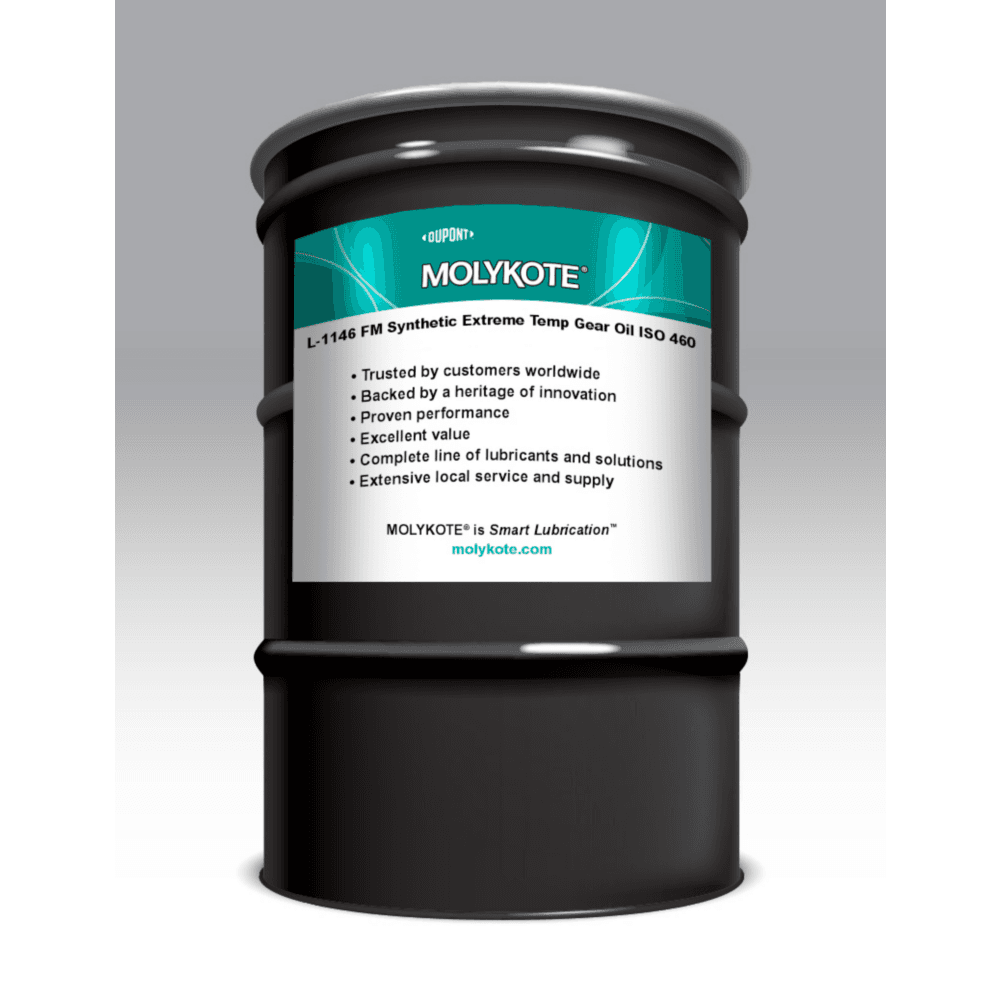
Molykote L-1146FM Synthetic Extreme Temp Gear Oil - ISO 460

Molykote L-1210 Synthetic Compressor and Vacuum Pump Oil


Molykote L-4646 Synthetic High Temp Compressor Oil
Questions we get asked
About this range
- 01What does ISO 150, 220 or 460 mean on a Molykote gear oil?
- It is the ISO viscosity grade: the oil's kinematic viscosity at 40°C in centistokes, within ±10%. Molykote L-1115FM is ISO VG 150, L-1122FM ISO VG 220 and L-1146FM ISO VG 460. Higher grades give a thicker film for slow, heavily loaded gears such as worm drives and large reducers; lower grades suit faster, lighter gears and cold starts. Use the grade the gearbox maker specifies, adjusted for ambient temperature if the manual allows, rather than moving between grades to cure a noise or temperature problem.
- 02What is Molykote 211 fluid and how do I choose its viscosity?
- Molykote 211 is a heat-stabilised dimethyl polysiloxane (silicone) fluid developed for viscous fan clutches, sold by viscosity in cSt at 25°C, from 2,000 to 30,000 cSt. In a viscous drive the fluid's shear resistance transmits torque, so the viscosity sets how strongly the clutch engages: replace it with the same cSt grade the unit was built with, from its service data. A different grade changes the engagement speed and the heat generated; mixing grades gives an intermediate viscosity that may not match either.
- 03What is a barrier fluid, and where is Molykote L-1605FM used?
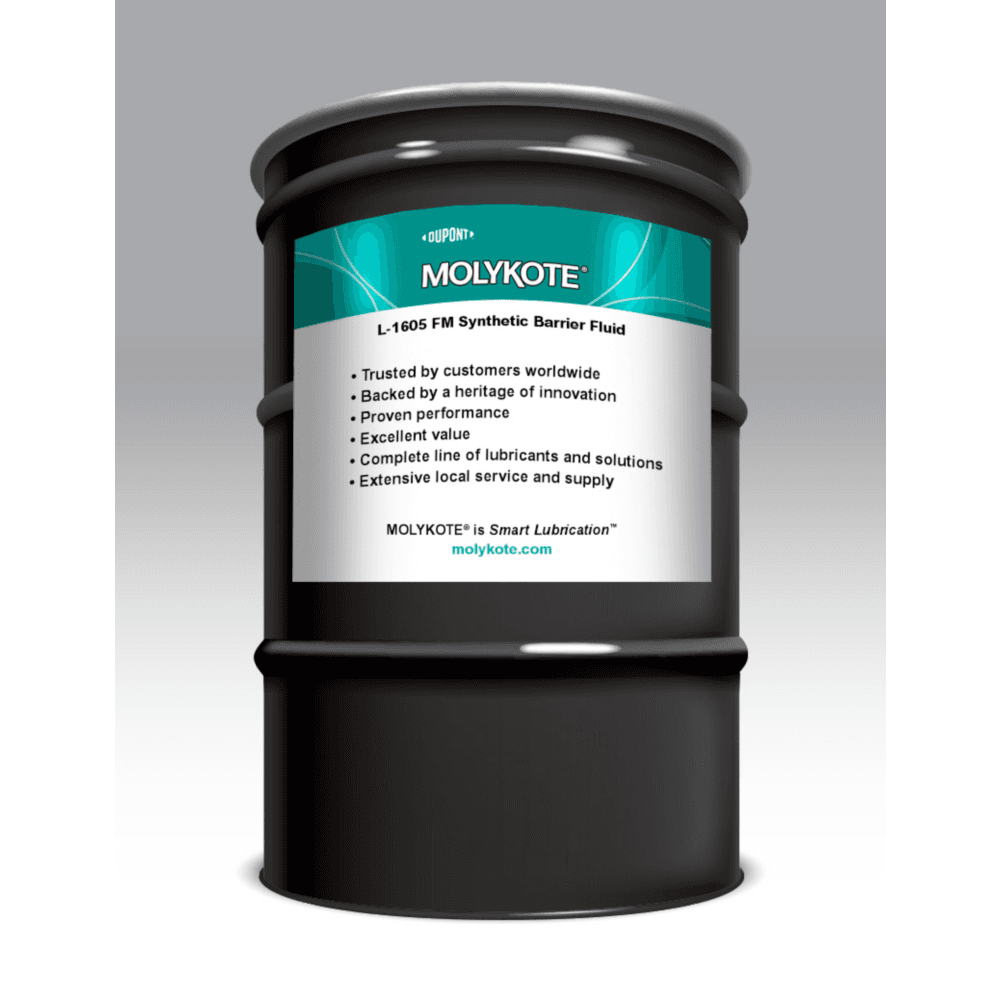
- A barrier fluid fills the space between the two seals of a pressurised dual mechanical seal, held above process pressure so that any leakage across the inner seal is barrier fluid into the product rather than product to atmosphere. It must lubricate and cool the seal faces and be compatible with the process, since a little of it ends up there. L-1605FM is a synthetic barrier fluid registered for incidental food contact, which suits pumps and mixers in food, beverage and pharmaceutical plants. Confirm viscosity against the seal maker's recommendation.
- 04When does a compressor need a process gas oil instead of a standard compressor oil?
- When it compresses a hydrocarbon or reactive gas rather than air. Gases such as natural gas, propane or other process streams dissolve into many oils, thinning them and reducing film strength, and some react with or are contaminated by mineral oil. Process gas oils such as Molykote L-0268, L-1510 and L-1568 are formulated to resist that dilution. Send the gas composition, discharge pressure and temperature and the compressor type, because the right oil depends on all three.
- 05Can I switch a compressor or gearbox from mineral oil to a synthetic Molykote oil?
- Usually, but drain and flush rather than topping up. Some synthetic bases, polyalkylene glycols in particular, do not mix with mineral oil and can form deposits or separate; others mix but lose part of their benefit when diluted. Check seal and paint compatibility, drain the old oil hot, flush if the maker recommends it, refill and check the oil and filters after the first hours of running. Tell us the oil in use now and we confirm the changeover procedure for the grade you choose.
- 06Which chain oil for ovens, freezers or general conveyors?
- Choose by the chain's temperature. Molykote CO-220 is a multi-purpose chain oil for general conveyor and drive chains; L-1468FM is a synthetic freezer chain oil that stays fluid at freezer temperatures and is registered for incidental food contact, for chains in cold stores and spiral freezers. For hot chains in ovens and dryers, choose an oil whose published upper temperature covers the chain, so it does not leave carbon deposits. Apply to the pins and bushes, not just the outside of the plates.
From the blog
Written about this range
Maintenance & reliability
Grease selection by base oil, thickener and NLGI grade: reading a grease listing
Every grease listing gives the same handful of numbers. What the base oil, the thickener, the base oil viscosity and the NLGI grade each tell you, with examples from the 63 Molykote greases we list.
5 min read
Maintenance & reliability
Molykote lubricant types explained: greases, pastes, coatings, compounds, oils and dispersions
Molykote sells six different kinds of lubricant, and choosing the wrong kind costs more than choosing the wrong product. What each type is, the job it does, and the products we supply in each.
5 min read