
Rigging twists. Chain kinks, wire rope and lines spin out, and a load that turns slowly in the wind winds its slings. A swivel lets one side turn freely relative to the other. What matters is whether it is meant to turn while the load hangs on it — because the common forged swivels are not. For swivel lifting points bolted to the load, see lifting points compared.
/01Two kinds of swivel.
| Type | Rotates under load? | Use |
|---|---|---|
| Regular swivel (eye and eye, jaw and eye, G-401/402/403 pattern)Highlighted | No — positioning device | Letting rigging untwist and align before the lift; mooring and chain lines |
| Bearing swivel (roller or ball thrust bearing) | Yes, as rated | Loads that must be turned while suspended |
| Swivel hook, plain | Not under load, per its maker | Aligning the hook to the load before lifting |
| Swivel hook, bearing | Only where the maker states it | Turning loads on the hook |
/02Rating is not size.
Swivels are sold by nominal size, but that size is not the size of chain they match. In our G-401 pattern chain swivel table, the 1/2″ swivel is rated 3,600 lb (about 1.6 t) and the 1″ swivel 12,500 lb (about 5.7 t) — below the chain of those sizes. Choose the swivel by its WLL against the load, then check it fits the shackle, link or hook either side. One maker designs its regular swivels to a 5:1 design factor; our Grade 80 roller-bearing lifting swivel is rated 3.15 t and 5.3 t.
/03Using swivels.
- Load a swivel in line — never side-load it.
- Check it turns freely before the lift; a seized swivel is a twisted sling waiting to happen.
- Inspect the shank, the eyes or jaws and, for bearing swivels, the bearing for wear and play.
- Remove from service on the same criteria as other hardware — see ASME B30.26 explained.
Common questions
- What is a rigging swivel used for?
- To let rigging untwist and align, so chain, rope or slings do not kink or wind up.
- What is the difference between a jaw end swivel and a regular swivel?
- A jaw end swivel has a pinned jaw at one end instead of an eye; both are positioning swivels, not designed to rotate under load.
- Is a 1/2 inch swivel rated for 1/2 inch chain?
- No — swivel ratings do not follow chain size. Check the swivel’s own WLL.
- Can I rotate a load on a swivel hook?
- Only if the hook is designed and marked for rotation under load, usually with a bearing.
- Are stainless swivels available?
- Yes, in eye-and-jaw, regular and jaw-end patterns, for marine and corrosive service.
Swivels and swivel hooks
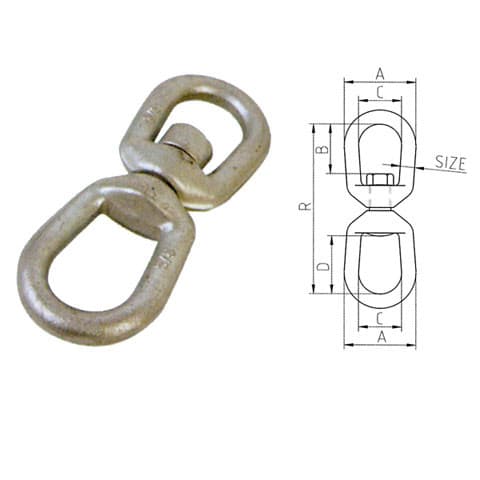 IH-LR-RL-G401Chain Swivel — G-401 Pattern, Hot-Dip Galvanized
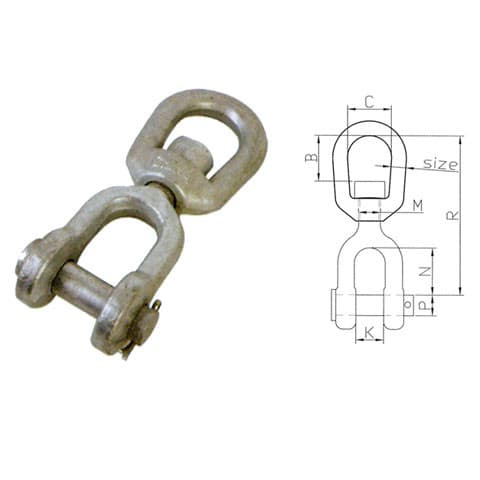 IH-LR-RL-RSRegular Swivel — Eye and Eye
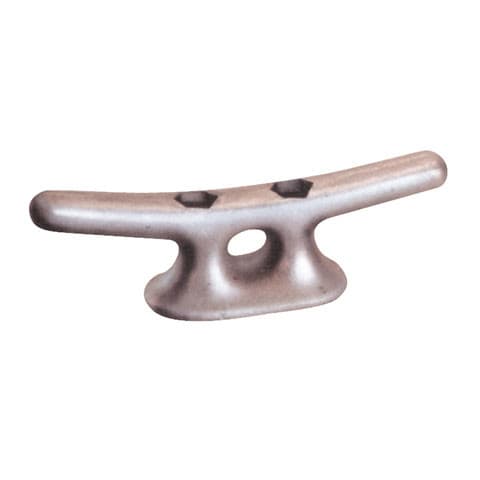 IH-LR-RL-JESJaw End Swivel
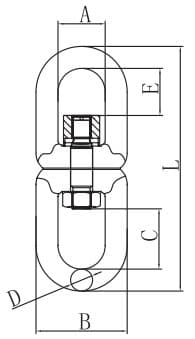 IH-LR-RL-80LSRBGrade 80 Lifting Swivel with Roller Bearing
 IH-LR-G8-SLHLKNKBBGrade 80 Swivel Latch Hook LKNK with Ball Bearing
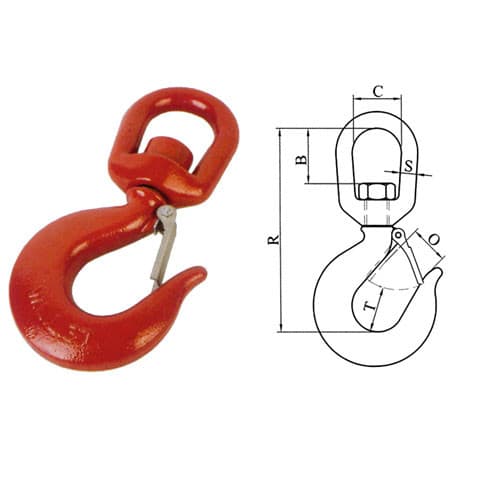 IH-LR-HK-322LSwivel Hoist Hook with Latch — 322 Pattern
 IH-LR-RL-SSJESG403Stainless Steel Jaw End Swivel — G-403 Pattern