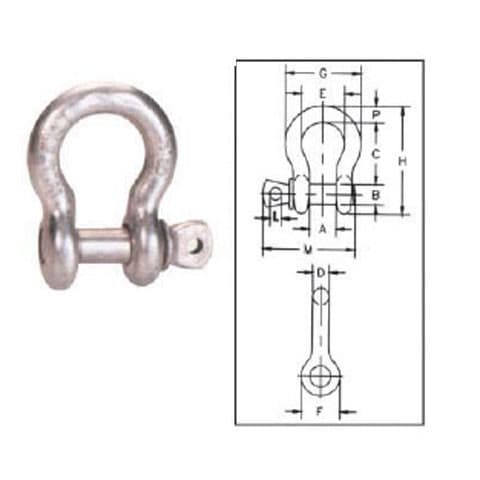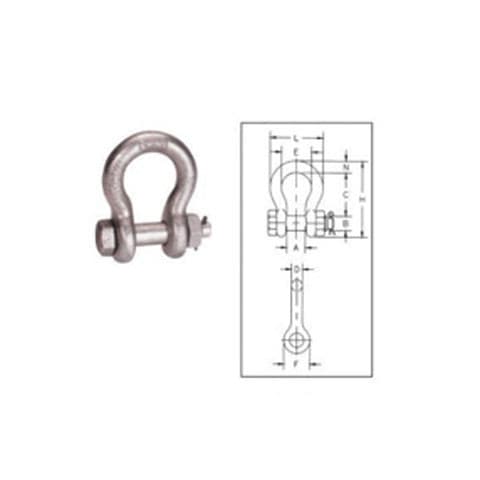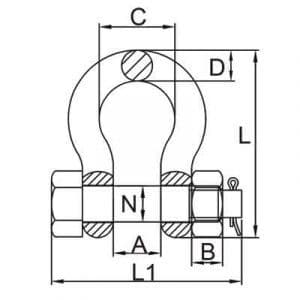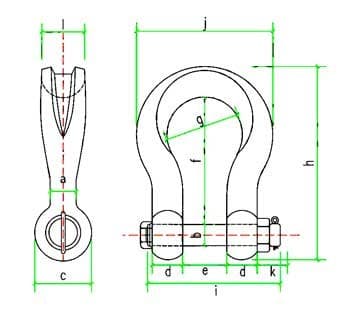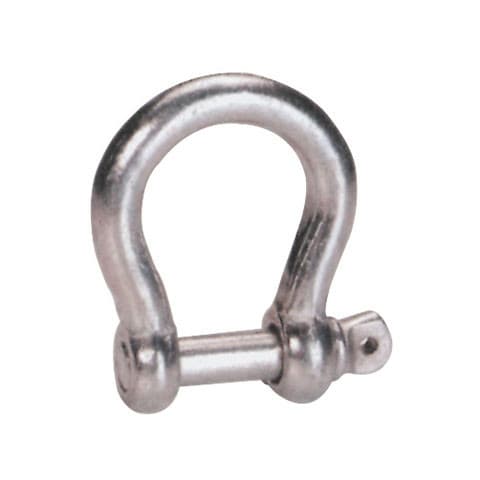
Most shackle failures are not material failures. They are rigging failures: a shackle loaded across its body, a screw pin unwound by a sling sliding over it, a bolt pushed through where the pin was lost. The rules that prevent them are short, and every major maker publishes them. This article brings them together. Where it quotes a maker’s figures, they are that maker’s, for its own shackles — for any other shackle, use its maker’s instructions.
/01Which way the pin goes.
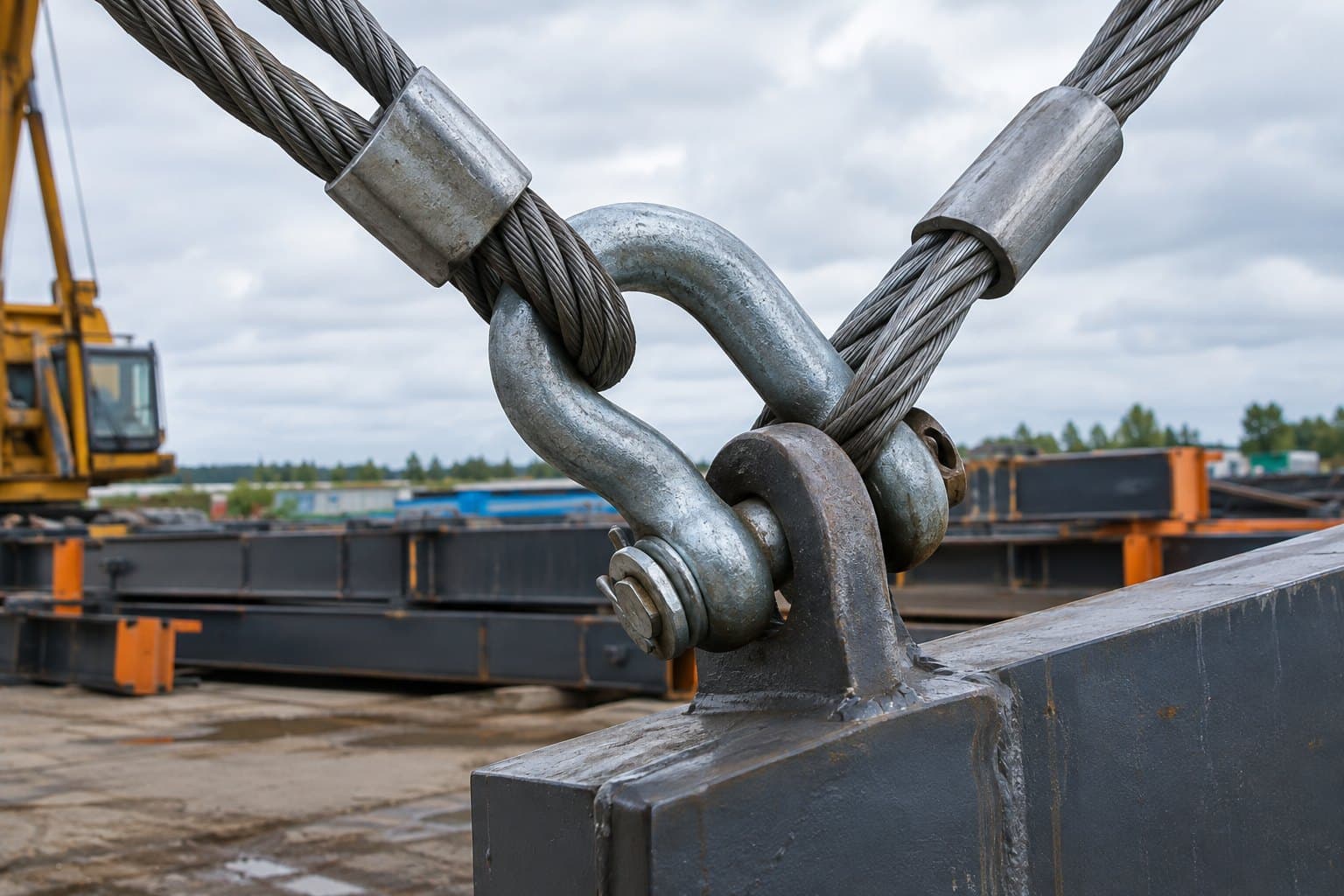
- Pin on the fixed point. Put the pin through the hook, eye or lifting lug that does not move, and the slings in the bow.
- Centre the load in the bow. A load pulled to one side of the bow side-loads the shackle; spacers can keep it central.
- Nothing running over the pin. A sling or rope that moves across a screw pin can turn it and unscrew it.
- Full engagement. Screw pins seated and tightened before every lift; bolt-type pins with nut and cotter fitted.
/02Side loading.
A shackle is designed to be pulled in line with its body. Pull it at an angle across the body and the working load limit falls. Makers publish their own reduction tables, and they differ — use the one for the shackle you have. Crosby’s current table for its screw-pin and bolt-type shackles, 3/16" to 3", is:
| Angle from in-line | Adjusted WLL |
|---|---|
| 0–10° | 100% |
| 11–20° | 85% |
| 21–30° | 75% |
| 31–45° | 70% |
| 46–55° | 60% |
| 56–70° | 55% |
| 71–90° | 50% |
Another maker, Gunnebo Industries, publishes 100% at 0°, 70% at 45° and 50% at 90° for its shackles and advises avoiding side loads altogether. For larger shackles the allowances tighten: Crosby allows only small angles on shackles above 3" and asks for its engineers to be consulted on side loads above 5° for its largest sizes. Round-pin shackles — G-213 and G-215 patterns — must not be side loaded at all.
/03Two-leg slings and the 120° rule.
Gathering two sling legs in the bow of an anchor shackle is normal practice, and Crosby rates its screw-pin and bolt-type shackles at their full WLL for a symmetrical two-leg sling up to a 120° included angle — never more — with the load in the plane of the bow; for its shackles above 125 t the limit is 90°. The legs go in the bow, not on the pin, and the sling’s own capacity still falls with angle — see the sling angle chart. Round-pin shackles must never be used to gather sling legs.
/04Running lines, mousing and pins.
- Running lines. Where a rope runs through or over the shackle, the pin must not bear on the moving line; use a bolt-type shackle where rotation is possible.
- Long-term rigging. Use a bolt-type shackle, or secure (mouse) a screw pin with wire against rotation.
- Lost pin? Replace it only with the maker’s pin for that size and grade. The UK lifting association’s code of practice warns never to replace a pin with an ordinary bolt, which will bend under load.
- Choker hitches. Do not let the live part of a choker run over a screw pin.
For the cotters and retaining pins that keep shackle bolts and nuts in place, see lynch pins, R-clips and wire lock pins.
Common questions
- How much does side loading reduce a shackle’s capacity?
- It depends on the maker. One major maker’s published table runs from 100% in line to 70% at 45° and 50% at 90° for its screw-pin and bolt-type shackles. Use the table for the shackle you have.
- Can I put two slings on a shackle pin?
- No. Gather sling legs in the bow, with the pin on the hook or lug.
- What is the maximum sling angle in a shackle?
- One major maker rates its screw-pin and bolt-type shackles at full WLL for a two-leg sling up to a 120° included angle, and never more.
- What is mousing a shackle?
- Securing a screw pin with wire through the pin eye and around the body so it cannot rotate loose.
- Can I use a bolt instead of a shackle pin?
- No. Use only the maker’s pin for that shackle; a hardware bolt is not rated and can bend.