
A chain sling’s capacity depends on three things: the chain size and grade, the number of legs, and the angle the legs hang at. The charts below give all three for every chain sling we list, taken directly from the size tables on the product pages. Find your chain size, then read across to the configuration you will rig.
/01Grade 80 chain sling capacity chart.
Working load limit in tonnes, from our Grade 80 sling listings. The angle is measured from the vertical — 0–45° from vertical is up to 90° between two opposite legs; 45–60° is 90° to 120° between them.
| Chain | Single leg | 2-leg, 0–45° | 2-leg, 45–60° | 3- & 4-leg, 0–45° | 3- & 4-leg, 45–60° |
|---|---|---|---|---|---|
| 4 mm | 0.5 | 0.7 | 0.5 | 1.05 | 0.75 |
| 5 mm | 0.8 | 1.12 | 0.8 | 1.6 | 1.18 |
| 6 mm | 1.12 | 1.6 | 1.12 | 2.36 | 1.7 |
| 7 mm | 1.5 | 2.12 | 1.5 | 3.15 | 2.24 |
| 8 mm | 2 | 2.8 | 2 | 4.25 | 3 |
| 10 mm | 3.15 | 4.25 | 3.15 | 6.7 | 4.75 |
| 13 mm | 5.3 | 7.5 | 5.3 | 11.2 | 8 |
| 16 mm | 8 | 11.2 | 8 | 17 | 11.8 |
| 18 mm | 10 | 14 | 10 | 21 | 15 |
| 19 mm | 11.2 | 15.6 | 11.2 | 23.5 | 16.8 |
| 20 mm | 12.5 | 17 | 12.5 | 26.2 | 18.7 |
| 22 mm | 15 | 21.2 | 15 | 31.5 | 22.4 |
| 26 mm | 21.2 | 30 | 21.2 | 44.5 | 31.5 |
| 28 mm | 25 | 33.5 | 25 | 52.5 | 37.5 |
| 30 mm | 28 | 39.2 | 28 | 58.8 | 42 |
| 32 mm | 31.5 | 45 | 31.5 | 66.1 | 47.2 |
| 36 mm | 40 | 56 | 40 | 84 | 60 |
| 38 mm | 45 | 63 | 45 | 94.5 | 67.5 |
| 40 mm | 50 | 70 | 50 | 105 | 75 |
| 45 mm | 63 | 88.2 | 63 | 132.3 | 94.5 |
| 50 mm | 78.5 | 109.9 | 78.5 | 164.8 | 117.7 |
/02Grade 100 chain sling capacity chart.
Grade 100 slings use a higher-strength alloy chain and matching Grade 100 fittings. Our listings run from 6 mm to 26 mm.
| Chain | Single leg | 2-leg, 0–45° | 2-leg, 45–60° | 3- & 4-leg, 0–45° | 3- & 4-leg, 45–60° |
|---|---|---|---|---|---|
| 6 mm | 1.4 | 2 | 1.4 | 3 | 2.12 |
| 7 mm | 1.9 | 2.65 | 1.9 | 4 | 2.8 |
| 8 mm | 2.5 | 3.55 | 2.5 | 5.3 | 3.75 |
| 10 mm | 4 | 5.6 | 4 | 8 | 6 |
| 13 mm | 6.7 | 9.5 | 6.7 | 14 | 10 |
| 16 mm | 10 | 14 | 10 | 21.2 | 15 |
| 18 mm | 12.5 | 17.5 | 12.5 | 26.2 | 18.7 |
| 19 mm | 14 | 20 | 14 | 30 | 21.2 |
| 20 mm | 16 | 22.4 | 16 | 33.6 | 24 |
| 22 mm | 19 | 26.5 | 19 | 40 | 28 |
| 26 mm | 26.5 | 37.5 | 26.5 | 56 | 40 |
| Chain | Grade 80 (t) | Grade 100 (t) | Difference |
|---|---|---|---|
| 6 mm | 1.12 | 1.4 | +25% |
| 7 mm | 1.5 | 1.9 | +27% |
| 8 mm | 2 | 2.5 | +25% |
| 10 mm | 3.15 | 4 | +27% |
| 13 mm | 5.3 | 6.7 | +26% |
| 16 mm | 8 | 10 | +25% |
| 18 mm | 10 | 12.5 | +25% |
| 19 mm | 11.2 | 14 | +25% |
| 20 mm | 12.5 | 16 | +28% |
| 22 mm | 15 | 19 | +27% |
| 26 mm | 21.2 | 26.5 | +25% |
The gain is what makes Grade 100 worth its price on heavy, repeated lifts: the same load can often go on the next chain size down, which is lighter to handle and fits smaller lifting points. Never mix grades in one sling — a Grade 80 hook on a Grade 100 leg drops the whole leg to the Grade 80 rating at best.
/03Where the numbers come from.
Multi-leg chain slings are rated by the uniform load method of EN 818-4: the single-leg working load limit multiplied by a fixed factor for each configuration and angle band. Our 10 mm Grade 80 sling shows each factor at work:
| Configuration | Factor | 10 mm Grade 80 (t) |
|---|---|---|
| Single leg, straight | 1.0 | 3.15 |
| Single leg, choked | 0.8 | 2.52 |
| 2-leg, 0–45° from vertical | 1.4 | 4.25 |
| 2-leg, 45–60° from vertical | 1.0 | 3.15 |
| 3- or 4-leg, 0–45° | 2.1 | 6.7 |
| 3- or 4-leg, 45–60° | 1.5 | 4.75 |
| Beyond 60° from vertical | — | Not rated |
The two-leg factors are the geometry at the top of each band: two legs at 45° give 2 × cos 45° = 1.41, rounded to 1.4, and at 60° give 2 × cos 60° = 1.0. The three- and four-leg factors are the same arithmetic for three legs — 3 × cos 45° = 2.12 and 3 × cos 60° = 1.5. Published tables round the products to a standard series, so a figure can sit slightly below the raw multiplication.
/04Reductions: choke, heat and shortening.
The charts assume a straight, in-line pull on each leg, at normal temperature, with every leg at its full length. Change any of those and the rating comes down:
- Choke hitch. A leg choked around the load is rated at 80% of its straight rating in chain-sling makers’ instructions. Let the choke draw up naturally; never hammer it down.
- Heat. A widely published Grade 8 table keeps the full rating from −40 °C to 200 °C, then 90% to 300 °C and 75% to 400 °C. Makers differ above 200 °C — including on whether the sling returns to full rating once it has cooled — and Grade 100 limits are set by each maker, so follow the instructions for the sling in use.
- Shortening. A leg shortened with a grab hook or clutch keeps its rating only if that fitting is rated for the full chain WLL. Some grab hooks reduce it; check the hook.
- Uneven loading. If the centre of gravity is off-centre, one leg can carry far more than its share. Plan the lift on the most heavily loaded leg.
- Edges. A link bent over a sharp edge loses strength. Use packing or edge protection, or a larger chain.
/05Worked example: sizing a two-leg sling.
A 5 t load is lifted on two lifting points, with the legs at about 40° from vertical. That is inside the 0–45° band, so the sling needs a two-leg rating of at least 5 t in the 0–45° column.
- Grade 80: 10 mm gives 4.25 t — not enough. 13 mm gives 7.5 t. Use 13 mm, at 3.73 kg of chain per metre.
- Grade 100: 10 mm gives 5.6 t. Use 10 mm, at 2.23 kg per metre.
The Grade 100 sling does the same job one chain size down, with roughly 40% less chain weight per leg. Had the legs opened past 45°, the 45–60° column would apply: 3.15 t for 10 mm Grade 80 and 4 t for 10 mm Grade 100, so both would have to move up a size.
Reading the chart for a lift
Work through these in order before choosing a size.
IfHow many legs will actually share the load?
Use the two-leg column for two legs; the three/four-leg column for three or four, on a load that lets them share.
IfWhat is the leg angle from vertical?
Up to 45°: first column for that leg count. 45–60°: second column. Beyond 60°: not rated — lengthen the legs or use a spreader.
IfWill any leg be choked?
Take 80% of the figure.
IfIs the load or the work area hot?
Apply the maker’s heat table for the grade.
IfIs the centre of gravity off-centre?
Size on the most heavily loaded leg, not the average.
/06The chain behind the sling.
Every sling above is made from Grade 80 or Grade 100 alloy chain with fittings of the same grade. The chain carries the same 4:1 design factor as the sling: our Grade 100 chain is proof-tested to 2.5 times its WLL and breaks at no less than four times it.
| Chain | WLL (t) | Proof load (kN) | Min. breaking (kN) | Weight (kg/m) |
|---|---|---|---|---|
| 6 mm | 1.4 | 35 | 57 | 0.8 |
| 7 mm (1/4″) | 1.9 | 48 | 77 | 1.09 |
| 8 mm (5/16″) | 2.5 | 63 | 101 | 1.43 |
| 10 mm (3/8″) | 4 | 98 | 157 | 2.23 |
| 12 mm | On request | 141 | 226 | 3.21 |
| 13 mm (1/2″) | 6.7 | 166 | 265 | 3.77 |
| 16 mm (5/8″) | 10 | 251 | 402 | 5.71 |
| 18 mm | 12.5 | 318 | 509 | 7.23 |
| 19 mm (3/4″) | 14 | 354 | 567 | 8.04 |
| 20 mm | 16 | 393 | 628 | 8.92 |
| 22 mm (7/8″) | 19 | 475 | 760 | 10.8 |
| 23 mm | On request | 519 | 831 | 11.8 |
| 25 mm (1″) | On request | 614 | 982 | 13.94 |
| 26 mm | 26.5 | 664 | 1,062 | 15.08 |
Grade 30, 43 and 70 chain is transport and lashing chain. It is not made into lifting slings and never appears in a lifting chart.
Chain slings in these charts
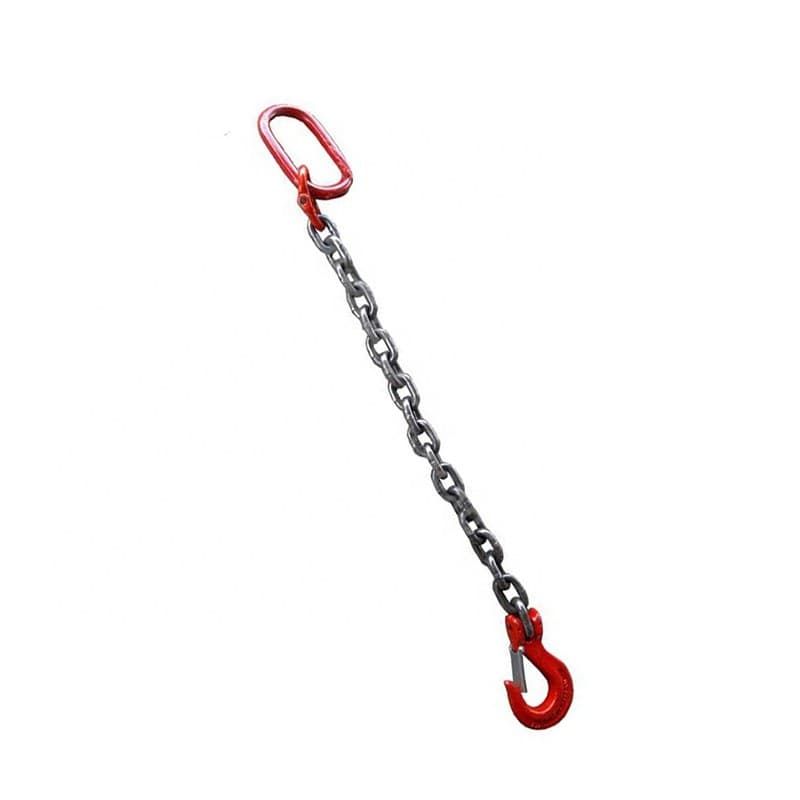 IH-LR-CS-G80SOSGrade 80 Single-Leg Chain Sling, Master Link and Sling Hook — Type SOS
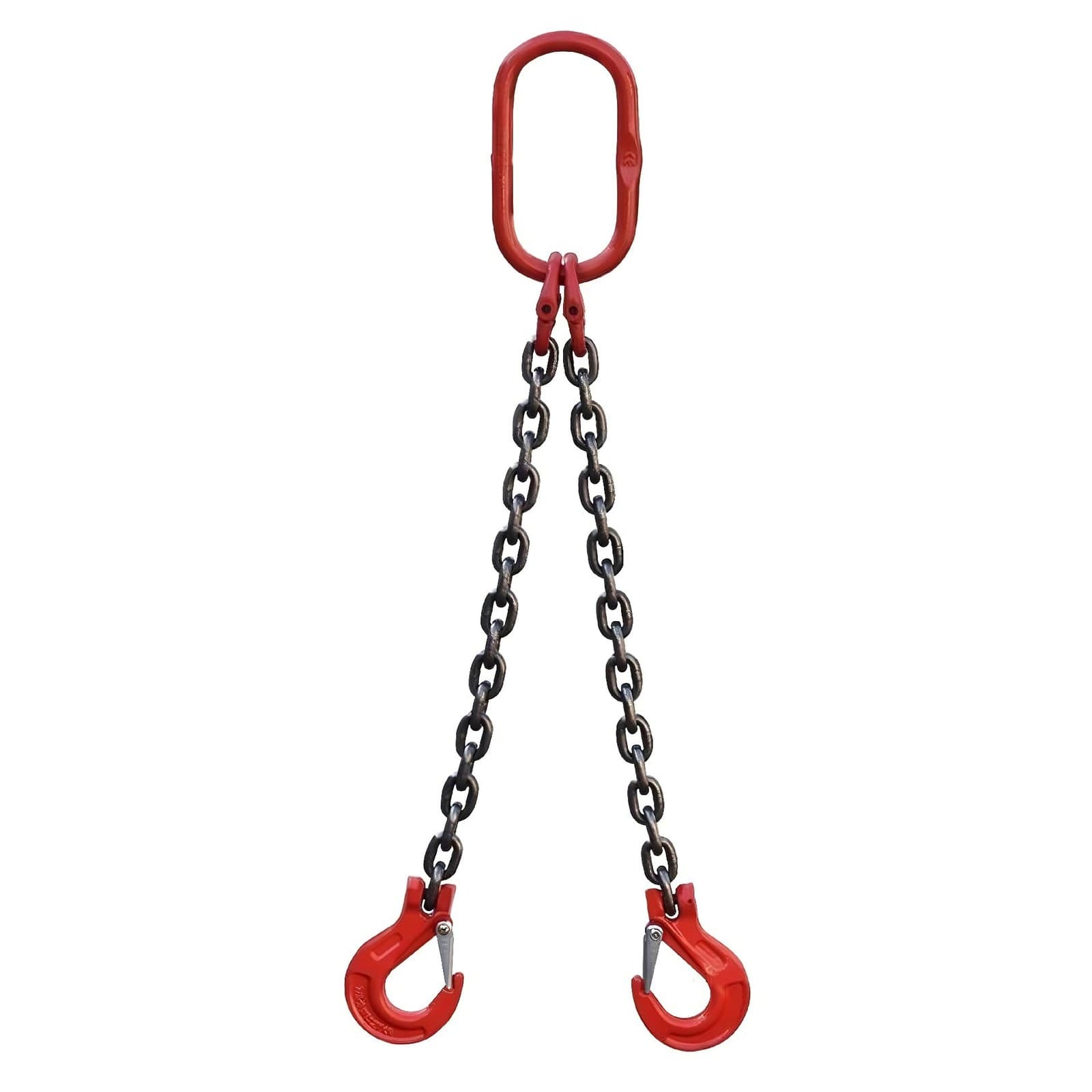 IH-LR-CS-G80DOSGrade 80 Two-Leg Chain Sling with Sling Hooks — Type DOS
 IH-LR-CS-G80TOSGrade 80 Three-Leg Chain Sling with Sling Hooks — Type TOS
 IH-LR-CS-G80QOSGrade 80 Four-Leg Chain Sling with Sling Hooks — Type QOS
 IH-LR-CS-G100SOSGrade 100 Single-Leg Chain Sling, Master Link and Sling Hook — Type SOS
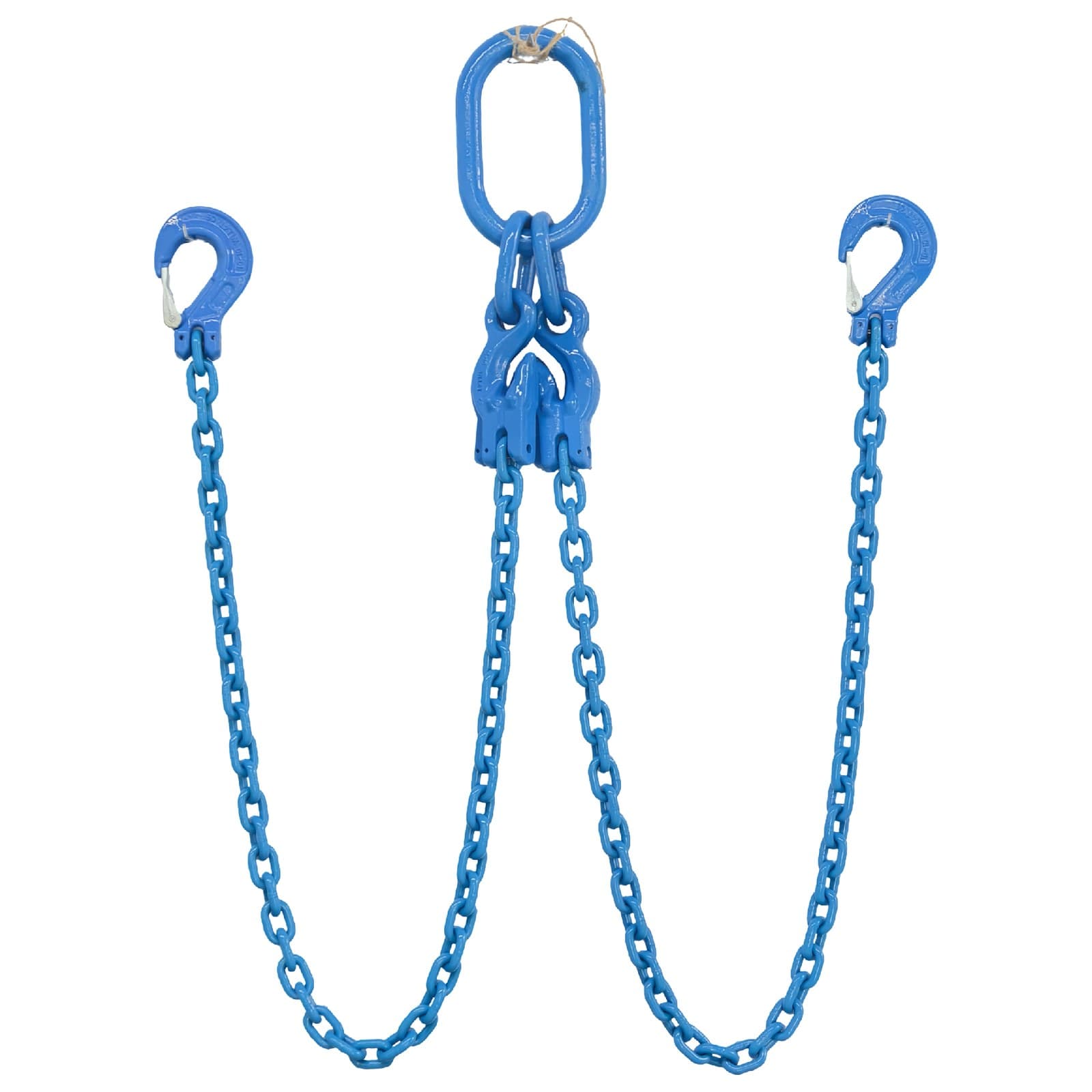 IH-LR-CS-G100DOSGrade 100 Two-Leg Chain Sling with Sling Hooks — Type DOS
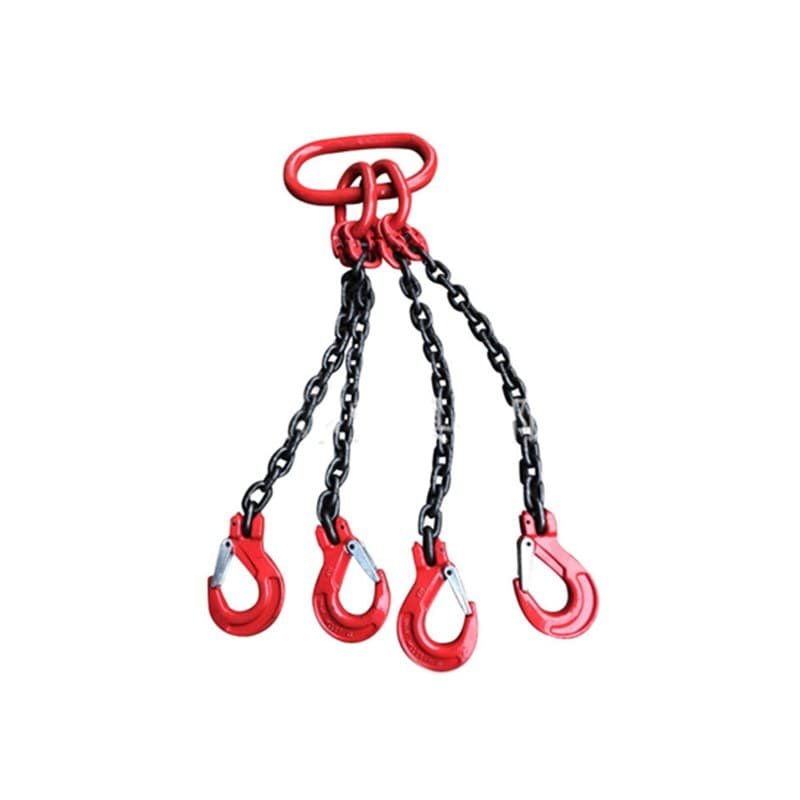 IH-LR-CS-G100QOSGrade 100 Four-Leg Chain Sling with Sling Hooks — Type QOS
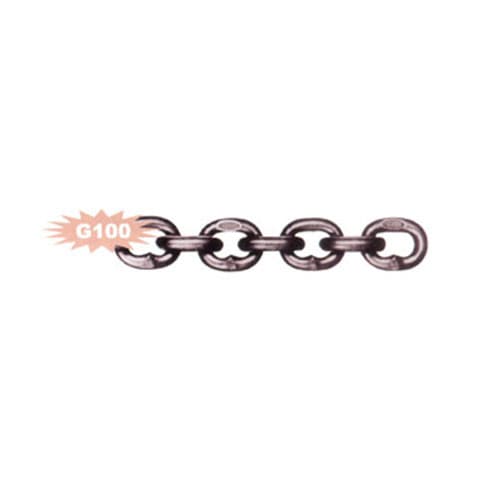 IH-LR-CH-G100Grade 100 Alloy Lifting Chain
Common questions
- What is the capacity of a 10 mm Grade 80 chain sling?
- 3.15 t on a single leg; 4.25 t as a two-leg sling with legs up to 45° from vertical and 3.15 t from 45° to 60°; 6.7 t and 4.75 t as a three- or four-leg sling.
- What is the capacity of a 13 mm chain sling?
- In Grade 80, 5.3 t single leg, 7.5 t two-leg and 11.2 t three- or four-leg, up to 45° from vertical. In Grade 100, 6.7 t, 9.5 t and 14 t.
- Why is a four-leg chain sling rated the same as a three-leg sling?
- Because on a rigid load the four legs cannot be relied on to share the weight equally — two or three of them usually take it. The rating assumes three legs carry the load.
- How much does a choke hitch reduce a chain sling?
- To 80% of the straight rating, in chain-sling makers’ instructions. A 10 mm Grade 80 leg rated 3.15 t straight is rated 2.52 t choked.
- Can a chain sling be used at more than 60° from vertical?
- No. Beyond 60° from vertical — more than 120° between two legs — each leg carries more than the whole load and the tension climbs steeply. No chain sling on our listings is rated there.
- Is Grade 100 chain stronger than Grade 80?
- Yes, by about 25% size for size on our listings: a 10 mm single leg is 3.15 t in Grade 80 and 4 t in Grade 100.