
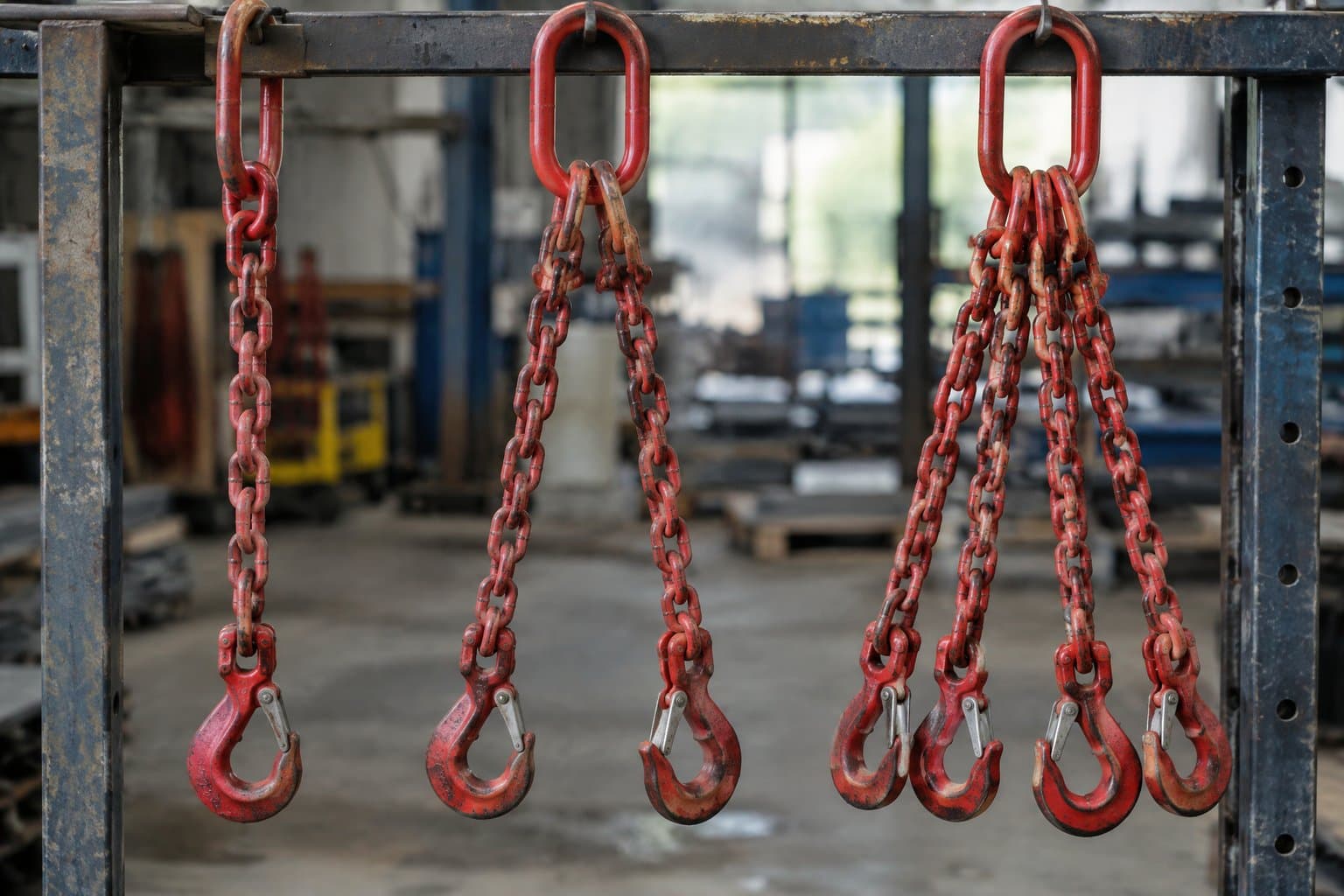
A chain sling is ordered from a code of three or four letters, and that code is the whole specification bar the chain size and grade. Read it correctly and you know how many legs, what hangs on the crane hook and what grips the load. Read it carelessly and a sling arrives with grab hooks where self-locking hooks were wanted, or with two legs where the lift needed four.
/01Reading the code.
| Position | Letter | Meaning |
|---|---|---|
| First — legsHighlighted | S / D / T / Q | Single, two, three or four legs |
| Second — top | O | Oblong master link |
| End — fitting | S | Sling hook, with latch |
| End — fitting | SL | Self-locking hook |
| End — fitting | G | Grab hook |
| End — fitting | F | Foundry hook |
| End — fitting | O | Oblong link |
Multi-leg slings always start from a master link, so their codes read legs-O-fitting: DOG is a two-leg sling with grab hooks, TOF a three-leg sling with foundry hooks, QOO a four-leg sling with oblong links on the ends. Single legs can have a master link (SOS, SOG, SOF, SOSL, SOO) or a fitting at each end with no master link, and then both ends are named: SSS (sling hooks), SGG (grab hooks), SFF (foundry hooks), SSLSL (self-locking hooks), SSG, SFG and SSLG (one of each). Our listings carry all 27 make-ups in Grade 80, from 4 mm to 50 mm, and in Grade 100, from 6 mm to 26 mm.
/02Which hook does what.
- Sling hook (S) — the general-purpose lifting hook, with a spring latch across the throat to stop slack slings jumping out.
- Self-locking hook (SL) — closes and locks when loaded and cannot open until it is unloaded and released, for lifts where a latch is not enough.
- Grab hook (G) — a narrow throat that grips a chain link, used to shorten a leg or choke it back on itself. Check the hook's own rating: some grab hooks reduce the chain's working load limit unless they are a type designed to carry it in full.
- Foundry hook (F) — a wide, open throat without a latch, for loads with large lifting eyes such as ladles and moulds.
- Oblong link (O) — a link on the leg end, for fitting the sling to shackles or pad-eyes, or choking it.
Hooks are covered more fully in lifting hook types, and master links in master links explained.
/03How multi-leg slings are rated.
| Sling | Legs up to 45° from vertical | Legs 45° to 60° |
|---|---|---|
| Single leg (SOS) | 3.15 t | — |
| Two-leg (DOS)Highlighted | 4.25 t | 3.15 t |
| Three-leg (TOS) | 6.7 t | 4.75 t |
| Four-leg (QOS) | 6.7 t | 4.75 t |
Our slings are rated on the EN 818-4 method. A two-leg sling is rated 1.4 times a single leg with its legs up to 45° from the vertical, and 1.0 times from 45° to 60°; three- and four-leg slings are rated 2.1 times and 1.5 times. The four-leg sling gets no more than the three-leg one because, on a rigid load, there is no guarantee all four legs take an equal share — two can end up carrying most of it. Grade 100 runs a quarter higher size for size: the 10 mm Grade 100 single leg is listed at 4 t and the four-leg at 8 t. Angles and their effect on leg tension are set out in the sling angle chart.
/04Ordering a chain sling.
Give the grade, the code, the chain size and the effective reach — the length from the bearing point of the master link to the bearing point of the hook. If you know the load and the lifting points rather than the sling, send the load mass, the number and position of lifting points and the headroom, and we will work out the code and size. Our slings ship with the manufacturer's test certificate and serial-numbered identification. They are made only from Grade 80 and Grade 100 alloy chain — Grade 30, 43 and 70 chain is for lashing and transport, never for overhead lifting. Chain grades themselves are compared in chain grades explained.
The shorteners and connectors behind the codes are covered in shortening a chain sling and hammerlocks, clevis fittings and connecting links.
Frequently asked questions
- What does SOS mean on a chain sling?
- Single leg, oblong master link, sling hook. On our listings a 10 mm Grade 80 SOS is rated 3.15 t.
- Why is a four-leg sling rated the same as a three-leg sling?
- Because on a rigid load the four legs cannot be relied on to share the load equally. EN 818-4 rates both at 2.1 times a single leg up to 45° from vertical.
- What is the difference between a sling hook and a self-locking hook?
- A sling hook has a spring latch. A self-locking hook locks closed under load and cannot open until it is unloaded and released.
- How much stronger is Grade 100 than Grade 80?
- About 25% size for size on our listings: a 10 mm single leg is 3.15 t in Grade 80 and 4 t in Grade 100.
Chain slings
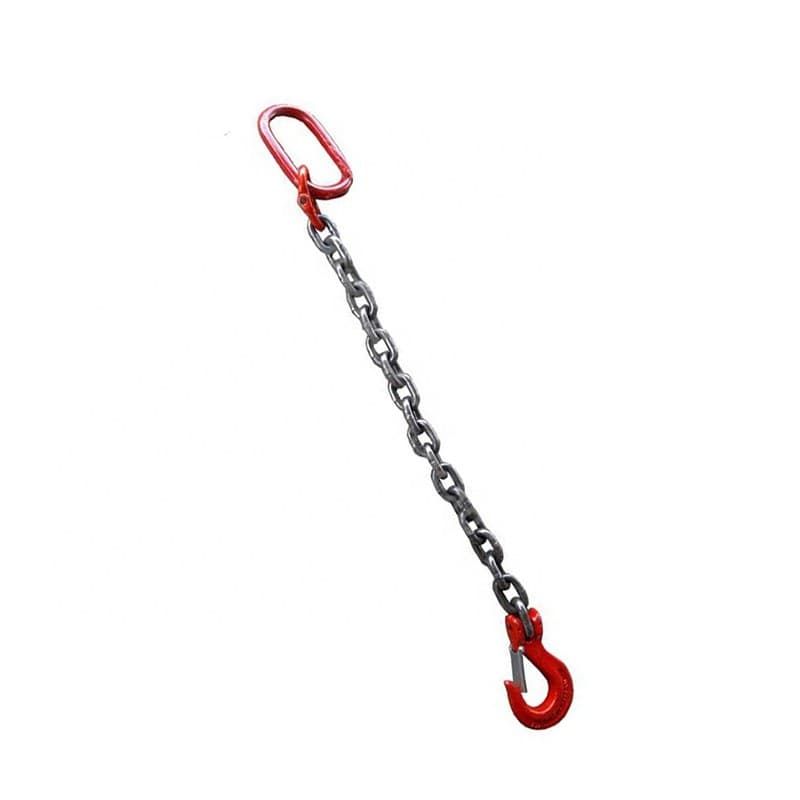 IH-LR-CS-G80SOSGrade 80 Single-Leg Chain Sling, Master Link and Sling Hook — Type SOS
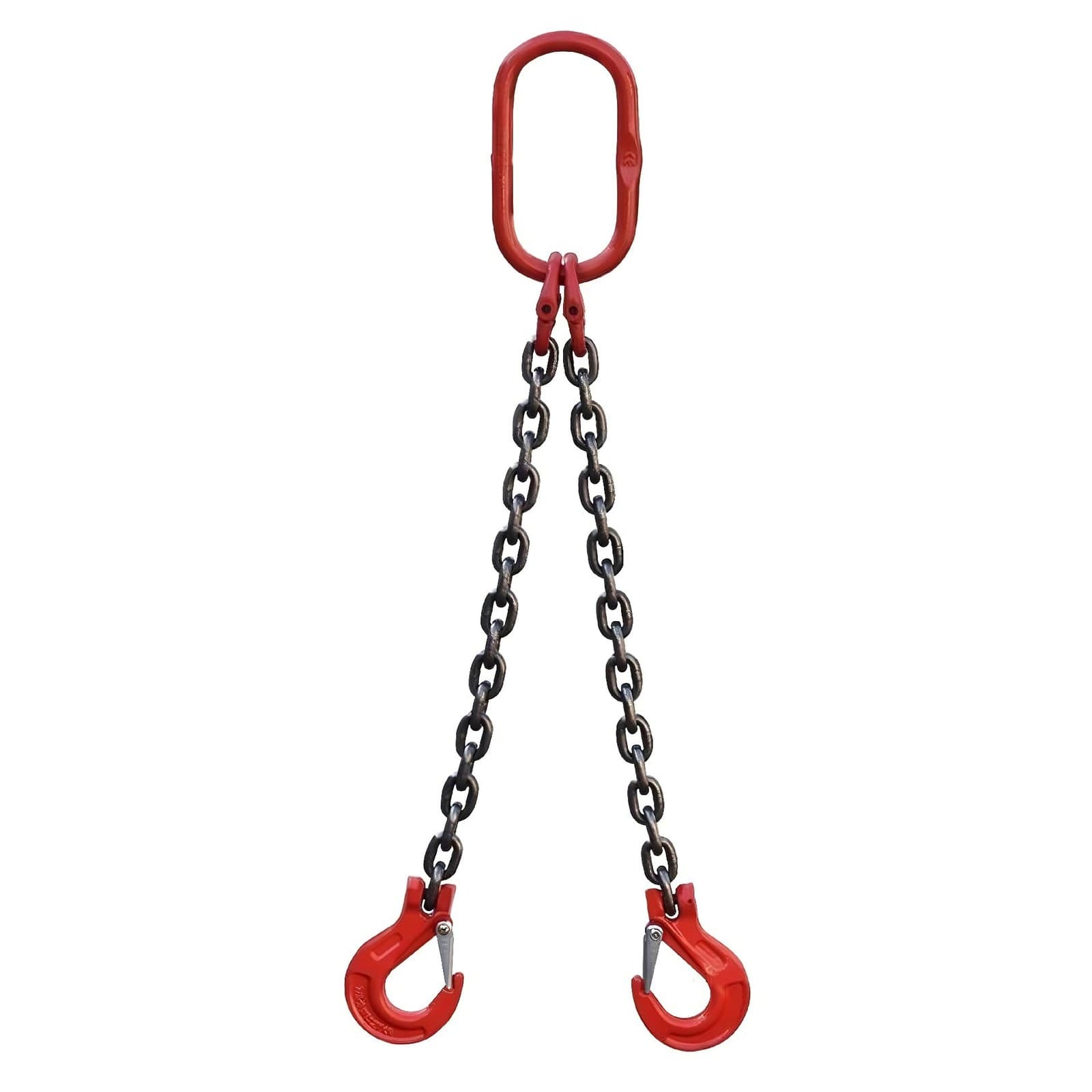 IH-LR-CS-G80DOSGrade 80 Two-Leg Chain Sling with Sling Hooks — Type DOS
 IH-LR-CS-G80TOSGrade 80 Three-Leg Chain Sling with Sling Hooks — Type TOS
 IH-LR-CS-G80QOSGrade 80 Four-Leg Chain Sling with Sling Hooks — Type QOS
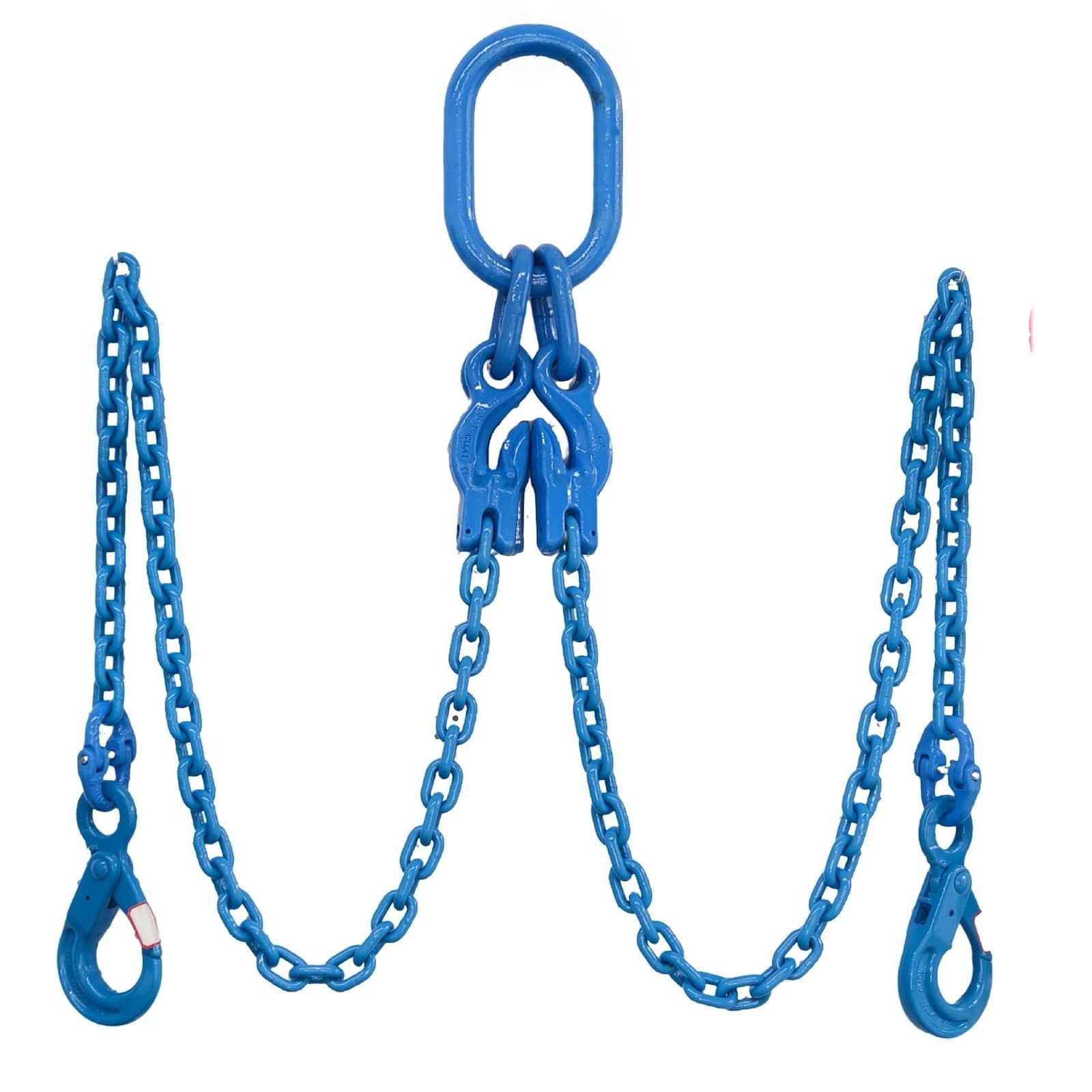 IH-LR-CS-G100DOSLGrade 100 Two-Leg Chain Sling with Self-Locking Hooks — Type DOSL
 IH-LR-CS-G100QOSLGrade 100 Four-Leg Chain Sling with Self-Locking Hooks — Type QOSL
 IH-LR-CS-G80DOGGrade 80 Two-Leg Chain Sling with Grab Hooks — Type DOG
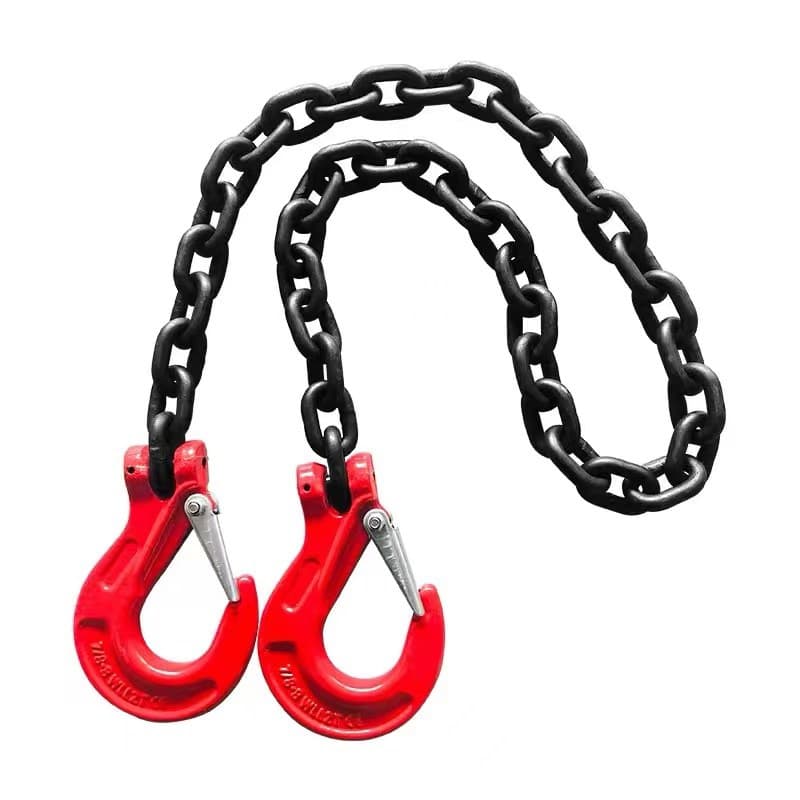 IH-LR-CS-G80SSSGrade 80 Single-Leg Chain Sling, Sling Hook Both Ends — Type SSS