
Eye bolt ratings are the least portable numbers in rigging. The same thread size is rated very differently under DIN, British, Japanese and US standards, and every one of those ratings falls — or disappears — when the pull leans away from the bolt’s axis. The charts below are grouped by standard, so the figure you read is the one for the bolt in your hand.
/01DIN 580 eye bolts and DIN 582 eye nuts.
DIN 580 eye bolts and DIN 582 eye nuts share one rating per thread size. Each bolt is rated for three directions: a vertical pull, a pull at up to 45° in the plane of the eye, and a pull at up to 45° across it (sideways). Ratings are per bolt, in kilograms.
| Thread | Eye ID (mm) | Vertical | ≤45° in eye plane | ≤45° sideways | DIN 580 weight | DIN 582 weight |
|---|---|---|---|---|---|---|
| M8 | 20 | 140 | 100 | 70 | 0.06 | 0.05 |
| M10 | 25 | 230 | 170 | 115 | 0.11 | 0.09 |
| M12 | 30 | 340 | 240 | 170 | 0.18 | 0.15 |
| M16 | 35 | 700 | 500 | 350 | 0.28 | 0.24 |
| M20 | 40 | 1,200 | 860 | 600 | 0.45 | 0.36 |
| M24 | 50 | 1,800 | 1,290 | 900 | 0.74 | 0.72 |
| M30 | 65 | 3,200 | 2,300 | 1,600 | 1.66 | 1.32 |
| M36 | 75 | 4,600 | 3,300 | 2,300 | 2.65 | 2.08 |
| M42 | 85 | 6,300 | 4,500 | 3,150 | 4.03 | 3.11 |
| M48 | 100 | 8,600 | — | — | 6.38 | 5.02 |
| M56 | 110 | 11,500 | — | — | 8.8 | 6.69 |
| M64 | 120 | 16,000 | — | — | 12.4 | 9.3 |
| M72×6 | 150 | 20,000 | — | — | 23.3 | — |
| M80×6 | 170 | 28,000 | — | — | 34.2 | — |
| M100×6 | 190 | 40,000 | — | — | 49.1 | — |
The angled columns are given here for M8 to M42, where we have checked them against the DIN 580:2018 user information. Above M42 the angled ratings are in the maker’s instructions supplied with the bolt. There is no rating for a pull at 90° to the eye: the standard says such a pull must not be applied. The ratings hold from −20 °C to 200 °C.
/02Same thread, different standard.
| Thread | DIN 580 | JIS B 1168 | BS 4278 collared |
|---|---|---|---|
| M8 | 140 | 80 | 150 |
| M10 | 230 | 150 | 250 |
| M12 | 340 | 220 | 400 |
| M16 | 700 | 450 | 800 |
| M20 | 1,200 | 630 | 1,600 |
| M24 | 1,800 | 950 | 2,500 |
| M30 | 3,200 | 1,500 | 4,000 |
| M36 | 4,600 | 2,300 | 6,300 |
| M42 | 6,300 | 3,400 | 8,000 |
| M48 | 8,600 | 4,500 | 10,000 |
| M64 | 16,000 | 9,000 | 20,000 |
At M20 the three standards give 630, 1,200 and 1,600 kg. All three are correct; they are different designs, steels and rating rules. A bolt marked with one standard is never lifted on another standard’s table — and a metric collar eye bolt is never assumed to match a US machinery eye bolt of a similar thread.
| Thread | WLL (t) | Eye ID (mm) | Thread length (mm) | Weight (kg) |
|---|---|---|---|---|
| M6 | 0.1 | 15 | 18 | 0.06 |
| M8 | 0.15 | 15 | 18 | 0.06 |
| M10 | 0.25 | 15 | 18 | 0.06 |
| M12 | 0.4 | 15 | 18 | 0.06 |
| M14 | 0.5 | 20 | 23 | 0.15 |
| M16 | 0.8 | 20 | 23 | 0.15 |
| M18 | 1 | 24 | 28 | 0.27 |
| M20 | 1.6 | 27 | 32 | 0.38 |
| M22 | 1.6 | 30 | 35 | 0.54 |
| M24 | 2.5 | 35 | 40 | 0.85 |
| M27 | 2.5 | 39 | 46 | 1.13 |
| M30 | 4 | 44 | 51 | 1.62 |
| M33 | 4 | 48 | 56 | 2.37 |
| M36 | 6.3 | 54 | 63 | 3.12 |
| M39 | 6.3 | 57 | 67 | 3.81 |
| M42 | 8 | 68 | 79 | 6.27 |
| M45 | 8 | 68 | 79 | 6.45 |
| M48 | 10 | 68 | 79 | 6.51 |
| M52 | 12.5 | 76 | 89 | 9.58 |
| M56 | 16 | 86 | 100 | 12.99 |
| M64 | 20 | 96 | 112 | 18.2 |
/03US shoulder and machinery eye bolts, by angle.
US-pattern shoulder nut and machinery eye bolts are rated in pounds for an in-line pull, then reduced as the pull leans away from the bolt’s axis. The reduction is 80% at 15°, 65% at 30°, 30% at 45° and 25% at 90°, applied in the plane of the eye. Our shoulder nut, machinery and regular nut eye bolts carry the same in-line rating at each nominal size:
| Size | In line (lb) | In line (kg) | 15° (lb) | 30° (lb) | 45° (lb) | 90° (lb) |
|---|---|---|---|---|---|---|
| 1/4″ | 650 | 294 | 520 | 422.5 | 195 | 162.5 |
| 5/16″ | 1,200 | 540 | 960 | 780 | 360 | 300 |
| 3/8″ | 1,550 | 700 | 1,240 | 1,007.5 | 465 | 387.5 |
| 1/2″ | 2,600 | 1,175 | 2,080 | 1,690 | 780 | 650 |
| 5/8″ | 5,200 | 2,355 | 4,160 | 3,380 | 1,560 | 1,300 |
| 3/4″ | 7,200 | 3,265 | 5,760 | 4,680 | 2,160 | 1,800 |
| 7/8″ | 10,600 | 4,805 | 8,480 | 6,890 | 3,180 | 2,650 |
| 1″ | 13,300 | 6,030 | 10,640 | 8,645 | 3,990 | 3,325 |
| 1-1/4″ | 21,000 | 9,525 | 16,800 | 13,650 | 6,300 | 5,250 |
| 1-1/2″ | 24,000 | 10,885 | 19,200 | 15,600 | 7,200 | 6,000 |
The kilogram figures are our conversion of the pound ratings, rounded down. Load the eye in its own plane — turn it to face the pull, with a shim under the shoulder if needed — and never reeve one sling through two eye bolts.
/04US eye nuts.
| Size | WLL (lb) | WLL (kg) | Max. tap |
|---|---|---|---|
| 1/4″ | 520 | 235 | 3/8″ |
| 5/16″ | 850 | 385 | 3/8″ |
| 3/8″ | 1,250 | 565 | 7/16″ |
| 7/16″ | 1,700 | 770 | 1/2″ |
| 1/2″ | 2,250 | 1,020 | — |
| 5/8″ | 3,600 | 1,630 | 3/4″ |
| 3/4″ | 5,200 | 2,355 | 7/8″ |
| 7/8″ | 7,200 | 3,265 | 1″ |
| 1″ | 10,000 | 4,535 | 1-1/4″ |
| 1-1/8″ | 12,300 | 5,575 | 1-1/4″ |
| 1-1/4″ | 15,500 | 7,030 | 1-1/2″ |
| 1-3/8″ | 18,500 | 8,390 | 1-1/2″ |
| 1-1/2″ | 22,500 | 10,205 | 1-3/4″ |
| 2″ | 40,000 | 18,140 | 2-3/4″ |
/05What every rating assumes.
- Fully seated. The collar or shoulder is screwed fully home and sits flat across its whole face. A bolt left proud to line up the eye has no rating at all.
- Thread engagement. In a tapped hole, at least 1.5 × the thread diameter in steel or grey cast iron, 2 × in aluminium alloys and 2.5 × in low-strength light metals.
- Through holes. A nut on the far side, at least 0.8 × the thread diameter thick for DIN 580.
- Repeated use. Where the same bolt is screwed into different loads again and again, use the next size up.
- Stainless. Stainless eye bolts are rated on their own maker’s certificate. Never assume a stainless bolt matches the carbon table for its thread.
Worked example: a 1.6 t gearbox has two DIN 580 tapped holes, and a two-leg sling will hang at about 40° from vertical in the plane of the eyes. Each bolt takes half the weight, pulled at an angle, so each must be rated at least 800 kg in the ≤45° in-plane column. M20 gives 860 kg — enough. M16 gives 500 kg — not enough, though its 700 kg vertical rating might suggest otherwise.
Choosing from the chart
Start from the direction of the pull.
IfStraight, vertical pull
Any rated eye bolt, sized on its vertical or in-line WLL.
IfAngled pull in the plane of the eye
DIN 580 up to 45° from its angled column, or a US shoulder eye bolt from the angle table.
IfPull across the eye, or beyond 45° on a DIN 580
Not an eye bolt. Use a swivel lifting point.
IfLoad turned over or pulled in changing directions
Swivel lifting point, rated for the full angle range.
Eye bolts in these charts
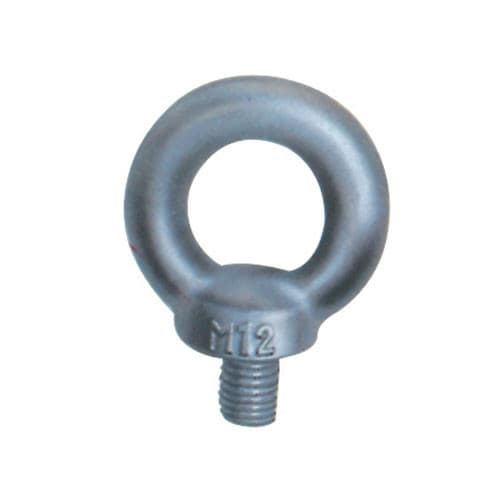 IH-LR-EB-D580DIN 580 Eye Bolt
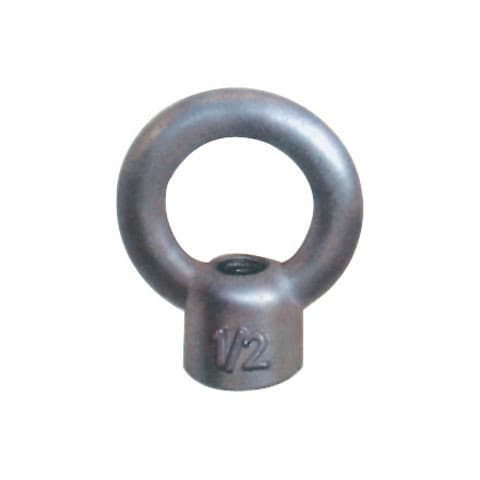 IH-LR-EB-D582DIN 582 Eye Nut
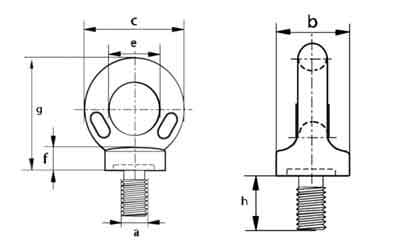 IH-LR-EB-CEB4278T1Collared Eyebolt — BS 4278 Table 1
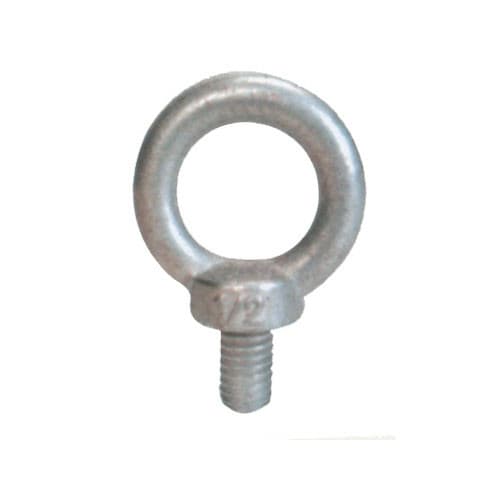 IH-LR-EB-JIS68JIS B 1168 Eye Bolt — Zinc Plated
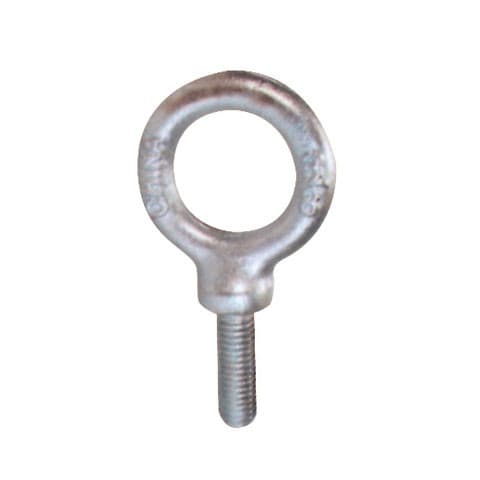 IH-LR-EB-SHNShoulder Nut Eye Bolt, Hot-Dip Galvanized
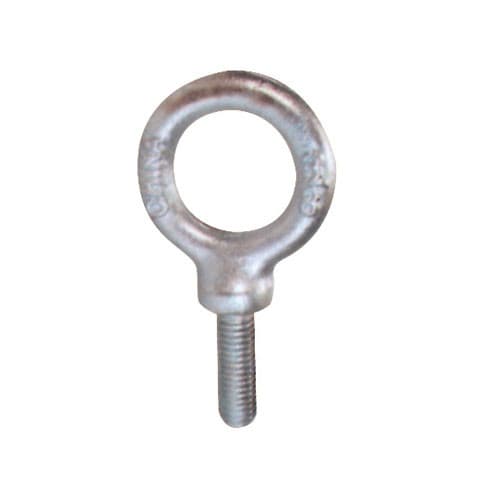 IH-LR-EB-MACHShoulder Machinery Eye Bolt
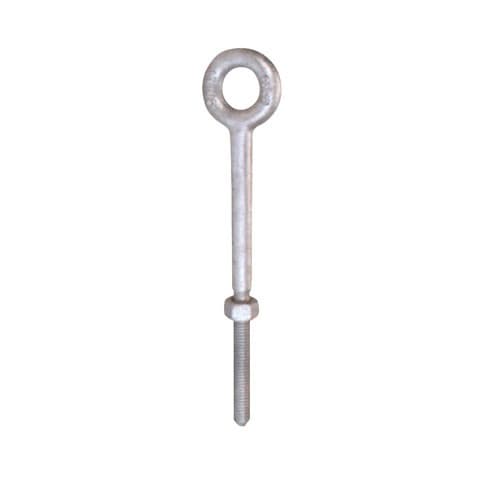 IH-LR-EB-REGRegular Nut Eye Bolt, Hot-Dip Galvanized
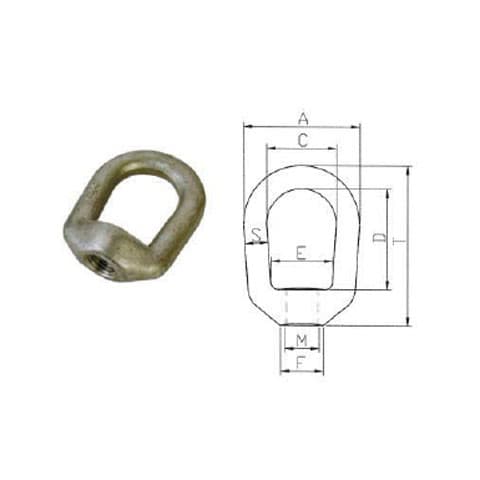 IH-LR-EB-NUTEye Nut — US Type
Common questions
- What is the WLL of an M12 eye bolt?
- 340 kg vertical for a DIN 580 eye bolt, 240 kg at up to 45° in the plane of the eye and 170 kg at up to 45° sideways. A JIS B 1168 M12 is rated 220 kg and a BS 4278 M12 400 kg.
- What is the WLL of an M20 eye bolt?
- 1,200 kg vertical for DIN 580, 860 kg at ≤45° in the eye plane and 600 kg at ≤45° sideways. JIS B 1168 M20 is 630 kg; BS 4278 M20 is 1,600 kg.
- How much does an eye bolt lose at 45°?
- A US shoulder or machinery eye bolt keeps 30% of its in-line rating at 45°. A DIN 580 bolt keeps about 70% at up to 45° in the plane of the eye and about 50% at up to 45° sideways, from its own table.
- Can a DIN 580 eye bolt be loaded at 90°?
- No. DIN 580 gives no rating for a pull at 90° to the bolt and says it must not be applied. Use a swivel lifting point.
- Do DIN 580 eye bolts and DIN 582 eye nuts have the same rating?
- Yes, size for size. The bolt screws into a tapped hole; the nut screws onto a stud or bolt.