
The breaking strength of a wire rope is set by three choices: its diameter, the tensile grade of its wires and its core. Construction — 6x19, 6x36, compacted — changes how it handles more than how strong it is. The charts below give the minimum breaking load for the ropes we list, by all three, so you can read off the rope and then work down to a safe load.
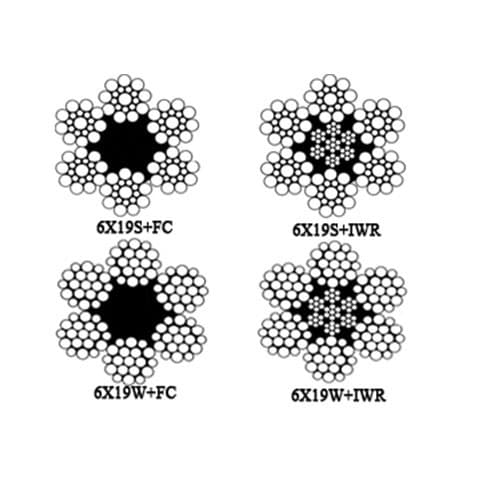
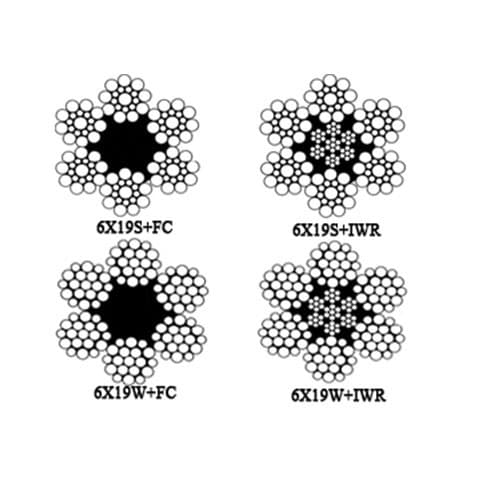
/016x19 line-contact rope (6x19S and 6x19W).
The general-purpose rope class for slings and rigging. Minimum breaking load in kN by tensile grade and core, with the 1770 IWRC figure in tonnes.
| Rope | 1770 FC | 1770 IWRC | 1960 FC | 1960 IWRC | 1770 IWRC (t) | Weight IWRC (kg/100 m) |
|---|---|---|---|---|---|---|
| 5 mm | 14.6 | 15.8 | 16.2 | 17.4 | 1.61 | 10.1 |
| 6 mm | 21 | 22.7 | 23.3 | 25.1 | 2.31 | 14.6 |
| 7 mm | 28.6 | 30.9 | 31.7 | 34.2 | 3.15 | 19.9 |
| 8 mm | 37.4 | 40.3 | 41.4 | 44.7 | 4.1 | 25.9 |
| 9 mm | 47.3 | 51 | 52.4 | 56.5 | 5.2 | 32.8 |
| 10 mm | 58.4 | 63 | 64.7 | 69.8 | 6.42 | 40.5 |
| 11 mm | 70.7 | 76.2 | 78.3 | 84.4 | 7.77 | 49.1 |
| 12 mm | 84.1 | 90.7 | 93.1 | 101 | 9.24 | 58.4 |
| 13 mm | 98.7 | 107 | 109 | 118 | 10.9 | 68.5 |
| 14 mm | 115 | 124 | 127 | 137 | 12.6 | 79.5 |
| 15 mm | 131 | 142 | 146 | 157 | 14.4 | 91.2 |
| 16 mm | 150 | 161 | 166 | 179 | 16.4 | 104 |
| 18 mm | 189 | 204 | 210 | 226 | 20.8 | 131 |
| 19 mm | 211 | 228 | 234 | 252 | 23.2 | 146 |
| 20 mm | 234 | 252 | 259 | 279 | 25.6 | 162 |
| 22 mm | 283 | 305 | 313 | 338 | 31.1 | 196 |
| 24 mm | 336 | 363 | 373 | 402 | 37 | 234 |
| 26 mm | 395 | 426 | 437 | 472 | 43.4 | 274 |
| 28 mm | 458 | 494 | 507 | 547 | 50.3 | 318 |
| 30 mm | 526 | 567 | 582 | 628 | 57.8 | 365 |
| 32 mm | 598 | 645 | 662 | 715 | 65.7 | 415 |
| 34 mm | 675 | 728 | 748 | 807 | 74.2 | 469 |
| 36 mm | 757 | 817 | 838 | 904 | 83.3 | 526 |
| 38 mm | 843 | 910 | 934 | 1,010 | 92.7 | 586 |
| 40 mm | 935 | 1,010 | 1,030 | 1,120 | 102.9 | 649 |
| 42 mm | 1,030 | 1,110 | 1,140 | 1,230 | 113.1 | 715 |
| 44 mm | 1,130 | 1,220 | 1,250 | 1,350 | 124.4 | 785 |
| 46 mm | 1,240 | 1,330 | 1,370 | 1,480 | 135.6 | 858 |
| 48 mm | 1,350 | 1,450 | 1,490 | 1,610 | 147.8 | 934 |
| 50 mm | 1,460 | 1,580 | 1,620 | 1,740 | 161.1 | 1,010 |
| 52 mm | 1,580 | 1,700 | 1,750 | 1,890 | 173.3 | 1,100 |
| 54 mm | 1,700 | 1,840 | 1,890 | 2,030 | 187.6 | 1,180 |
| 56 mm | 1,830 | 1,980 | 2,030 | 2,190 | 201.9 | 1,270 |
| 58 mm | 1,960 | 2,120 | 2,180 | 2,350 | 216.1 | 1,360 |
| 60 mm | 2,100 | 2,270 | 2,330 | 2,510 | 231.4 | 1,460 |
Our 6x19S / 6x19W listing runs to 80 mm; the chart stops at 60 mm, where most rigging work ends. Larger sizes are on the product page.
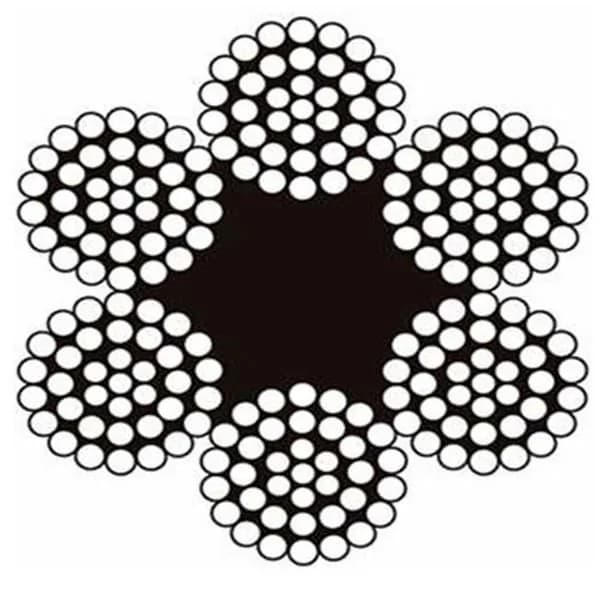
/026x36WS rope.
Warrington-Seale is the usual construction for crane ropes, hoists and flexible slings — more wires per strand, so it bends more easily and lasts longer over sheaves.
| Rope | 1570 FC | 1770 FC | 1570 IWRC | 1770 IWRC | Weight FC (kg/100 m) | Weight IWRC (kg/100 m) |
|---|---|---|---|---|---|---|
| 8 mm | 33.2 | 37.4 | 35.8 | 40.3 | 24.3 | 26.8 |
| 10 mm | 51.8 | 58.4 | 55.9 | 63 | 38 | 41.8 |
| 12 mm | 74.6 | 84.1 | 80.5 | 90.7 | 54.7 | 60.2 |
| 13 mm | 87.6 | 98.7 | 94.5 | 106 | 64.2 | 70.6 |
| 14 mm | 102 | 114 | 110 | 124 | 74.5 | 81.9 |
| 16 mm | 133 | 150 | 143 | 161 | 97.3 | 107 |
| 18 mm | 168 | 189 | 181 | 204 | 123 | 135 |
| 20 mm | 207 | 234 | 224 | 252 | 152 | 167 |
| 22 mm | 251 | 283 | 271 | 305 | 184 | 202 |
| 24 mm | 298 | 336 | 322 | 363 | 219 | 241 |
| 26 mm | 350 | 395 | 378 | 426 | 257 | 283 |
| 28 mm | 406 | 458 | 438 | 494 | 298 | 328 |
| 30 mm | 466 | 526 | 503 | 567 | 342 | 376 |
| 32 mm | 531 | 598 | 572 | 645 | 389 | 428 |
| 34 mm | 599 | 675 | 646 | 728 | 439 | 483 |
| 36 mm | 671 | 757 | 724 | 817 | 492 | 542 |
| 38 mm | 748 | 843 | 807 | 910 | 549 | 604 |
| 40 mm | 829 | — | 894 | — | 608 | 669 |
| 42 mm | 914 | — | 986 | — | 670 | 737 |
/03Construction by construction.
At the same diameter, grade and core, the common six-strand constructions break within about 12% of each other; compacted rope stands clear of them. All figures 1770 grade with a steel core (IWRC), in kN:
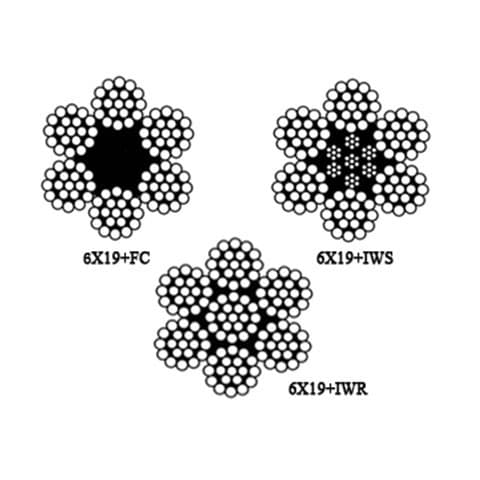
| Rope | 6x7 | 6x19 (point) | 6x19S/W (line) | 6x36WS | 6x37 (point) | Compacted 6x19S |
|---|---|---|---|---|---|---|
| 8 mm | 40.7 | 37.6 | 40.3 | 40.3 | 36.1 | — |
| 10 mm | 63.5 | 58.8 | 63 | 63 | 56.5 | — |
| 12 mm | 91.5 | 84.6 | 90.7 | 90.7 | 81.3 | 110 |
| 14 mm | 125 | 115 | 124 | 124 | 111 | 150 |
| 16 mm | 163 | 150 | 161 | 161 | 145 | 196 |
| 18 mm | 206 | 190 | 204 | 204 | 183 | 248 |
| 20 mm | 254 | 235 | 252 | 252 | 226 | 306 |
| 22 mm | 308 | 284 | 305 | 305 | 273 | 370 |
| 24 mm | 366 | 339 | 363 | 363 | 325 | 441 |
| 26 mm | 430 | 397 | 426 | 426 | 382 | 517 |
| 28 mm | 498 | 461 | 494 | 494 | 443 | 601 |
| 32 mm | 651 | 602 | 645 | 645 | 578 | 784 |
| 36 mm | 824 | 762 | 817 | 817 | 732 | 993 |
| 40 mm | 1,020 | 940 | 1,010 | — | 903 | 1,225 |
Compacted figures are converted from tonnes in our table and rounded down. The five standard constructions sit within about 12% of each other; choose construction for how the rope works — abrasion, bending, crushing on a drum — and then size it for the load. Our guide to wire rope construction explains the trade-off.
/04Compacted 6x19S rope.
Compacted strands are drawn through a die before closing, which flattens the outer wires. More steel fits in the diameter and the smooth surface resists wear and crushing. Steel core, in tonnes:
| Rope | 1770 | 1960 | 2160 | Weight (kg/m) |
|---|---|---|---|---|
| 11.2 mm (7/16″) | 9.8 | 10.6 | — | 0.57 |
| 12 mm | 11.3 | 12.1 | — | 0.65 |
| 12.7 mm (1/2″) | 12.6 | 13.6 | — | 0.73 |
| 13 mm | 13.2 | 14.3 | — | 0.76 |
| 14 mm | 15.3 | 16.5 | 17.3 | 0.89 |
| 14.3 mm (9/16″) | 16 | 17.2 | 18 | 0.92 |
| 15 mm | 17.6 | 19 | 19.8 | 1.02 |
| 16 mm (5/8″) | 20 | 21.6 | 22.6 | 1.16 |
| 17.5 mm (11/16″) | 23.9 | 25.8 | 27 | 1.38 |
| 18 mm | 25.3 | 27.3 | 28.6 | 1.46 |
| 19 mm (3/4″) | 28.2 | 30.4 | 31.8 | 1.63 |
| 20 mm | 31.3 | 33.7 | 35.3 | 1.81 |
| 21 mm (13/16″) | 34.5 | 37.2 | 38.9 | 1.99 |
| 22 mm | 37.8 | 40.8 | 42.7 | 2.19 |
| 22.2 mm (7/8″) | 38.6 | 41.7 | 43.5 | 2.23 |
| 24 mm (15/16″) | 45 | 48.6 | 50.8 | 2.6 |
| 25 mm | 48.8 | 52.7 | 55.1 | 2.83 |
| 25.4 mm (1″) | 50.4 | 54.4 | 56.9 | 2.92 |
| 26 mm (1-1/16″) | 52.8 | 57 | 59.6 | 3.06 |
| 28 mm | 61.3 | 66.1 | 69.1 | 3.54 |
| 28.6 mm (1-1/8″) | 63.9 | 69 | 72.1 | 3.7 |
| 30 mm (1-3/16″) | 70.3 | 75.9 | 79.3 | 4.07 |
| 31.5 mm (1-1/4″) | 77.5 | 83.7 | 87.5 | 4.49 |
| 32 mm | 80 | 86.4 | 90.3 | 4.63 |
| 34 mm | 90.3 | 97.5 | 101.9 | 5.23 |
| 35 mm (1-3/8″) | 95.7 | 103.3 | 108 | 5.54 |
| 36 mm | 101.3 | 109.3 | 114.2 | 5.86 |
| 38 mm | 112.8 | 121.8 | 127.3 | 6.53 |
| 38.1 mm (1-1/2″) | 113.4 | 122.4 | 127.9 | 6.56 |
| 40 mm | 125 | 134.9 | — | 7.23 |
| 42 mm | 137.8 | 148.8 | — | 7.97 |
| 44 mm | 151.3 | 163.3 | — | 8.75 |
| 44.5 mm (1-3/4″) | 154.4 | 166 | — | 8.93 |
| 46 mm | 165.3 | 178.5 | — | 9.56 |
| 48 mm | 180 | — | — | 10.41 |
| 50 mm | 195.3 | — | — | 11.3 |
| 50.8 mm (2″) | 201.3 | — | — | 11.66 |
| 52 mm | 211.3 | — | — | 12.22 |
/05From breaking load to working load.
A breaking load is the force that breaks new rope in a tensile test. Nothing is ever lifted on it. For a sling, the working load limit is the rope’s minimum breaking load, multiplied by the efficiency of the eye termination, divided by the design factor:
- Design factor: 5 for general-purpose slings under EN 13414. Running ropes on cranes and hoists use the factor set for the machine’s classification, which is usually different.
- Termination efficiency: at least 0.9 for ferrule-secured eyes, 0.8 for spliced eyes and 1.0 for poured sockets, under the EN 13411 series.
- Illustration: 16 mm 6x36WS, 1770 IWRC, breaks at 161 kN (16.4 t). With a ferrule eye: 161 × 0.9 ÷ 5 = about 2.95 t. That shows the arithmetic only — the rating of a real sling is the one its maker marks on the tag.
Conversions: 1 t = 9.81 kN = 2,205 lb. 1 kN = 225 lbf. The minimum breaking load on a rope certificate is the figure the rope must exceed in test; the actual breaking load measured is usually higher, but a rating is never built on it.
Wire rope in these charts
Common questions
- What is the breaking strength of 12 mm wire rope?
- For 6x19 line-contact rope in 1770 grade, 84.1 kN with a fibre core and 90.7 kN (about 9.24 t) with a steel core. Our compacted 6x19S steel-core rope breaks at 11.3 t at 12 mm.
- What is the breaking strength of 16 mm wire rope?
- For 6x19 line-contact rope in 1770 grade, 150 kN fibre core and 161 kN steel core. In 6x36WS, 150 kN and 161 kN.
- How do I convert wire rope breaking strength from kN to tonnes?
- Divide by 9.81. 161 kN is about 16.4 t.
- What is the safe working load of wire rope?
- For a sling: the minimum breaking load × the termination efficiency ÷ the design factor, which is 5 for general lifting. The maker calculates it and marks it on the sling. For a hoist rope, the design factor depends on the machine.
- Is IWRC wire rope stronger than fibre core?
- Yes, by about 8% at the same diameter and grade, and it resists crushing on a drum. A fibre core is more flexible.
Cranes — Wire ropes — Care and maintenance, inspection and discard
How crane ropes are inspected in service and when they are discarded — broken wires over a stated length, loss of diameter, corrosion and deformation such as kinks, birdcaging and core protrusion. A breaking-strength chart describes new rope; this standard decides when rope in service no longer meets it.