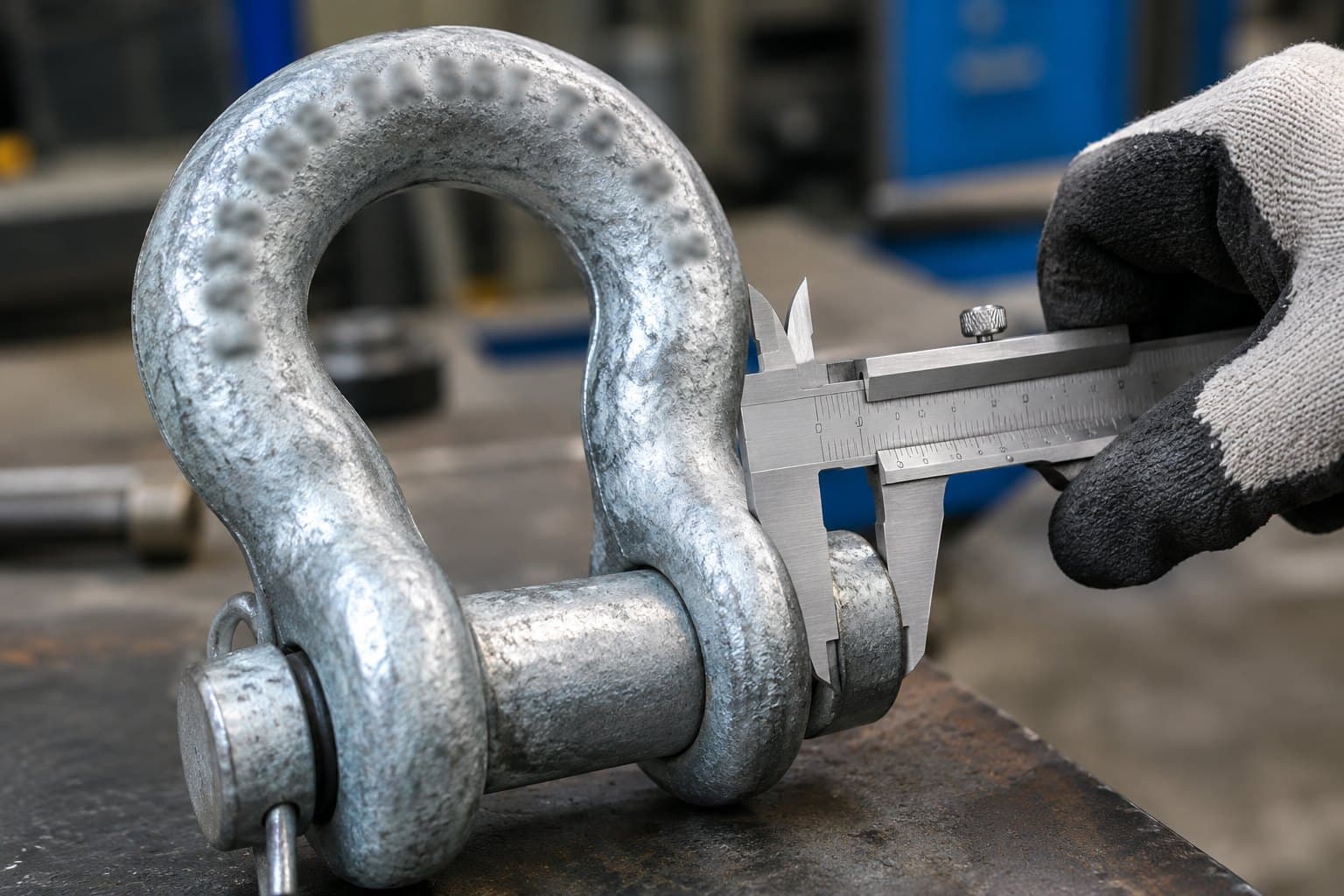
The marks on a shackle are not decoration. They are how the person using it knows what it will carry, how the inspector knows what it is, and how a test certificate is tied to the steel in your hand. Abu Dhabi’s lifting code of practice puts it plainly: every lifting accessory must show its safe working load, and one that does not comes out of service. So the time to check markings is at the store door, not at the six-monthly examination.
/01What the standards require.
| Source | Body | Pin |
|---|---|---|
| US Federal Spec RR-C-271 (pattern shackles) | Maker’s name or trademark, size and WLL on the bow | Maker’s mark; Grade B (high strength) pins also marked "HS" |
| ASME B30.26 (rigging hardware, as summarised by industry)Highlighted | Maker’s name or trademark, rated load and size | Maker’s name or trademark, plus grade, material or rating |
| AS 2741 (Australian shackles) | Maker’s name or mark, grade, WLL, and an identifier linked to the test certificate | — |
/02Reading the marks.
- Maker’s name or mark — who made it and whose rating applies. Side-load tables and warnings apply to that maker’s shackles.
- WLL — usually in tonnes (e.g. “WLL 8.5 T” or “8 1/2 T”). This is the in-line rating; see WLL vs breaking strength.
- Size — the nominal bow diameter, e.g. 1" or 25 mm. It is not a rating.
- Grade or material — for alloy and high-strength shackles, and stainless.
- Traceability code — a batch or heat code that ties the shackle to its test certificate.
- Pin marks — the maker’s mark, and a grade mark on high-strength pins. A pin without them may not be the shackle’s own pin.
/03The five-minute receiving check.
- Count and match the delivery to the purchase order: pattern, body, pin type, size.
- Read the marks on every shackle: maker, WLL, size, and code if present. Reject any that are unmarked or illegible.
- Match to the certificate: the certificate should cover the type, size, WLL and batch or traceability code you have received.
- Look for damage: bent or distorted bodies, damaged threads, pins that do not seat fully, cracks, heat discolouration.
- Register and tag each shackle into the site lifting register before issue — see lifting equipment inspection in the UAE.
Markings also matter at every later examination. ASME B30.26, as summarised by industry, lists missing or illegible markings first among the removal criteria for shackles, alongside heat damage, excessive wear (10% of the original dimension), bent or distorted parts, cracks and incomplete pin engagement. Our lifting gear rejection criteria covers the full list, and what a test certificate should show explains the paperwork side.
If the markings are missing or do not add up, see how to spot counterfeit rigging hardware.
Common questions
- What does WLL mean on a shackle?
- Working load limit — the most the maker rates the shackle to carry in service, in line. It is usually stamped in tonnes.
- Is the size on a shackle its capacity?
- No. The size is the nominal bow diameter. The WLL stamp is the rating, and it differs between patterns and grades of the same size.
- Can I use a shackle with worn-off markings?
- No. Missing or illegible markings are a removal criterion; the shackle comes out of service until a qualified person decides otherwise.
- What does HS on a shackle pin mean?
- In US Federal Specification RR-C-271, Grade B (high strength) pins and bolts are marked "HS".
- Should the certificate match the shackle?
- Yes. Check the type, size, WLL and traceability code on the certificate against the marks on the shackles received.