
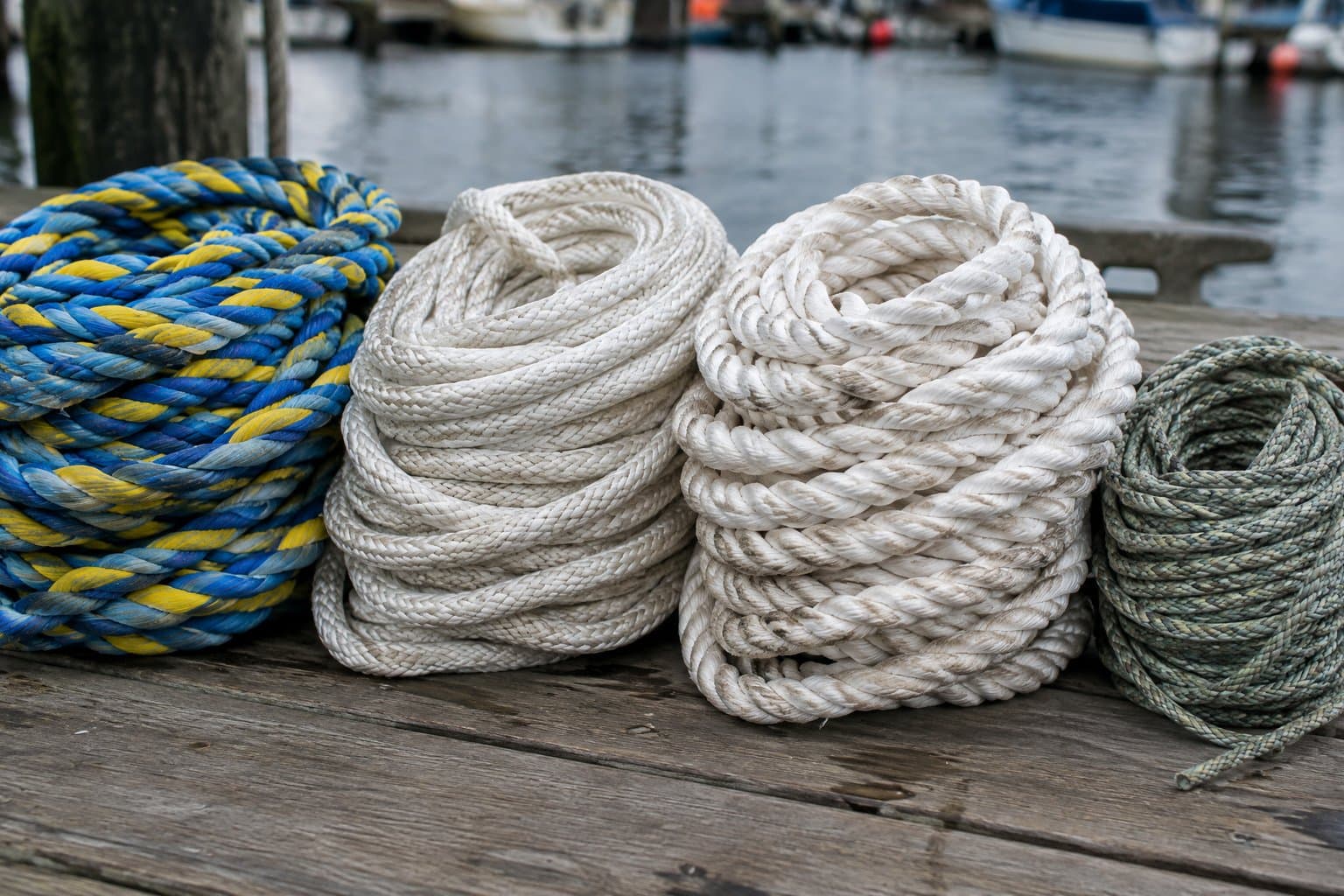
Two ropes of the same diameter can differ fourfold in strength, float or sink, stretch a little or a lot, and last years or months in the sun. Diameter tells you very little; the fibre tells you almost everything, and the construction — laid, plaited or braided — adds the rest. Choose the fibre for the job first.
/01Five fibres.
| Fibre | Character | Floats? |
|---|---|---|
| Polypropylene (PP, incl. danline) | Light and cheap; lowest strength; degrades in sunlight | Yes |
| Polyethylene (PE) | Light, slippery, cheap; similar duty to PP | Yes |
| Polyester | Strong, low stretch, good UV and abrasion resistance | No |
| Nylon (polyamide) | High stretch, absorbs shock loads; weaker when wet | No |
| HMPE (UHMWPE)Highlighted | Highest strength for size, very low stretch; heat-sensitive | Yes |
/02Strength at the same size.
| Rope | ISO basis | MEG4 basis |
|---|---|---|
| HMPE (UHMWPE)Highlighted | 1,329 kN | 1,196 kN |
| Nylon, high tenacity | 350 kN (dry) | 268 kN |
| Polyester / polyolefin mixed | 330 kN | 297 kN |
| PP / PE polyolefin, high tenacity | 300 kN | 270 kN |
Most of our mooring rope listings give two breaking loads per size. One is to the ISO rope standard; the other is labelled MEG4, after OCIMF's Mooring Equipment Guidelines, and on our rows it runs about ten per cent lower for HMPE, polyester mixed and PP/PE ropes. Nylon is the exception: its ISO figure is quoted dry, and nylon loses strength when wet, so its MEG4 figure sits well below — 268 kN against 350 kN at 40 mm. When a mooring plan specifies a line by breaking load, check which basis it uses before comparing ropes.
/03Construction.
The same fibre can be made up several ways, and our listings cover most of them:
- Three-strand twisted (laid) rope — polypropylene from 4 mm to 30 mm, polyethylene from 6 mm to 20 mm, danline and coloured PE from 4 mm to 60 mm. Easy to splice, it rotates under load.
- Eight-strand plaited rope and hawsers — braided rope from 3 mm to 20 mm, and mooring hawsers from 40 mm to 120 mm in PE, PP, polyester or nylon. Torque-balanced, so it does not kink.
- Sixteen-strand braid — 3 mm to 30 mm, for smaller, smoother lines.
- Double braid — a braided core inside a braided cover, listed in nylon, polyester and polypropylene multifilament.
- Combination rope — fibre over a steel wire core, from 36 mm (190 kN) to 54 mm (562 kN), or over a lead or chain core for weight.
Within one construction the fibre still sets the strength: in our double-braid rows, 24 mm nylon is listed at 19.4 t, polyester at 13.6 t and polypropylene multifilament at 7.5 t.
/04Choosing the fibre.
For mooring tails and towing, where shock loads must be absorbed, nylon's stretch is the point. For lines that must stay a fixed length and survive years of sun — static moorings, lashings, guys — polyester. For floating lines, rescue and general utility on a budget, polypropylene or polyethylene. For maximum strength at minimum weight, HMPE, provided it is kept off hot surfaces and sharp edges: it melts at around 150 °C and creeps under sustained load. Lines are made off on fittings rated for them — see types of mooring bollards.
Frequently asked questions
- How much stronger is HMPE rope than nylon or polypropylene?
- About four times at the same diameter on our listings: a 40 mm HMPE rope breaks at 1,329 kN on the ISO basis, against 350 kN for high-tenacity nylon (dry) and 300 kN for high-tenacity PP/PE.
- Why is nylon used for mooring tails?
- It stretches more than any other common rope fibre, so it absorbs shock loads from swell and passing ships. It is weaker when wet, which its MEG4 rating reflects.
- Does polypropylene rope float?
- Yes. Polypropylene and polyethylene float, as does HMPE. Polyester and nylon sink.
- What is the difference between ISO and MEG4 breaking loads?
- They are two bases for the rope's minimum breaking load. On our listings the MEG4 figure is about ten per cent below the ISO figure for most ropes, and further below for nylon, whose ISO figure is dry.
Fibre rope
 IH-LR-FR-HMPEURHMPE (UHMWPE) Rope
 IH-LR-FR-NPRHTNylon (Polyamide) Rope, High Tenacity
 IH-LR-FR-PPMR2Polyester / Polyolefin Mixed Rope
 IH-LR-FR-PPPEPRHTPP/PE Polyolefin Rope, High Tenacity
- IH-LR-FR-DBRPPNPEUDouble Braided Rope — PP, Nylon, PE, UHMWPE
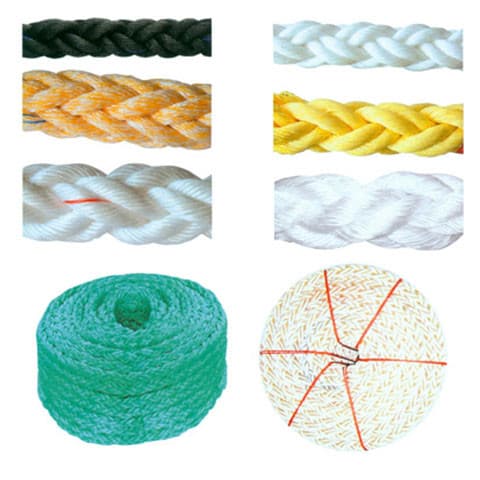 IH-LR-FR-8HAW8-Strand Mooring Hawser
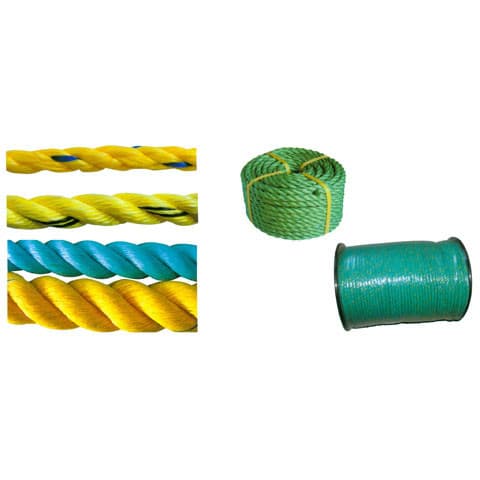 IH-LR-FR-DANPolypropylene Danline Rope
- IH-LR-FR-CRCCombination Rope with Steel Core