
Double-Jacket Fire Hose, EPDM Liner
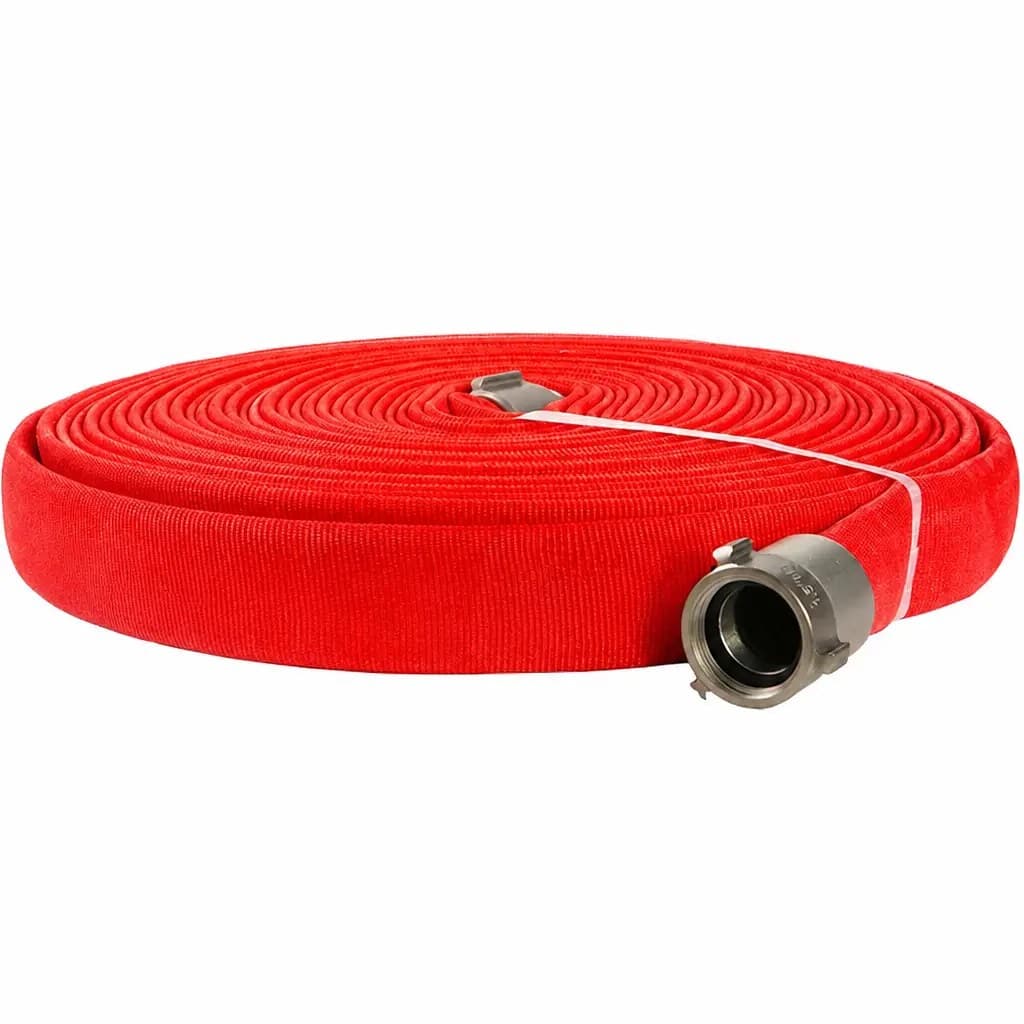
Heavy-duty double-jacket fire hose with an EPDM rubber liner, for high-pressure firefighting, industrial fire water systems and emergency response. Red jacket, supplied coupled. Coupled, banded and tested to order by Indus Hydraulics in the UAE.
Key features
- Application Family: fire hose, double jacket
- Inner Diameter Range: On request
- Max Working Pressure: Confirmed with quotation
- Application Family
- fire hose, double jacket
Product description
A double-jacket attack and supply hose for high-pressure firefighting: fire brigades, industrial fire teams, refinery and plant fire water systems, and emergency water delivery. Two woven jackets, one inside the other, carry the pressure and protect the hose from abrasion when it is dragged over concrete, gravel and debris.
Construction
- Liner: EPDM rubber — resists heat, ozone, ageing, abrasion and a broad range of chemicals, and keeps a smooth bore for flow
- Reinforcement: double woven jacket
- Outer jacket: coated for UV, weather and abrasion resistance and low water absorption
- Colour: red
Why double jacket
The second jacket raises the pressure the hose can carry, adds abrasion protection and keeps the hose serviceable if the outer jacket is cut. It is the usual choice for attack lines and supply lines on industrial sites where hoses are dragged hard and used often.
Care and testing
- Lay the hose out without kinks before charging it, and open the hydrant or pump valve slowly to avoid pressure surge.
- Keep it away from hot surfaces, sharp edges and dragged loads; use hose bridges where vehicles cross.
- After use, drain it, wash off oil, foam concentrate and mud, and let the jacket dry before it is rolled or racked.
- Store it out of direct sunlight, away from chemicals and in a dry place, rolled or flaked as your equipment requires.
- Inspect the jacket, liner and coupling bands before use, and service-test hoses at the interval your fire code sets — annually is common practice.
How to order
Send the bore, the length per hose (fire hose is usually supplied in 15, 20, 25 or 30 m lengths), the couplings and the standard your site, insurer or authority requires. We confirm construction, pressure rating and compliance before quoting, and supply hoses coupled, banded and pressure tested on request.
Identification
| Parameter | Value |
|---|---|
| Application Family | fire hose, double jacket |
| Colour | Red |
| Construction Type | Lay flat, woven textile jacket |
Dimensions
| Parameter | Value |
|---|---|
| Inner Diameter Range | On request |
Performance
| Parameter | Value |
|---|---|
| Max Working Pressure | Confirmed with quotation |
Construction
| Parameter | Value |
|---|---|
| Cover Material | Outer woven jacket with protective coating |
| Lining / Tube Material | EPDM rubber |
| Reinforcement | Double woven polyester jacket |
Shipping & lead time
Single or double jacket?▾
Which fire hose standards does it meet?▾
What pressure is it rated for?▾
Which couplings can be fitted?▾
What lengths are supplied?▾
Shipped worldwide from our Dubai warehouse. Transit, routes and documentation for 126 destinations
From the blog
Written about this part
Industrial hose
Single vs double jacket fire hose: construction, uses and how to choose
A double jacket fire hose has a second woven jacket inside the first. That buys pressure capacity, abrasion protection and a hose that keeps working if the outer jacket is cut — at the cost of weight and bulk. Where each belongs, how the NFPA, EN and UAE rules treat them, and how to choose for attack lines, supply lines, hose stations, cabinets and forestry work.
4 min read
Industrial hose
Fire hose liners compared: EPDM, natural rubber, polyurethane and nitrile
The jacket carries the pressure; the liner decides how the hose ages, what it tolerates and how much it weighs. EPDM resists heat, ozone and weathering; natural rubber is supple and cheap; polyurethane is thin, light and abrasion-resistant; nitrile handles oil and fuel. Here is how to match the liner to the duty — attack line, hose station, forestry pack or cabinet.
5 min read
Industrial hose
Fire hose standards compared: EN 14540, EN 671, BS 6391, DIN 14811 and NFPA
A fire hose tender can ask for EN 14540, BS 6391, DIN 14811, EN 694 or NFPA 1961 — and they are not interchangeable. Each covers a different kind of hose for a different user. A plain map of the European, British, German and American standards for lay flat and reel hose, what each one covers, and how to specify against them.
5 min read
Engineers viewing this also looked at
Double-Jacket Fire Hose, Natural Rubber Liner
Double-Jacket Fire Hose, Polyurethane Liner
Forestry Fire Hose, Single Jacket, EPDM Liner
Forestry Fire Hose, Rubber Liner, PU-Coated Jacket
Rack and Cabinet Fire Hose, Polyurethane Liner
Single-Jacket Fire Hose, Natural Rubber Liner
