Skip to content
Oilfield & pressure control

BOP control hose: why fire survival is half the specification

An API 16D control hose is rated on pressure like anything else — and then on something most hose never has to do: keep working inside a fire for long enough to shut the well in.

Written by
Ayush Bhatia, Director
Published
Updated
Reading
3 min · 3 sections
Share
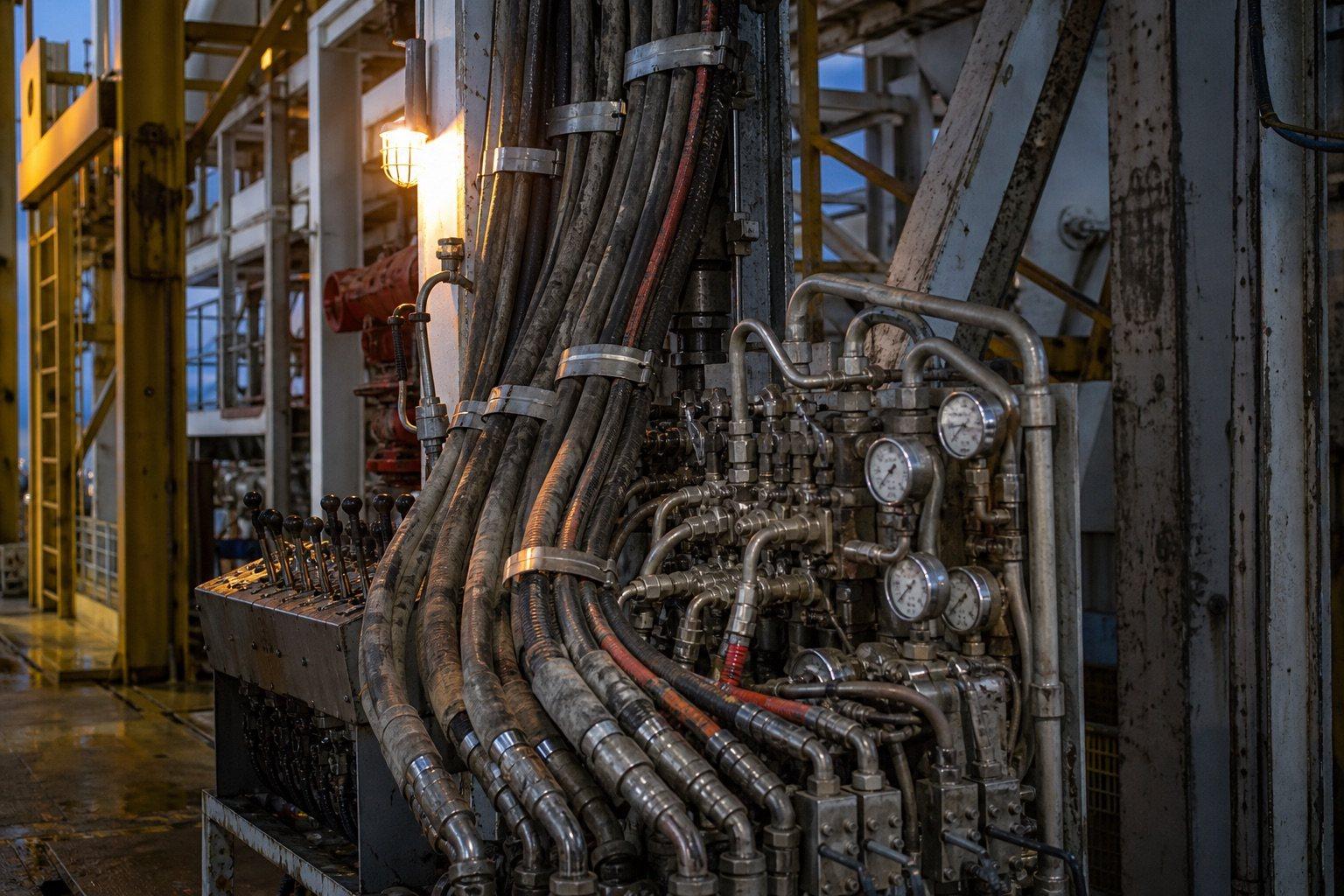
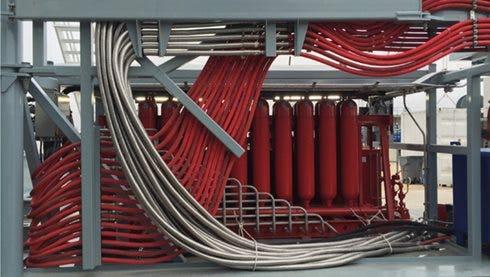
A bundle of fire-resistant blowout preventer control hoses clamped down rig steel into a hydraulic control manifold of valves and gauges
BOP control hoses are specified to keep working through a fire, not only to hold pressure.

At a glance

Key takeaways

  1. API Spec 16D governs BOP control hose. The constructions we supply are rated 5,000 psi working.
  2. The defining requirement is not pressure. It is fire survival — our Fireshield constructions are rated 1,300 °F (704 °C) for 30 minutes per API Spec 16D and API RP 17H.
  3. Fire performance is verified by test, to ISO 15540, rather than asserted from the compound.
  4. The reason is functional: the stack has to be operable during the event, not merely intact after it.
  5. A hose that meets the pressure rating and not the fire rating is not a control hose.

Figures verified · Ratings from the constructions we stock, resting on the manufacturers’ API certification and ISO 15540 test basis.

Almost every hose specification is about containing pressure. BOP control hose has a second requirement that reframes the first: it has to still be doing its job while it is on fire, because the moment it is most needed is the moment the rig is burning.

/01The rating that matters.

What the specification asks for
RequirementValueSource
Working pressure5,000 psiAPI Spec 16D
Fire survivalHighlighted1,300 °F (704 °C) for 30 minutesAPI Spec 16D / API RP 17H
Fire test methodISO 15540Test standard
Size range1/4" – 1"As supplied

Thirty minutes is not an arbitrary number. It is a functional window — long enough for the control system to operate the stack and secure the well while the fire is happening. That is why the requirement is survival with function rather than simply resistance to burning, and why it is demonstrated by a test method rather than inferred from the cover compound.

/02Tested, not asserted.
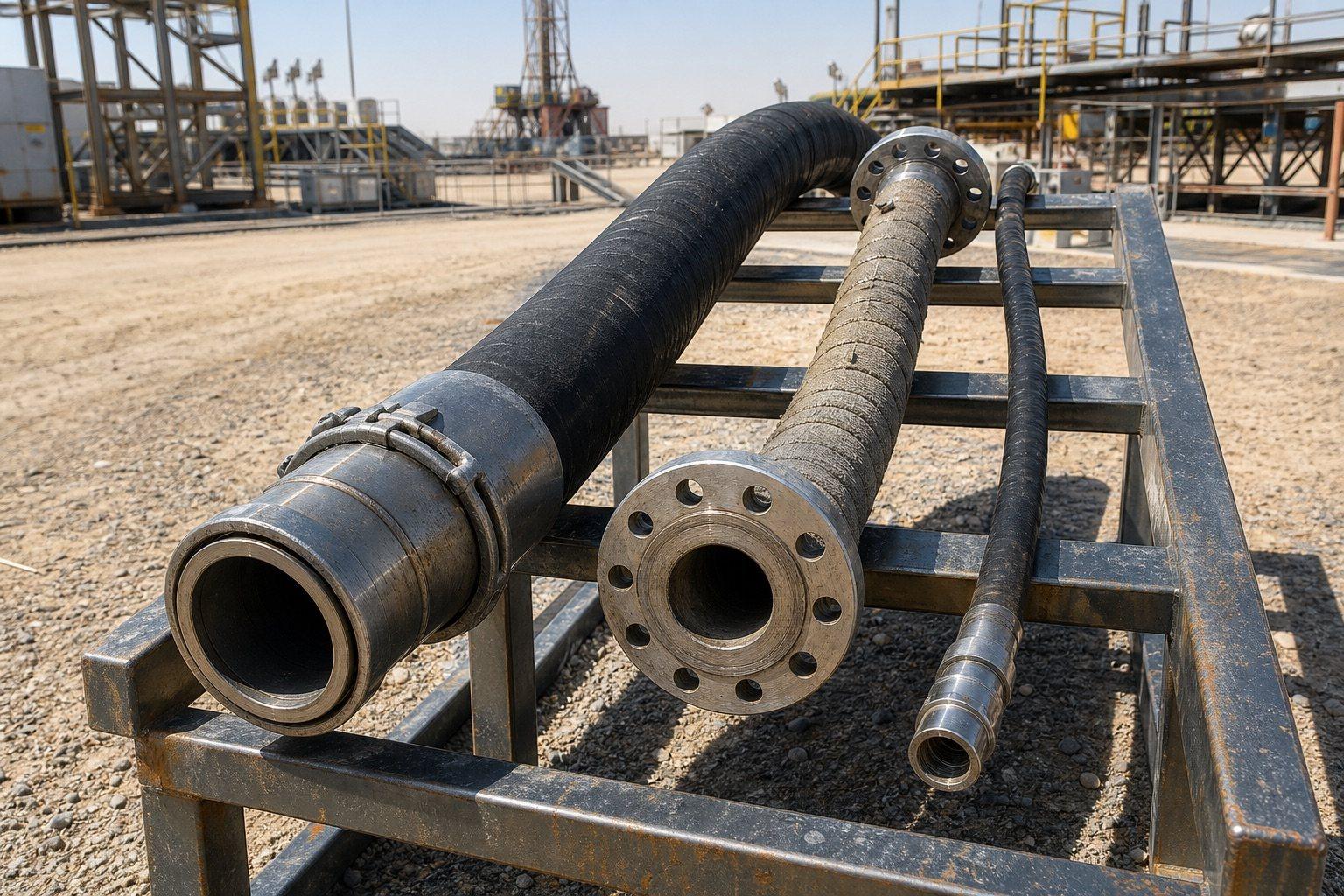
Three oilfield hose assemblies racked side by side in a rig yard — a rotary hose, a flanged armoured line and a slim control hose
Which standard governs the hose decides what the certificate has to prove — and fire survival is not an optional annexe.

The same logic applies to the assembly rather than the hose alone. The end fittings, the crimp and any protective sheathing are part of what has to survive, which is why control hose is bought as a certified assembly rather than built from bulk hose and whatever ends are in stock.

/03Where else fire rating appears.

Fire-rated construction is not confined to the control circuit. The Megashield 5000 assemblies we supply carry the same API Spec 16D and ISO 15540 basis at 5,000 psi across a 1/4" to 2" range, and the Flameshield low-pressure oilfield hose carries a flame-resistant cover for general rig service at far lower pressures. The requirement follows the consequence of the fire, not the pressure of the line.

Fire-rated oilfield constructions
Common questions

Does a fire-rated hose survive indefinitely in a fire?
No. The rating is a duration — 30 minutes at the stated temperature on these constructions. It is designed to keep the system functional through the window in which the well can be secured, not to be permanently fireproof.
Can I add a fire sleeve to a standard hose instead?
A sleeve may help a general hydraulic line survive radiant heat, but it does not turn a standard hose into a 16D control hose. The qualification is of the assembly against a test method, and it cannot be retrofitted.
Is API RP 17H the same as API Spec 16D?
They are different documents that both bear on this equipment — 16D is the specification for control systems, RP 17H a recommended practice relevant to subsea intervention. Our Fireshield constructions cite both for the fire rating.
What documentation should come with a control hose?
The certification for the assembly as supplied, including the fire rating basis. Ask for it at order — as with any certified assembly, obtaining it later is much harder than specifying it up front.
IndustryOil and gasPressure control, drilling and downstream hose across the Gulf.MarketSupplying Mozambique from DubaiFreight, import documents and lead times for oil and gas operators and contractors in Mozambique.MarketSupplying Indonesia from DubaiFreight, import documents and lead times for oil and gas operators and contractors in Indonesia.

What next

  1. 01
  2. 02
  3. 03

    Where this equipment ships

    API-rated hose and pressure-control equipment is supplied against the certification the operator is audited to, with mill and test documentation travelling alongside the goods. We ship it from Dubai into the basins that buy it, and on these lanes it is the paperwork rather than the freight that usually sets the timeline — which is the part worth planning around.

    GCC & Middle East

    West & Central Africa

    South America

    Everything above ships from the same Dubai warehouse. If your destination is not listed, it is almost certainly still one we quote. See every export destination

Replacing control hose?

Tell us the stack and the circuit. We supply certified assemblies with the fire-rating documentation, and our services team handles BOP recertification alongside.

Plant-down? Call +971 52 2477942 — 24/7

Keep reading

More on Oilfield & pressure control

All articles in this topic
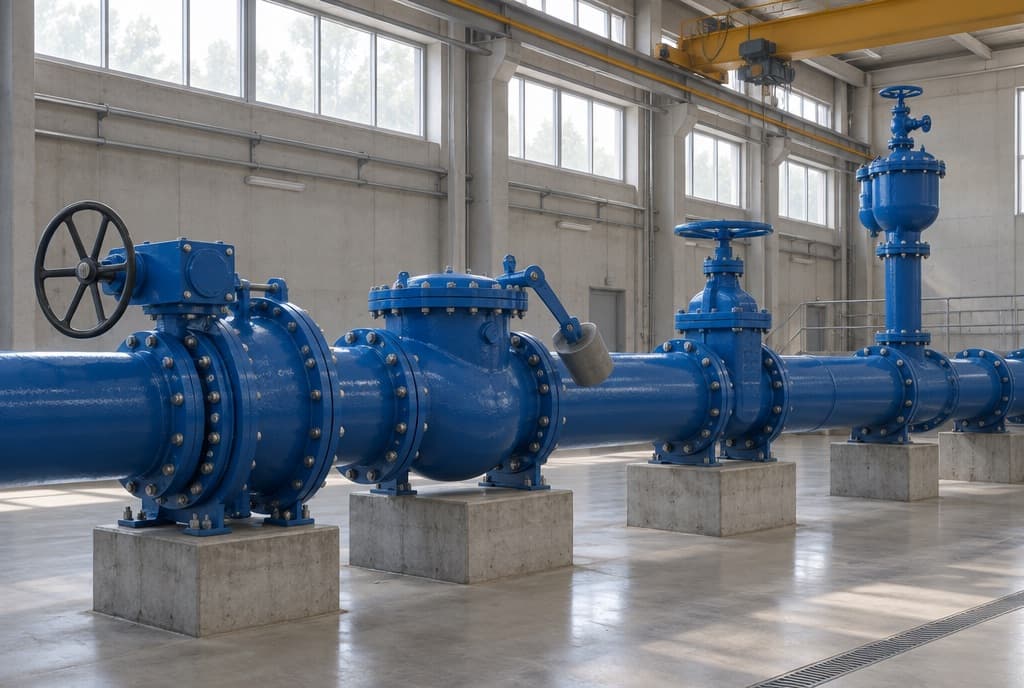
Blue epoxy-coated butterfly, swing check and gate valves on a pump station header, with an air valve on top

Waterworks valves: gate, check, butterfly and air valves for water, wastewater and desalination

9 min read

Large side-entry trunnion ball valve with flanged ends beside a small lever-operated floating ball valve on a test bench

Floating vs trunnion-mounted ball valves: how each seals, where one hands over to the other, and how to specify

10 min read

Back to Blog